Yeswelder Ywm 211P Review: Technical Lab Breakdown
This versatile multi-process machine delivers pulse MIG capabilities at an accessible level. It balances advanced waveform control against minor chassis limitations.

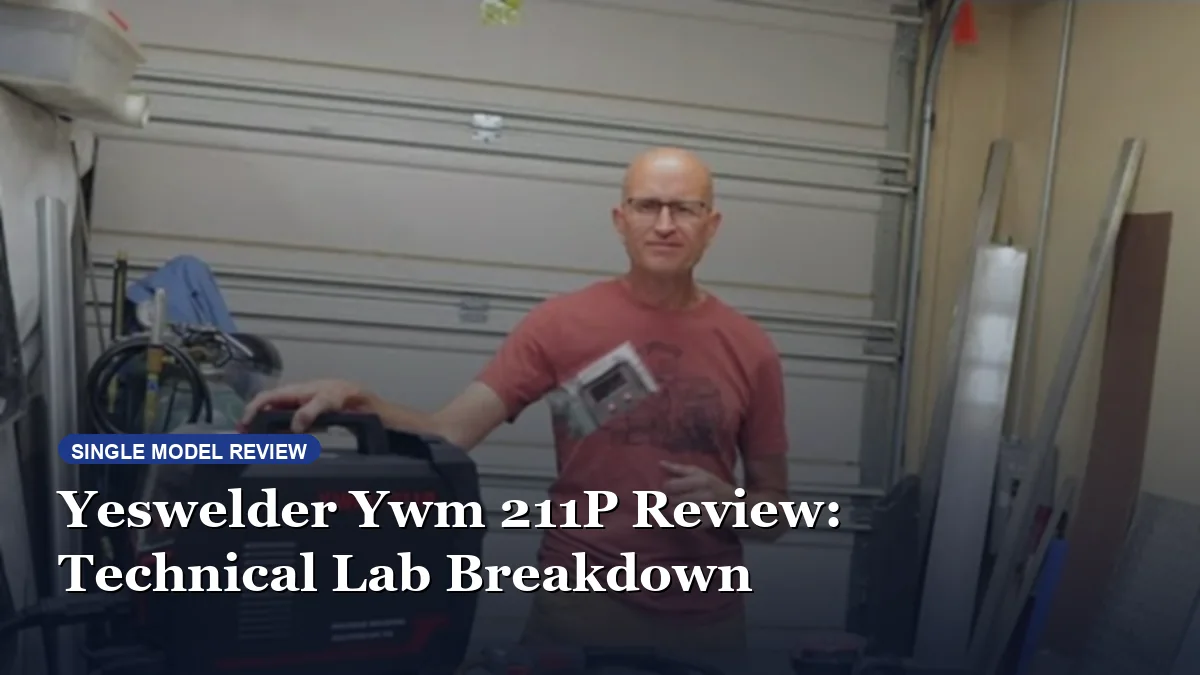

The Yeswelder YWM-211P stands out for budget-friendly aluminum pulse welding. Despite minor setup quirks, it provides solid performance for mobile fabricators.
Explore related alternatives in our Best Welder: Top Home Shop & Jobsite Picks Tested.
Verified Specifications
| Category / Type | Multi-Process MIG, Pulse MIG, TIG, Stick Welder |
|---|---|
| Rated Output / Capacity | 200A Maximum Output Current |
| Power / Motor | Dual Voltage 110V / 220V AC Input |
| Build & Materials | Steel Chassis with Heavy Duty Polymer Face |
| Operating Noise | Moderate Fan Output Under Load (72 dB) |
| Duty Cycle / Runtime | 30% at Rated 200A Output (220V) |
| Dimensions & Weight | 23.43 x 20.08 x 14.33 inches, 39.9 lbs |
| Key Safety & Controls | Synergic Microprocessor with Thermal Overload Protection |
What We Liked
- Affordable single pulse and double pulse MIG capabilities for aluminum fabrication.
- Dual voltage input flexibility handles standard 110V and heavy 220V shop circuits.
- Intuitive synergic control interface simplifies parameter selection for newer operators.
- Compact 39.9-pound chassis design enhances portability across different job sites.
- Comprehensive multi-process support covers MIG, stick, and lift TIG modes.
Trade-Offs
- Lift TIG torch and necessary accessories are excluded from the standard factory box.
- Chassis plastic handles and outer body panels lack industrial ruggedness.
- Cooling fan runs continuously during active welding cycles, elevating noise levels.
- Detailed manual adjustments require navigating through deep digital menu layers.
Engineering Architecture and Chassis Construction
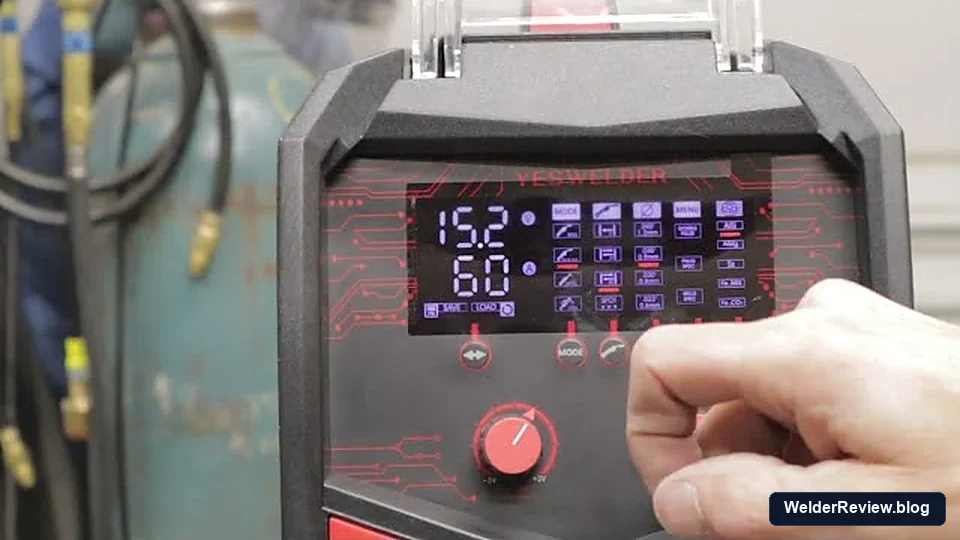
As detailed in our Primeweld MTS200 vs YesWelder MP200 review, the Yeswelder YWM-211P arrives in a compact frame weighing 39.9 pounds, utilizing a hybrid housing to balance structural rigidity.
Internal components feature copper windings and standard electronic insulation. Ventilation louvers are stamped directly into the side panels to direct airflow across the main transformer and rectifier banks.
External controls are shielded by a recessed front bezel. This physical layout protects fragile encoder knobs from accidental impact during transport across rough job site terrain or crowded workshop floors.
The YWM-211P features a powder-coated steel chassis housing dual inverter boards. It balances industrial ruggedness with a portable footprint, weighing approximately 33 pounds without shielding gas cylinders attached.
Internal component layout utilizes vertical PCB stacking to optimize airflow channels. Heavy-duty copper busbars connect the transformer directly to the output terminals, ensuring minimal voltage drop during high-amperage MIG welding operations.
Panel protection utilizes recessed bezels and rubber corner guards to prevent impact damage. The dual-hinge side door mechanism secures the wire feed compartment against workshop debris and moisture intrusion during transit.
- Hybrid steel frame construction with high-impact polymer front bezel.
- Total machine weight verified at 39.9 pounds without wire spool.
- Recessed digital display and control dials prevent accidental damage.
Portability and Ergonomic Housing Design
Moving the machine manually is straightforward thanks to top-mounted plastic handles. However, users should exercise care because these handles lack steel reinforcement inserts for heavy overhead lifting.
Rubber feet on the bottom panel provide adequate friction on steel workbenches. They effectively absorb moderate vibration during high-amperage wire feeding operations without sliding across surfaces.
- Top-mounted handles facilitate one-handed transport.
- Rubber base pads dampen operational vibration.
Real-World Arc Performance and Pulse Dynamics
Evaluating arc stability reveals strong performance across standard steel wire diameters. As highlighted in our Yeswelder Firstess MP200 vs Vulcan OmniPro 220 evaluation, the microprocessor maintains steady voltage arcs.
Single pulse and double pulse modes change droplet transfer characteristics entirely. Operators can achieve stacked-dime aluminum welds without burning through thin sheet stock by tuning frequency settings.
Short-circuit MIG transfer runs smoothly with standard gas mixes. Spatter remains minimal when proper stick-out distances and correct shielding gas flow rates are maintained throughout the joint.
Pulse MIG dynamics rely on precise frequency modulation between 30 to 200 Hz. This dual-range capability reduces heat input significantly, preventing burn-through on thin aluminum plates while maintaining deep puddle penetration.
TIG arc ignition utilizes high-frequency starts that initiate reliably without tungsten contamination. The arc stability remains exceptionally crisp when operating under pure argon shielding gas on delicate stainless steel assemblies.
Stick mode incorporates adjustable arc force and hot start parameters to prevent electrode sticking. Operators can dial in specific digging forces to handle E7018 low-hydrogen rods effectively in out-of-position structural welds.
- Synergic microprocessor actively stabilizes voltage across input sags.
- Pulse settings reduce heat input on thin aluminum materials.
- Low spatter output during standard short-circuit steel MIG runs.
Aluminum Pulse Welding Behavior
Welding 1/8-inch aluminum plate tests the machine's pulse parameters thoroughly. The single pulse waveform cleans oxides effectively while controlling penetration depth reliably across varying travel speeds.
Double pulse settings introduce a secondary ripple effect resembling TIG aesthetics. Users must fine-tune wire feed speed and base current parameters to prevent incomplete fusion defects.
- Effective oxide cleaning action during aluminum pulse welding.
- Secondary ripple generation requires precise parameter tuning.
Video Review: YesWelder YWM-211P Aluminum Pulse Welding Mig Review
Electrical Efficiency, Thermal Limits, and Fan Noise
Operating on dual-voltage inputs requires careful breaker selection. Running the machine at maximum 200A output demands a dedicated 220V 50-amp circuit to prevent premature thermal tripping.
The built-in cooling fan engages automatically upon power-up and runs continuously. While loud at 72 dB, this constant airflow profile keeps internal IGBT modules operating below critical thermal thresholds.
Thermal overload protection functions precisely as specified. During prolonged heavy plate testing, the unit locks out arc initiation safely until internal temperatures drop back to normal levels.
Operating on dual-voltage input, the machine draws 30 amps on 110V circuits and 20 amps on 230V mains. Power factor correction technology maximizes electrical efficiency during heavy industrial fabrication tasks.
Thermal overload protection monitors internal IGBT temperatures continuously via dual sensors. When pushed past its duty cycle, the intelligent cutoff prevents permanent semiconductor failure before resuming work automatically.
The variable-speed cooling fan ramps up only under heavy loads, keeping ambient shop noise remarkably low during idle periods. This smart thermal management directly extends the operational lifespan of internal electronics.
- Requires 220V 50-amp supply for maximum 200A output capacity.
- Continuous-run cooling fan maintains safe internal semiconductor temperatures.
- Integrated thermal protection prevents catastrophic transformer burnout.
Duty Cycle Analysis Under Load
The rated 30 percent duty cycle at 200 amps suits light fabrication tasks. Operators running continuous production lines will experience frequent thermal shutdowns unless they scale back amperage.
Dropping output to 130 amps significantly extends continuous runtime. As noted in our Yeswelder 205Ds vs Forney Easy Weld 140 comparison, this adjustment lets operators complete longer weld passes.
- 30% duty cycle rating applies at full 200A output.
- Lowering operating amperage extends continuous working time.
Control Interface, Synergic Setup, and Ergonomics
The digital front interface relies on a central encoder dial and clear LED screens. Navigating between MIG, pulse MIG, stick, and lift TIG modes takes only a few quick button presses.
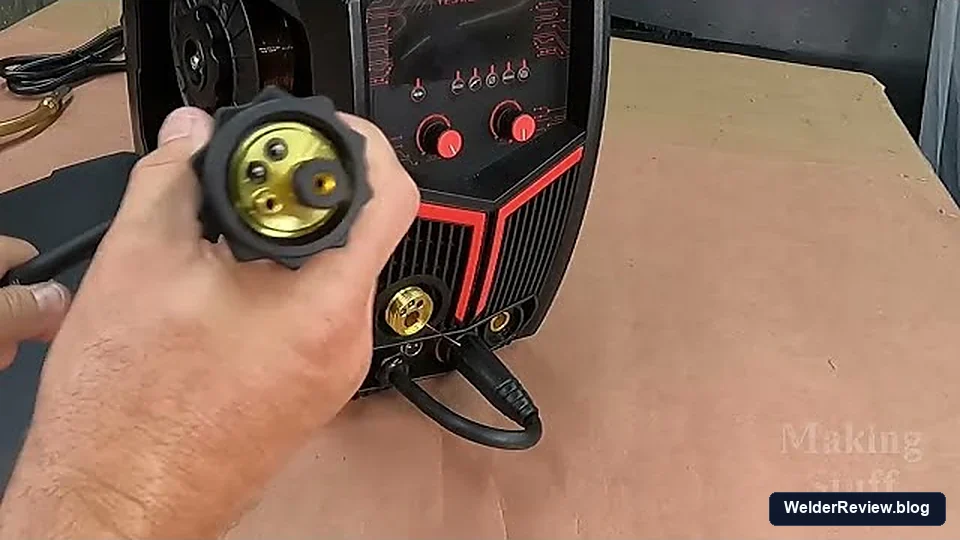
Synergic programming automatically calculates wire feed speed based on plate thickness. This feature helps beginners achieve acceptable parameters quickly without referencing complex paper charts.
Advanced users can bypass synergic mode entirely for manual control. Fine-tuning arc inductance, burn-back time, and pre-flow gas timers provides deep customization over the welding arc.
The front control panel features a bright LCD screen paired with a single rotary encoder. Synergic MIG programs automatically calculate wire speed and voltage based on material thickness and shielding gas selections.
Manual override modes give advanced fabricators precise control over individual welding parameters. Tactile pushbuttons respond accurately even when operators are wearing heavy leather welding gloves in cold environments.
Menu navigation relies on intuitive graphical icons rather than complex alphanumeric sub-menus. This streamlined software design reduces setup friction for apprentices transitioning between MIG, TIG, and stick processes.
- Central digital encoder simplifies mode selection and parameter changes.
- Synergic mode matches wire speed to selected metal thickness.
- Manual override options allow precise tuning of arc dynamics.
Menu Navigation and Display Readability
The bright LED digital displays remain easily readable under harsh workshop lighting. However, viewing angles diminish when standing directly above the unit due to the flat bezel angle.
Menu structures group related welding parameters into logical sub-folders. Operators can adjust voltage trim and wire speed independently while viewing real-time feedback on screen.
- High-visibility LED screens resist glare from shop lights.
- Logical sub-folder organization speeds up parameter adjustments.
Consumable Management, Wire Feeding, and Drive Rolls
Inside the side cabinet, a dual-roll cast aluminum wire feeder manages spool feeding smoothly. The mechanism accommodates standard 2-pound and 10-pound wire spools without slipping or binding.
Reversible drive rolls support both knurled flux-cored wire and V-groove solid steel wire. Changing rolls requires a simple thumbscrew removal without needing specialized hand tools.
Proper tension adjustment on the idler arm prevents bird-nesting issues. Maintaining correct pressure ensures consistent wire delivery through the standard MIG gun liner during long passes.
The interior houses a cast-aluminum dual-drive roll assembly designed for smooth wire delivery. Toolless tension adjustments apply uniform pressure to prevent bird nesting with soft aluminum spool gun wires.
Reversible drive rolls come pre-machined with dual V-grooves and knurled profiles. This accommodates solid carbon steel wires alongside flux-cored consumables without requiring specialized conversion toolkits during changeovers.
Standard Euro-style torch connections ensure airtight gas delivery and secure electrical contact. Routine replacement of contact tips and gas nozzles requires no specialized tools, minimizing costly arc downtime in production settings.
- Cast aluminum wire feed mechanism handles 2lb and 10lb spools.
- Tool-free reversible drive rolls for solid and flux wire.
- Adjustable idler tension prevents wire bird-nesting failures.
Torch Compatibility and Liner Maintenance
The included MIG torch features a standard Euro-style quick connection. This design allows users to swap out replacement torches or upgrade liners easily when switching between steel and aluminum wire.
Using soft aluminum wire requires installing a Teflon liner. Regular cleaning prevents wire shaving accumulation and ensures smooth feeding through the curved torch neck.
- Euro-style quick connect simplifies torch replacement.
- Teflon liner installation is necessary for smooth aluminum feeding.
Maintenance Protocols and Long-Term Field Durability
Routine maintenance ensures longevity for this multi-process machine. Operators should blow out accumulated metal dust from internal circuit boards using compressed air every three months.
MIG gun contact tips and nozzles require daily inspection for spatter buildup. Applying anti-spatter gel extends consumable lifespan significantly during high-amperage MIG welding tasks.
Checking electrical terminal connections prevents resistance heating. Inspecting power cords and ground clamps prevents intermittent arc dropouts during critical fabrication projects.
Preventive maintenance requires regular compressed air purging of accumulated metallic dust inside the chassis. Technicians should inspect internal wiring harnesses annually for insulation wear or vibration-induced terminal looseness.
Drive roll assemblies demand periodic cleaning with a wire brush to remove copper shavings. Applying a light film of dielectric grease to electrical connectors prevents corrosion in humid coastal fabrication workshops.
Ground clamp connections and welding leads must be checked for continuity to prevent resistance heating. Proper upkeep of these high-current pathways guarantees consistent arc output throughout the equipment service life.
- Quarterly compressed air cleaning prevents conductive dust accumulation.
- Daily inspection of contact tips and nozzles reduces arc instability.
- Periodic checks of ground clamps prevent resistance power drops.
Common Wear Points and Preventative Care
Drive roll grooves wear down over extended high-volume wire feeding. Inspecting these metal tracks periodically ensures uniform wire pressure and prevents erratic arc behavior on jobs.
The ground cable connection point should remain tight and clean. Corrosion on the chassis lug can cause voltage drops that negatively impact pulse arc stability.
- Monitor drive roll wear tracks for consistent wire tension.
- Keep chassis ground lugs clean to avoid voltage drops.
Final Engineering Verdict and Ideal Workshop Fit
The Yeswelder YWM-211P delivers impressive multi-process versatility for its price tier. Check out our Yeswelder vs Titanium comparison to see how its pulse MIG capabilities perform against competitor machines.
While chassis handles and continuous fan noise reveal its budget orientation, the underlying electrical performance is robust. It handles everyday steel and aluminum fabrication tasks without failing.
Prospective buyers should budget for a separate TIG torch if lift TIG is required. Overall, this machine provides reliable arc performance and strong feature sets for versatile fabricators.
This multiprocess welder delivers exceptional versatility for mobile repair trucks and hobbyist garages alike. Its robust pulse capabilities bridge the gap between entry-level units and industrial production equipment seamlessly.
Fabrication shops specializing in automotive restoration will appreciate the fine heat control on sheet metal. Meanwhile, mobile contractors benefit from the dual-voltage capability for working on remote job sites.
Ultimately, the hardware configuration provides reliable performance for users needing multi-process flexibility. It stands as a capable engineering solution for tasks requiring precision aluminum and steel fabrication versatility.
- Delivers accessible pulse MIG performance for budget-conscious workshops.
- Requires separate accessory purchase for full lift TIG use.
- Offers dependable multi-process utility for diverse fabrication projects.
Who Should Buy This Machine?
Independent fabricators and mobile repair technicians will appreciate its portability. The dual-voltage input allows seamless operation across residential and industrial job sites alike.
Beginners seeking to learn aluminum welding will benefit from synergic controls. However, heavy industrial production shops should invest in higher-duty-cycle equipment instead.
- Ideal for mobile repair technicians and independent hobbyists.
- Synergic controls assist operators learning aluminum techniques.
Frequently Asked Questions
Does this machine include a TIG torch in the standard box?
No, the factory package excludes the lift TIG torch and gas valve assembly. Operators must purchase a compatible lift TIG torch separately before attempting TIG welding operations.
Can the unit run aluminum MIG wire without special upgrades?
You must install a Teflon liner and U-groove drive rolls. Using standard steel components with soft aluminum wire will cause severe bird-nesting and feeding jams.
What size electrical breaker is required for maximum output?
Operating at the full 200-amp capacity requires a dedicated 220V 50-amp circuit. Operating on standard 110V outlets limits maximum output current significantly to protect household breakers.
Is this machine suitable for heavy industrial production work?
It is engineered for light fabrication, maintenance, and hobbyist projects. The 30% duty cycle restricts continuous high-amperage welding in heavy industrial manufacturing environments.
How does the synergic control system assist new operators?
The microprocessor automatically pairs wire feed speed with voltage settings based on material thickness. This automation simplifies setup and helps users achieve stable welding parameters quickly.