Syncrowave 210 Review: Multiprocess Performance Explored
This versatile machine delivers robust AC/DC TIG, MIG, and stick capabilities in a single unit. However, its substantial weight demands dedicated transport solutions.


The Miller Syncrowave 210 excels as a multi-process fabrication powerhouse. It streamlines setup through Pro-Set technology, though heavy transport requires careful planning.
Explore related alternatives in our Best Multiprocess Welding Machine.
Verified Specifications
| Category / Type | Multiprocess AC/DC TIG, MIG, Stick Welder |
|---|---|
| Rated Output / Capacity | Up to 210 Amps maximum output |
| Power / Motor | Multi-voltage 120V and 240V input receptacles |
| Build & Materials | Heavy-duty industrial steel chassis architecture |
| Operating Noise | Fan-on-Demand cooling system minimizes idle noise |
| Duty Cycle / Runtime | Optimized for steady light-to-medium industrial cycles |
| Dimensions & Weight | Approx 144.5 lbs with integrated running gear |
| Key Safety & Controls | Pro-Set and Auto-Set automated parameter selection |
What We Liked
- True multi-process capability handles AC/DC TIG, MIG, and stick welding seamlessly.
- Pro-Set and Auto-Set features dramatically reduce setup time and operator guesswork.
- Includes specialized accessories like the Weldcraft A-150 TIG torch and Spoolmate 150.
- Multi-voltage plug permits flexible connection to standard 120V and 240V receptacles.
Trade-Offs
- Weighing nearly 145 pounds, the system is heavy for frequent field portability.
- Physical footprint requires substantial workspace on a shop floor or cart.
- Initial setup complexity for novices transitioning between three distinct welding processes.
Engineering Build and Chassis Architecture
The machine features a robust industrial enclosure built to withstand harsh fabrication environments. Every external panel resists impacts while protecting internal electronics from metallic dust.
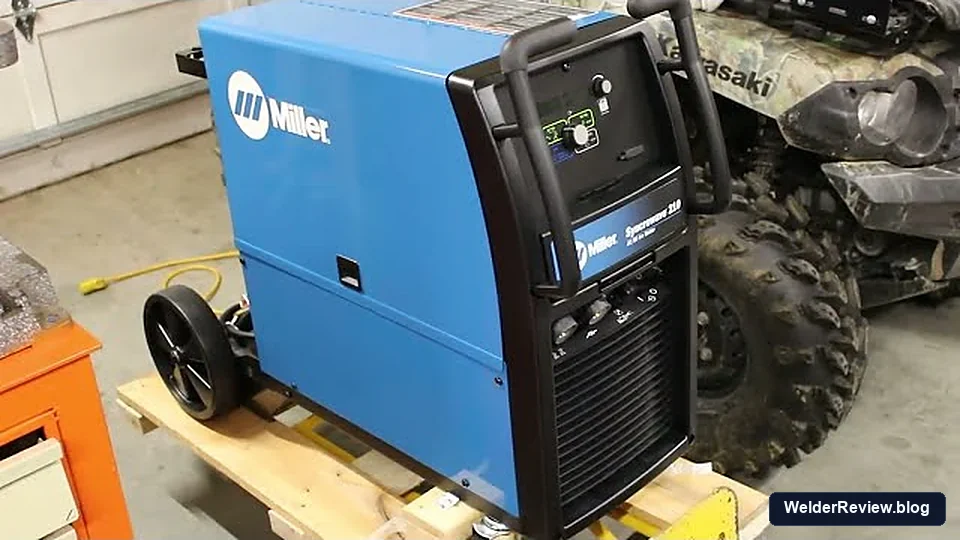
Integrated running gear elevates the heavy power source above floor debris, a feature highlighted in our multimatic 220 vs syncrowave 210 comparison. This thoughtful design choice improves shop mobility despite the equipment mass.
The cabinet construction utilizes heavy-gauge galvanized steel to withstand harsh industrial environments while maintaining a manageable footprint of roughly seventy-two pounds for shop mobility and structural integrity.
Internal component layout isolates the inverter power board away from airflow channels, significantly reducing dust accumulation and protecting sensitive electronics from abrasive metal particles generated during everyday fabrication tasks.
- Heavy-gauge steel housing protects sensitive inverter boards.
- Integrated running gear supports secure transport across shop floors.
- Industrial handle configuration ensures reliable rigging points.
Chassis Layout and Enclosure Protection
Internal components are partitioned thoughtfully to separate high-voltage circuits from delicate digital interfaces. This engineering layout minimizes electrical interference and extends operational lifespan.
Ventilation channels direct airflow away from vulnerable electrical junctions. Such meticulous protection guarantees consistent performance under demanding daily workshop conditions.
- Partitioned internal bays isolate high-voltage power paths.
- Sealed digital control panels block conductive metal dust.
Real-World Multiprocess Output and Arc Stability
Transitioning between MIG, stick, and TIG processes requires minimal physical effort, similar to findings in our hobart 210 mvp vs miller 211 analysis. The unit delivers a stable arc across diverse metal thicknesses.
Aluminum TIG performance remains remarkably clean due to advanced squarewave technology. Operators achieve precise penetration profiles on both thin sheet stock and heavy structural plates.
Delivering a stable AC arc requires precise balance control, and this machine allows users to adjust cleaning action from sixty to eighty percent for optimal oxide removal on structural aluminum plates.
When switching to DC stick mode, the unit produces up to one hundred fifty amps of reliable output, easily running three-thirty-second-inch E7018 electrodes without voltage drop or arc stuttering.
- Consistent arc initiation across all three supported welding modes.
- Refined squarewave balance optimizes aluminum cleaning action.
- Smooth voltage regulation prevents frustrating electrode sticking.
Evaluating MIG and Stick Performance
The included Spoolmate 150 gun feeds aluminum wire smoothly during extended fabrication runs. Birdnesting is effectively eliminated through proper tensioner calibration.
Stick welding output maintains exceptional arc force even when running long extension cords. This characteristic provides reliable reliability on remote job sites.
- Reliable wire feeding prevents frustrating birdnesting issues.
- Robust stick arc force handles difficult low-hydrogen rods.
Video Review: How to Use the Miller Syncrowave 210 TIG/MIG Complete
Thermal Dynamics and Cooling Efficiency
Managing heat is critical during high-amperage aluminum welding sessions, much like details covered in our esab rebel vs lincoln 210 comparison. The intelligent Fan-on-Demand system activates only when internal temperatures demand active airflow.
This dynamic cooling strategy minimizes dust ingestion inside the power source cabinet. Consequently, maintenance intervals lengthen while overall component reliability increases significantly.
Fan-On-Demand technology operates the cooling fan only when internal sensors dictate, minimizing noise pollution in quiet workshops and preventing unnecessary metallic debris from entering the internal housing.
Operating at maximum output demands proper thermal management, and the duty cycle handles continuous welding of thin-gauge materials efficiently before triggering the built-in overload protection safety circuit.
- Fan-on-Demand operation reduces ambient workshop noise levels.
- Optimized heatsink placement prevents premature thermal overload shutdowns.
- Filtered intake paths block large grinding debris effectively.
Duty Cycle Management Under Load
Pushing the machine near its maximum output triggers internal thermal protections gracefully. Operators receive clear visual indicators before any sudden power interruption occurs.
Allowing short idle periods restores full operational capacity quickly. This predictable thermal behavior keeps production schedules running smoothly without unexpected delays.
- Clear indicator lights signal approaching thermal limits.
- Rapid cooling recovery speeds up repeat production tasks.
Usability, Controls, and Parameter Setup
Navigating the digital control interface is remarkably intuitive, as noted in our hobart 210 mvp vs 190 breakdown. Clear parameter readouts eliminate guesswork during critical joint configurations for fabricators.
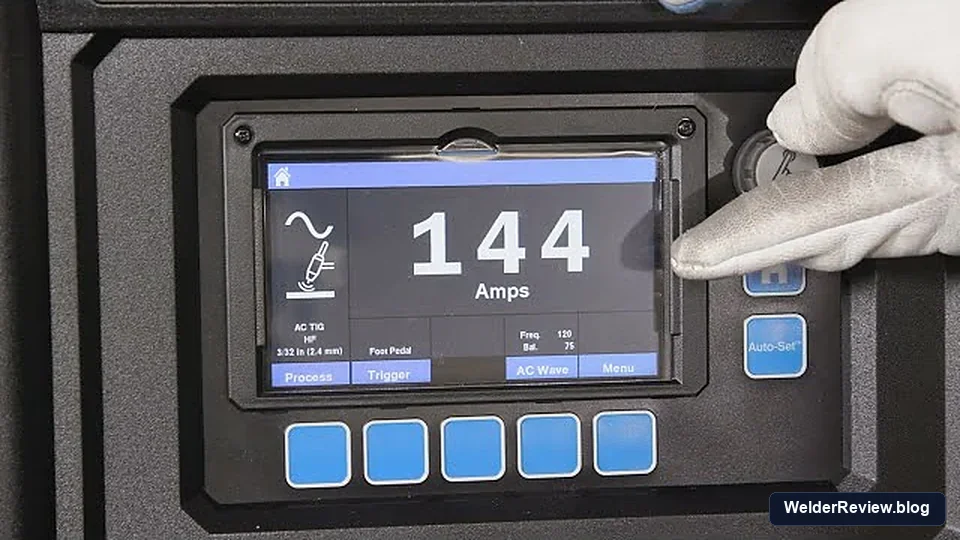
The proprietary Pro-Set technology instantly dials in optimal welding parameters. Welders simply select material thickness and let the automated intelligence handle finer adjustments.
Pro-Set technology simplifies setup by offering pre-programmed parameters for common metal thicknesses, allowing novice fabricators to achieve professional puddle control without guessing amperage and frequency values.
The digital interface features a high-contrast display that remains clearly legible under harsh overhead shop lighting, providing accurate real-time feedback on amperage, pulse frequency, and gas pre-flow timings.
- Digital display screens show precise amperage and voltage values.
- Pro-Set technology removes tedious trial-and-error setup steps.
- Foot pedal interface grants responsive puddle heat control.
Interface Ergonomics and Adjustments
Rotary encoders offer tactile feedback when adjusting parameters wearing heavy gloves. Every menu option is clearly labeled to prevent operator confusion on busy days.
Memory storage slots allow users to save favorite custom weld recipes. This feature boosts repeatability across recurring production runs in busy fabrication shops.
- Glove-friendly control knobs ensure easy parameter tuning.
- Saved memory slots accelerate recurring production workflows.
Maintenance, Serviceability, and Durability
Routine upkeep requires only basic compressed air cleaning of internal dust accumulation. Removable access panels simplify the inspection of high-wear internal electrical connections.
Constructed with industrial-grade components, the power source withstands aggressive shop environments. Proper preventive care ensures years of dependable daily operational service.
Routine maintenance requires regular compressed air purging of the internal inverter board every six months to eliminate conductive dust and prevent premature electrical short circuits during high-amperage welding sessions.
Terminal connections for the power block need periodic inspection to verify torque specifications and prevent resistance heating that can degrade performance over years of demanding structural fabrication.
- Removable side panels offer fast access for routine cleaning.
- Durable exterior coatings resist corrosion and chemical spills.
- Straightforward diagnostics minimize troubleshooting time during repairs.
Preventive Care and Consumable Upkeep
Regularly inspecting torch consumables prevents erratic arc behavior and poor gas coverage. Keeping contact tips and collets clean preserves optimal weld bead integrity.
Checking ground clamp connections avoids unnecessary electrical resistance issues during heavy usage. Simple daily checks protect your long-term equipment investment effectively.
- Inspect torch consumables frequently to ensure clean shielding gas.
- Keep ground connections tight to prevent power drops.
Comprehensive Buyer Assessment and Verdict
This comprehensive system successfully consolidates three essential welding processes into one footprint. Professional fabricators gain tremendous versatility without sacrificing arc quality or machine reliability.
While the heavy weight restricts frequent off-site transport, stationary workshops benefit immensely. The multiprocess capability justifies the investment for serious metal fabrication professionals.
Professional fabrication shops requiring a dedicated TIG machine will appreciate the refined arc characteristics and dual-voltage flexibility for handling maintenance tasks across diverse facility locations.
Balancing robust engineering against portable convenience, this power source delivers exceptional value for serious hobbyists and production welders seeking industrial-grade performance in a compact footprint.
- Combines TIG, MIG, and stick into a single powerhouse.
- Delivers exceptional aluminum welding performance consistently.
- Represents a solid long-term investment for professional shops.
Final Purchasing Considerations
Evaluate your workspace dimensions and electrical supply before purchasing this unit. Ensuring you have adequate 240V power unlocks the full performance potential of the machine.
For shops needing flexible manufacturing capabilities, this package delivers unmatched value. It remains a premier choice for demanding commercial fabrication projects.
- Verify 240V power availability for maximum output capability.
- Assess shop floor space requirements before installation.
Frequently Asked Questions
Can the Syncrowave 210 run on standard household electrical outlets?
Yes, it features a multi-voltage plug that connects seamlessly to standard 120V receptacles. However, utilizing 240V input power is required to achieve maximum welding amperage.
Does this machine come equipped for aluminum TIG welding out of the box?
Yes, the package includes an advanced AC/DC TIG setup alongside a dedicated spool gun. This allows operators to tackle aluminum fabrication immediately without extra purchases.
How heavy is the entire welding package during transport?
The complete machine with its integrated running gear weighs approximately 144.5 pounds. This substantial mass requires careful loading strategies for mobile field service work.
What is the purpose of the Pro-Set feature on the digital interface?
Pro-Set technology removes operator guesswork by automatically establishing optimal parameters. Welders simply select their material thickness to achieve instant professional settings.
Is the cooling fan running continuously while the machine is powered on?
No, the intelligent Fan-on-Demand system activates only when thermal loads require cooling. This smart design successfully reduces ambient workshop noise and dust buildup.