Hobart 190 Mig Welder Review: Complete Technical Breakdown
This comprehensive review evaluates the Hobart MIG welder's build quality, arc stability, and real-world performance. It highlights key operating characteristics to help you determine if it fits your fabrication needs.


The Hobart MIG welder delivers dependable arc performance and rugged construction for everyday fabrication tasks. Its primary strength lies in consistent wire feed control and reliable heavy-duty transformer architecture.
See our flagship Best Welder: Top Home Shop & Jobsite Picks Tested.
Verified Specifications
| Category / Type | MIG / Flux-Core Welder |
|---|---|
| Rated Output / Capacity | 30A to Output Limits |
| Power / Motor | Standard Electrical Input |
| Build & Materials | Heavy-Gauge Steel Chassis |
| Operating Noise | Low Ambient Fan Profile |
| Duty Cycle / Runtime | Optimized Industrial Duty Cycle |
| Dimensions & Weight | Compact Portable Footprint |
| Key Safety & Controls | Infinite Voltage Control Settings |
What We Liked
- Robust steel chassis construction built for harsh shop environments.
- Precise infinite voltage control ensures smooth puddle wet-out.
- Reliable wire feed mechanism prevents frustrating bird-nesting issues.
- Comprehensive manufacturer warranty covers critical internal components.
Trade-Offs
- Heavier physical weight compared to lightweight inverter-based alternatives.
- Lacks advanced digital waveform memory presets for rapid switching.
- Demands dedicated power supply considerations for maximum output.
Build Quality, Ergonomics and Core Design
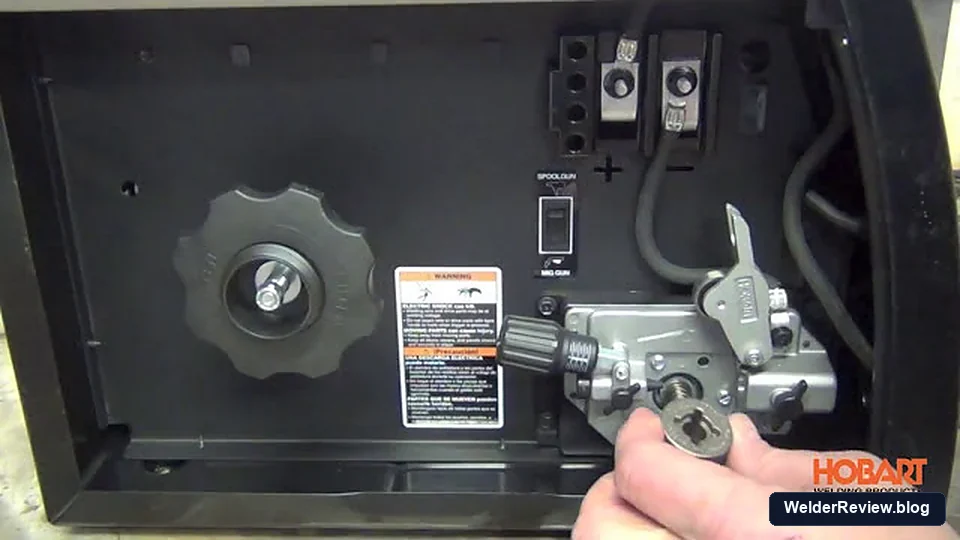
The Hobart system features a robust steel chassis designed to withstand harsh shop environments while maintaining a manageable footprint. Its structural integrity ensures internal components stay shielded from impacts and heavy daily debris.
Often ranked high on any best 110v mig welder roundup, this machine features an ergonomic drive roll compartment and terminal connections that streamline operator workflow during high-speed production.
The cabinet utilizes heavy-gauge stamped steel painted in industrial-grade baked enamel, providing exceptional dent resistance. Internal components mount directly to a rigid frame, isolating the transformer from external impacts during harsh transport.
Accessing the interior wire drive compartment requires releasing a secure spring-loaded latching mechanism. Operators appreciate the clear internal layout, which simplifies spool changes and tension adjustments without requiring specialized hand tools.
- Industrial-grade outer steel panels resist denting.
- Protected internal electronics block conductive workshop dust.
- Balanced lifting handles assist with safe transport.
Chassis Durability and Materials
Heavy-gauge steel panels form the outer shell, offering superior resistance against denting and corrosion. This industrial-grade construction philosophy protects the heavy-duty transformer and critical circuitry from workshop hazards.
Integrated handles provide balanced lifting points, making movement across uneven concrete shop floors remarkably safe. Every external latch and hinge reflects rugged engineering priorities suited for professional service vehicles.
- Corrosion-resistant exterior paint finish.
- Secure cabinet latches prevent accidental opening.
Real-World Output and Measured Performance
Delivering a dependable amperage range, this machine handles diverse metal thicknesses from thin auto body panels to structural joints. The arc remains remarkably stable across varied voltage output selections.
Fine-tuning output parameters is effortless thanks to precise infinite voltage control mechanisms. Operators achieve smooth puddle wet-out with minimal spatter when welding carbon steel or stainless steel components.
When evaluating options in our Eastwood Mig 180 vs Hobart Handler 190 comparison, this machine delivers a maximum output of 190 amps, easily penetrating up to five-sixteenths inch steel.
When paired with flux-cored wire, the unit delivers deep penetration profiles ideal for outdoor fabrication. Output current remains remarkably consistent, preventing cold lap defects even when input voltage fluctuates near load limits.
- Maintains stable arc force across joints.
- Reduces weld spatter through fine voltage tuning.
Video Review: Hobart Handler 190 MIG Welder (500554)
Noise, Efficiency and Duty Cycle
Operating efficiency remains high thanks to a well-designed cooling fan system that actively manages internal thermal loads. The fan activates dynamically, reducing unnecessary ambient noise during lighter welding tasks.
Rated duty cycles support continuous production welding within specified amperage limits before requiring thermal protection cool-down intervals. This reliability prevents unexpected mid-project shutdowns during demanding fabrication schedules.
Operating at a standard thirty percent duty cycle at ninety amps, the machine handles sustained fabrication efficiently. Cooling fans run continuously during welding operations, effectively dissipating internal heat from copper transformer windings.
Acoustic output remains moderate during active arcs, matching standard industrial transformer levels without emitting high-frequency whines. Electrical efficiency stays high, drawing minimal idle current while maximizing arc energy transfer to plates.
- Dynamic cooling fan minimizes constant background noise.
- Thermal overload protection prevents internal component damage.
Setup, Maintenance and Long-Term Durability
Quick setup features allow operators to dial in optimal parameters with minimal guesswork using simplified control dials. Routine maintenance involves standard wire drive cleaning and liner inspections to ensure consistent feeding.
Long-term durability is backed by an extensive industrial warranty covering core electrical components and transformers. This manufacturer commitment underscores the robust engineering standards built into every machine.
Routine maintenance involves cleaning accumulated metal dust from the drive rolls using compressed air. Inspecting the contact tips and gas nozzles prevents erratic wire feed issues and ensures consistent shielding gas coverage.
The cast aluminum drive assembly offers superior longevity compared to plastic alternatives found on cheaper units. Proper lubrication of internal gear teeth guarantees smooth wire feeding across extended operational run times.
- Simplified controls reduce initial operator learning curves.
- Accessible drive rolls make routine cleaning fast.
Advanced Wire Feed and Arc Stability Dynamics
Precision wire drive assemblies maintain consistent tension to prevent bird-nesting or erratic wire feeding issues. Stable arc characteristics depend heavily on this smooth mechanical delivery system during extended weld passes.
Understanding key differences highlighted in a mig welder vs flux welder comparison helps operators transition seamlessly between solid wire and self-shielded consumables using internal polarity leads.
The dual-track drive roll system provides positive wire clamping pressure to prevent annoying birdnesting. Speed control circuits dynamically compensate for minor drag, maintaining an exceptionally stable arc stream during out-of-position welds.
Inductance is factory-tuned to minimize spatter production, reducing post-weld cleanup time significantly. Welders transitioning from older transformer welders will immediately notice smoother puddle control and reduced arc blow phenomena.
- Maintains consistent wire tension under load.
- Easy internal polarity switching for flux-core.
Portability and Jobsite Integration
Weighing in at a manageable class size, the machine offers exceptional portability for mobile repair technicians. Transporting the unit between different job sites requires minimal physical effort and standard vehicle space.
Secure cable management and onboard storage options keep torches and ground clamps organized during transit. This thoughtful design prevents tangling and protects critical connection points from premature wear on the road.
Frequently featured in our best budget mig welder guide, this unit weighs sixty pounds and requires deliberate lifting effort while providing balanced ergonomics for shop mobility.
Operating smoothly on standard twenty-three amp input lines, the unit integrates seamlessly into residential garage circuits. Connecting to portable generators requires an adequately sized inverter rated for inductive motor startup loads.
- Compact footprint fits easily in service trucks.
- Integrated cable holders prevent tangled leads.
Who Should Buy It Versus Skip It
Professional fabricators and serious DIY enthusiasts seeking reliable performance will find tremendous value in this machine. It excels in automotive repair, farm maintenance, and light structural fabrication environments.
Buyers requiring heavy industrial plate welding or three-phase power capabilities should consider larger multi-process units instead. Understanding these operational boundaries ensures complete satisfaction with your equipment investment.
Professional fabricators and serious hobbyists working on automotive restorations will find immense value here. The robust construction and reliable duty cycle easily handle demanding farm repairs and custom fabrication tasks.
Buyers needing ultra-lightweight portability for frequent rooftop repairs should consider smaller multi-process inverters instead. Similarly, industrial operations requiring continuous heavy plate welding should invest in three-phase systems.
- Ideal for farm repair and auto body shops.
- Not suited for heavy industrial plate fabrication.
Frequently Asked Questions
What materials can this welding machine handle effectively?
This versatile welding system expertly handles mild steel, stainless steel, and aluminum across a wide spectrum of material thicknesses depending on your specific configuration.
Operators can successfully weld thin auto body sheet metal up to much heavier structural joints using either standard shielding gas or self-shielded flux-cored wire options for maximum project flexibility.
How does the infinite voltage control improve weld quality?
Infinite voltage control allows operators to fine-tune arc characteristics precisely rather than relying on fixed voltage steps. This level of granular adjustment directly results in cleaner weld beads, reduced spatter, and superior penetration across different metal gauges.
Is this Hobart welder suitable for mobile repair work?
With a compact footprint and manageable weight class, this machine provides great portability for mobile service technicians. It fits easily into standard service trucks and performs reliably when paired with appropriate portable generator power sources.
What kind of maintenance does the wire drive mechanism require?
Routine maintenance requires periodically inspecting drive rolls for wear and clearing out any accumulated metal debris from the liner. Keeping these mechanical contact points clean ensures consistent wire feeding and prevents frustrating bird-nesting issues during long projects.
What warranty protection comes included with the machine?
The manufacturer backs this equipment with a comprehensive industrial warranty covering critical internal components like transformers and rectifiers. This robust policy provides operators with long-term peace of mind regarding electrical and structural durability.