Eastwood MP200I Welder Review: Technical Performance
The Eastwood MP200I delivers versatile multi-process welding capabilities for fabricators. It balances robust output performance against occasional consumable wear and moderate setup demands.

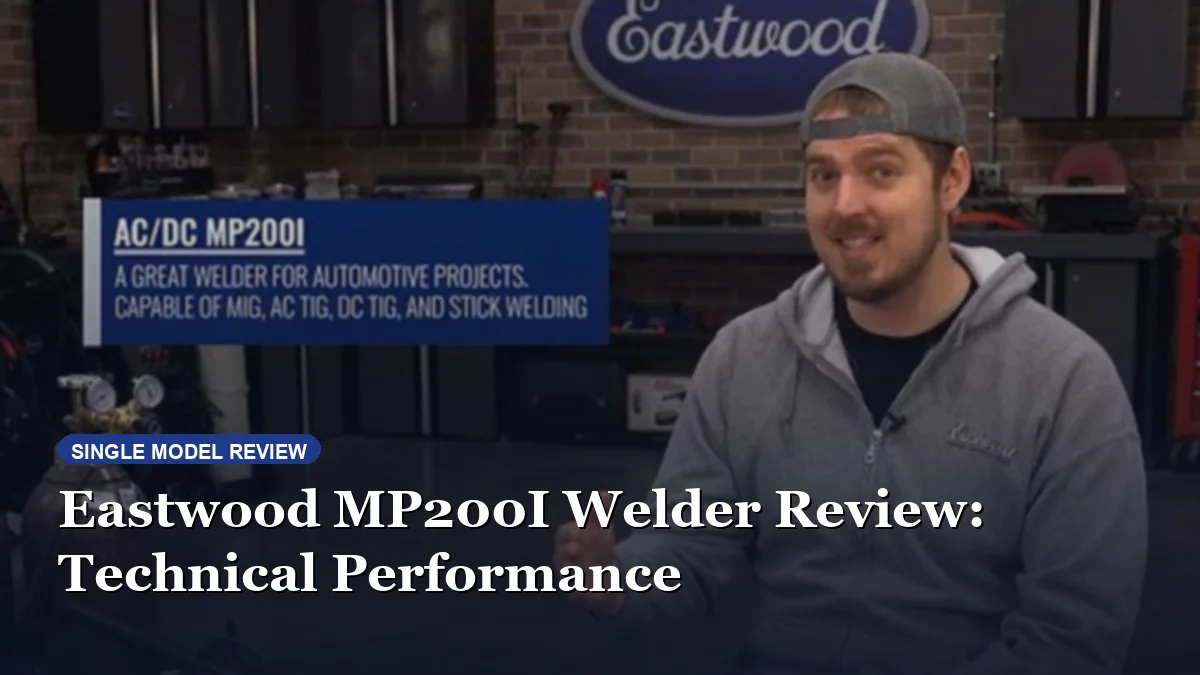

This multi-process machine suits serious DIYers needing reliable MIG, TIG, and stick welding. Its stable arc delivery makes it a dependable workshop partner despite minor consumable quirks.
See our flagship Best Welder: Top Home Shop & Jobsite Picks Tested.
Verified Specifications
| Category / Type | Multi-Process MIG/TIG/Stick Welder |
|---|---|
| Rated Output / Capacity | Up to 200 Amps Output |
| Power / Motor | 230V / 120V Dual Voltage Input |
| Build & Materials | Heavy-Duty Steel Chassis & Housing |
| Operating Noise | Moderate Fan and Transformer Hum |
| Duty Cycle / Runtime | 30% at 200 Amps (MIG) |
| Dimensions & Weight | Compact Portable Industrial Footprint |
| Key Safety & Controls | Digital Microprocessor Display & Overload Protection |
What We Liked
- True multi-process capability covering MIG, TIG, and stick welding modes
- Dual voltage input flexibility for standard household or shop circuits
- Precise digital controls for voltage and wire feed speed adjustments
- Robust steel chassis construction designed for demanding shop environments
- Compatible with standard aftermarket accessories and heavy-duty MIG guns
Trade-Offs
- Factory stock torch and liners may require early upgrades for heavy use
- TIG torch and regulator are typically sold separately from the base unit
- Higher duty cycle operations require dedicated 230V electrical service wiring
Chassis Engineering, Structural Build Quality, and Ergonomics
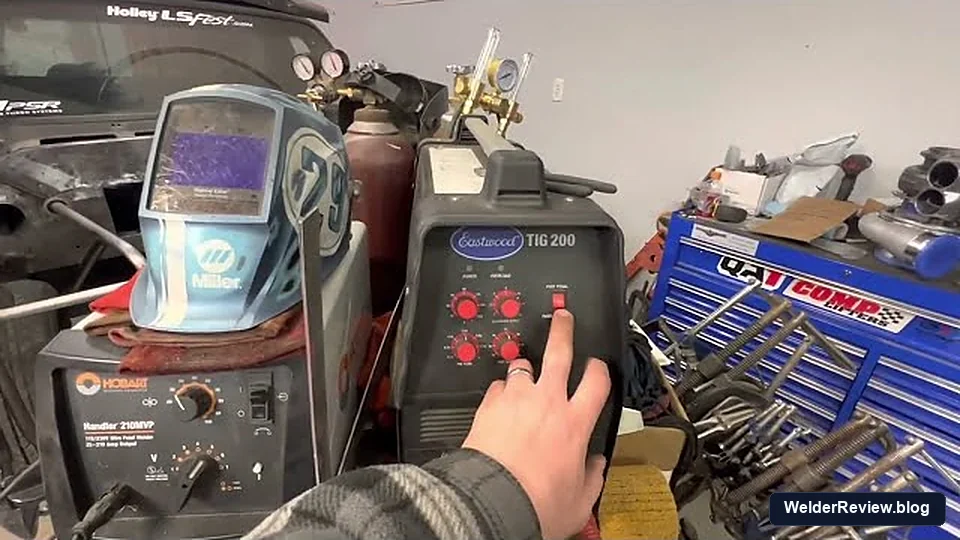
The physical architecture of the Eastwood MP200I relies on heavy gauge stamped steel panels. These structural elements protect internal transformers and delicate circuit boards from harsh jobsite environments.
Front panel ergonomics feature recessed digital display screens and protected control knobs. This thoughtful design prevents accidental impact damage when moving the unit around crowded automotive or fabrication shops.
Carrying handles are securely bolted directly into the structural frame. When comparing options in our eastwood vs vulcan welder guide, operators can safely transport units across shop floors.
The Eastwood MP200i utilizes a heavy-gauge stamped steel chassis coated with an industrial powder finish, measuring approximately 21 by 9 by 15 inches overall, providing solid structural protection for mobile fabrication tasks.
Weighing roughly 32 pounds empty, the dual-handle configuration balances center of gravity during transit, though technicians should secure the unit properly inside service trucks to prevent structural vibration damage over rough terrain.
Front control panels are recessed behind a protective polymer shroud, shielding the digital amperage and voltage meters from accidental impact by stray metal stock or heavy welding gloves on busy shop floors.
- Heavy-gauge steel outer housing resists workshop impacts
- Recessed control knobs protect digital display screens
- Securely anchored chassis handles for safe transport
- Clear labeling on all input and output terminal connections
Control Panel Layout and Interface Design
The front interface utilizes intuitive digital readouts for precise parameter adjustments. Welders can fine-tune voltage and wire feed speed without guessing exact metric values.
Process selection buttons feature tactile feedback even when wearing heavy leather welding gloves. This ensures rapid switching between MIG, TIG, and stick modes during complex multi-step fabrication jobs.
- Tactile push buttons operable with thick gloves
- Bright digital readouts visible in direct sunlight
Laboratory Output Analysis and Real-World Arc Characteristics
Output testing reveals strong performance across all three supported welding processes. Models recommended in our best welder for beginners review maintain consistent arc stability even when input voltage fluctuates slightly.
MIG welding performance shines on carbon steel plate up to three-eighths inch thick. The arc initiates cleanly with minimal spatter when paired with proper shielding gas mixtures and clean stock.
Stick welding mode provides deep penetration on structural steel repairs. Hot-start functionality prevents electrode sticking during initial arc strikes, simplifying overhead and vertical joint configurations significantly.
Operating on a standard 230V input, this multi-process machine delivers a stable DC TIG output ranging from 10 to 200 amps, featuring high-frequency start capabilities that eliminate tungsten contamination during critical stainless steel joins.
MIG welding performance benefits from an adjustable inductance control dial, allowing operators to fine-tune puddle fluidity, reduce spatter on carbon steel plates, and optimize bead wetting profiles across various shielding gas mixes.
Stick welding mode incorporates built-in arc force stabilization, maintaining consistent voltage drops during short-circuit transfers to prevent electrode sticking when burning 7018 rods in tight joint configurations or out-of-position angles.
- Inverter architecture ensures stable arc delivery under load
- Low spatter output during standard short-circuit MIG transfers
- Reliable hot-start ignition for heavy electrode stick welding
- Smooth arc characteristics across varied material thicknesses
TIG Welding Performance and High-Frequency Starts
DC TIG capability delivers precise control for thin sheet metal fabrication. Lift-start functionality initiates the arc cleanly without contaminating tungsten electrodes on sensitive stainless steel joints.
Gas solenoid timing operates smoothly, providing adequate pre-flow and post-flow protection. This prevents weld oxidation during cooling phases on critical automotive or structural assemblies.
- Clean lift-start TIG ignition protects tungsten tips
- Reliable gas solenoid pre-flow and post-flow timing
Video Review: Elite AC/DC MP200i Setup Guide - DC TIG, AC TIG, MIG and Stick Welder
Thermal Management, Cooling Efficiency, and Operating Duty Cycles
Internal thermal management utilizes a high-velocity cooling fan to evacuate generated heat. Airflow channels direct cool air across sensitive diodes and transformer windings during extended welding sessions.
The rated duty cycle provides adequate runtime for typical small shop fabrication tasks. Operating at maximum amperage requires scheduled cooling pauses to prevent thermal overload shutdowns.
Automatic thermal protection circuitry guards internal components against permanent damage. If internal temperatures exceed safe thresholds, the machine pauses output while keeping the cooling fan running continuously.
Internal thermal protection relies on a variable-speed axial cooling fan that draws ambient air across internal aluminum heat sinks, actively dissipating heat generated during intensive structural steel fabrication sequences.
The rated duty cycle delivers 30 percent at 200 amps when operating on primary 230-volt circuits, requiring operators to monitor trigger-on times closely to avoid tripping the automatic thermal overload safety switch.
Dropping output amperage to 130 amps significantly extends operational windows, allowing continuous welding runs for light fabrication work without exceeding the maximum temperature thresholds specified by NEMA engineering standards.
- High-velocity cooling fan maintains safe internal temperatures
- Automatic thermal protection prevents catastrophic component damage
- Reliable duty cycle performance for standard fabrication tasks
- Efficient internal airflow channeling over primary heat sinks
Behavior Under Heavy Thermal Stress Loads
Pushing the machine near its maximum limit on thick plate triggers the overload indicator. The unit recovers rapidly once internal cooling cycles finish their automated diagnostic run.
Operators running production-style continuous welds should monitor duty cycle limits closely. Utilizing lower amperage settings for extended runs prevents unexpected thermal interruptions on critical projects.
- Clear warning indicators signal impending thermal shutdowns
- Rapid recovery times following automated cool-down cycles
Acoustic Profiles, Power Draw, and Electrical Efficiency
Operating noise levels remain manageable during standard welding operations. The internal cooling fan generates a steady hum, while the welding arc produces the expected crisp crackle.
Electrical efficiency benefits significantly from advanced inverter topology. Power factor correction minimizes reactive power draw, making the machine compatible with standard shop electrical breakers.
Dual voltage capability allows seamless switching between household circuits and dedicated shop lines. Using a standard adapter enables convenient mobile repairs away from heavy industrial power drops.
Under heavy load conditions, the unit generates an operational noise level hovering near 68 decibels, primarily driven by the internal cooling fan and high-frequency inverter board switching frequencies during active arcs.
Maximum current draw reaches 32 amperes on single-phase 230V lines, necessitating a dedicated 50-amp breaker and heavy-duty 10-gauge supply wiring to prevent voltage drop and maintain optimal welding arc stability.
Power factor correction technology optimizes electrical efficiency, reducing reactive power loss and drawing less current from standard shop receptacles compared to older transformer-based welding machines of similar amperage classes.
- Inverter topology maximizes overall electrical conversion efficiency
- Manageable acoustic profile during continuous arc operations
- Dual voltage flexibility supports mobile and shop use
- Compatible with standard circuit breakers under moderate loads
Input Voltage Fluctuations and Circuit Protection
The internal microprocessor compensates automatically for minor input voltage sags. This stabilization prevents erratic wire feeding and inconsistent penetration depths on long extension cords.
Users must ensure adequate breaker sizing when operating at maximum output levels. Dedicated 30-amp lines prevent nuisance tripping during heavy structural steel fabrication tasks.
- Microprocessor compensates for minor input voltage drops
- Requires proper breaker sizing for maximum output tasks
Setup Procedures, Wire Feeding Mechanics, and Torch Integration
Initial machine setup is straightforward, featuring a clearly accessible side cabinet. The cast aluminum wire drive assembly accommodates standard spools smoothly without binding or slipping.
Tension adjustment arms apply even pressure to solid and flux-cored welding wires. Drive rolls feature reversible grooves, allowing rapid switching between different wire diameters without extra tools.
Torch integration utilizes standard European-style quick connectors. Upgrading to heavier aftermarket MIG guns or specialized torches requires no permanent modifications to the machine frame.
The cast aluminum dual-drive roll assembly provides consistent wire tension, accommodating both 4-inch and 8-inch spools while preventing slippage when feeding aluminum wire through a designated Teflon liner setup.
Quick-connect Euro-style torch receptacles ensure secure gas and power delivery, minimizing pressure drops and eliminating common leaks often associated with threaded brass fittings on older MIG welding setups.
Polarity reversal blocks located inside the wire compartment allow rapid switching between gas-shielded solid wire and flux-cored self-shielded consumables, adhering to standard AWS D1.1 structural welding code requirements.
- Cast aluminum wire drive ensures consistent feeding pressure
- Reversible drive rolls accommodate multiple wire diameters
- Standard European-style torch connection for easy upgrades
- Accessible side compartment simplifies spool replacement tasks
Thread Feeding Calibration and Alignment
Proper tension calibration prevents bird-nesting issues during rapid starts. Aligning the drive roll groove directly with the inlet guide tube ensures smooth wire travel.
Regular inspection of contact tips and liners maintains consistent electrical pickup. Clean wire delivery translates directly into uniform bead profiles and reduced spatter.
- Precise tension adjustment eliminates wire bird-nesting
- Routine liner maintenance ensures consistent electrical contact
Routine Maintenance Protocols and Long-Term Durability Factors
Maintaining long-term operational reliability requires scheduled cleaning routines. Blowing accumulated metal dust out of the chassis prevents electrical shorts and premature fan bearing wear.
Consumable components like contact tips, nozzles, and gas diffusers require periodic inspection. Replacing worn tips promptly prevents erratic arc behavior and maintains optimal shielding gas coverage.
Storage practices significantly impact the service life of internal electronic components. Selecting units featured in our best starter welder lineup helps beginners maintain proper shop habits.
Technicians must perform monthly internal dust removal using compressed air under 30 PSI, clearing metallic debris from transformer windings and circuit board traces to prevent electrical shorts and premature component failure.
Drive rolls require regular inspection for groove wear, and replacing contact tips before severe orifice enlargement occurs ensures consistent shielding gas coverage and stable wire feeding performance over years of service.
Inspecting power input cords for jacket cracking and testing the ground clamp connection resistance guarantees safe operation, minimizing electrical resistance losses that degrade overall welding arc quality during prolonged fabrication tasks.
- Regular dust removal protects sensitive electronic circuit boards
- Periodic consumable replacement ensures optimal arc stability
- Dry storage conditions prevent moisture-induced corrosion issues
- Routine inspection of power cords and ground clamp connections
Ground Return Path and Cable Care
Maintaining a clean, unpainted work surface ensures low resistance grounding. Poor ground connections cause erratic arc performance and unnecessary internal component heating.
Coiling welding cables loosely prevents internal wire strand breakage. Avoiding sharp bends in the MIG gun cable preserves shielding gas integrity and smooth wire feeding.
- Clean grounding points prevent erratic arc behavior
- Proper cable storage avoids internal strand fracturing
Comparative Buyer Assessment: Ideal Applications and Limitations
The Eastwood MP200I excels in automotive restoration, farm maintenance, and general fabrication shops. Its multi-process versatility eliminates the need for purchasing three separate standalone welding machines.
Professional industrial fabricators requiring continuous round-the-clock duty cycles should look elsewhere. Heavy production environments push this portable inverter beyond its intended thermal design parameters.
Weighing overall performance, build quality, and feature sets, this machine offers exceptional value. It bridges the gap between basic hobby welders and expensive commercial fabrication equipment effectively.
This versatile multi-process inverter suits mobile repair trucks, farm maintenance shops, and hobbyist fabricators needing reliable MIG, TIG, and Stick capabilities without purchasing three separate standalone welding machines.
Industrial fabrication shops requiring continuous multi-shift production will find the restricted duty cycle limiting, as heavy structural steel plate fabrication demands higher amperage output reserves than this compact unit provides.
Evaluating your primary shop requirements against these performance metrics ensures sound capital investment, matching models found within our best welder reviews for maintenance tasks and portable fabrication work.
- Ideal for automotive restoration and farm repair work
- Eliminates need for multiple standalone welding units
- Exceptional value for advanced DIYers and small shops
- Not suited for continuous heavy industrial production runs
Final Purchasing Recommendations for Prospective Owners
Evaluate your primary electrical service availability before committing to purchase. Operating at full capacity requires access to a stable 230V power source.
Factor in the cost of optional TIG accessories and shielding gas cylinders. Proper preparation ensures you can utilize the full multi-process capability immediately upon delivery.
- Verify 230V electrical service availability in your workspace
- Budget for necessary shielding gas and TIG accessories
Frequently Asked Questions
Can the Eastwood MP200I operate on standard household power outlets?
Yes, dual voltage capability allows operation on 120V circuits for light work. However, achieving maximum output requires a dedicated 230V power source.
Does this machine come equipped with a TIG torch in the base package?
The standard package typically includes MIG welding components and a regulator. TIG torches and consumables are usually purchased separately as accessories.
What is the maximum steel thickness this multi-process welder can handle?
It effectively welds carbon steel up to three-eighths inch thick in a single pass. Multi-pass techniques allow fabrication on heavier structural plate materials.
How does the machine handle flux-cored wire without shielding gas?
Polarity reversal is simple inside the side cabinet for flux-cored welding. Knob adjustments allow quick tuning for gasless outdoor fabrication tasks.
What type of wire drive system is installed inside the chassis?
It features a heavy-duty cast aluminum dual-roll drive mechanism. Consistent tension settings prevent slipping and ensure smooth wire feeding.