Vulcan OmniPro 220 vs Miller 215: Head-to-Head Welder Guide
Choosing between these multi-process machines requires balancing duty cycles, input power versatility, and workshop demands. We examine engineering fundamentals to clarify your final tool investment.

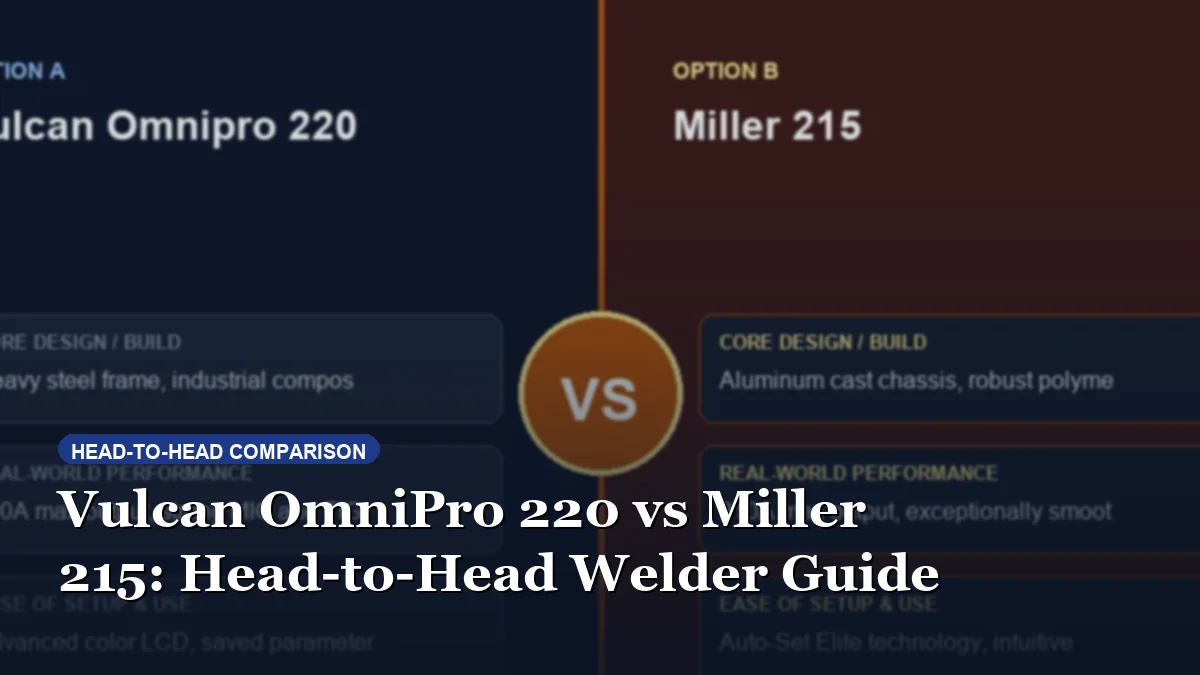
Choose the Vulcan OmniPro 220 for maximum raw amperage and value in heavy fabrication. Opt for the Miller 215 if you prioritize legendary arc stability and portability.
Compare all top models in our Best Welder: Top Home Shop & Jobsite Picks Tested.
Side-by-Side Breakdown
| Criteria | Vulcan Omnipro 220 | Miller 215 | Edge |
|---|---|---|---|
| Core Design / Build | Heavy steel frame, industrial composite housing | Aluminum cast chassis, robust polymer shell | Split |
| Real-World Performance | 220A max output, strong MIG and TIG arc | 210A max output, exceptionally smooth multi-process | Miller 215 |
| Ease of Setup & Use | Advanced color LCD, saved parameter memory | Auto-Set Elite technology, intuitive digital menu | Miller 215 |
| Durability & Reliability | Rugged industrial grade, dual cooling fans | Industrial internal components, robust build quality | Vulcan Omnipro 220 |
| Efficiency / Operating Footprint | Dual voltage capability, heavier footprint | Multi-voltage plug, lightweight compact chassis | Miller 215 |
| Maintenance Requirements | Standard drive roll cleaning, regular dusting | Standard consumable checks, easy spool access | Split |
| Best Ideal Use Case | Heavy fabrication shops and garage welding | Mobile maintenance rigs and precision sheet metal | Split |
Core Engineering and Transformer Design
Evaluating multi-process welders requires analyzing internal transformer topologies and power conversion stages. Both machines utilize advanced inverter architectures to minimize overall unit weight while maximizing available output amperage.
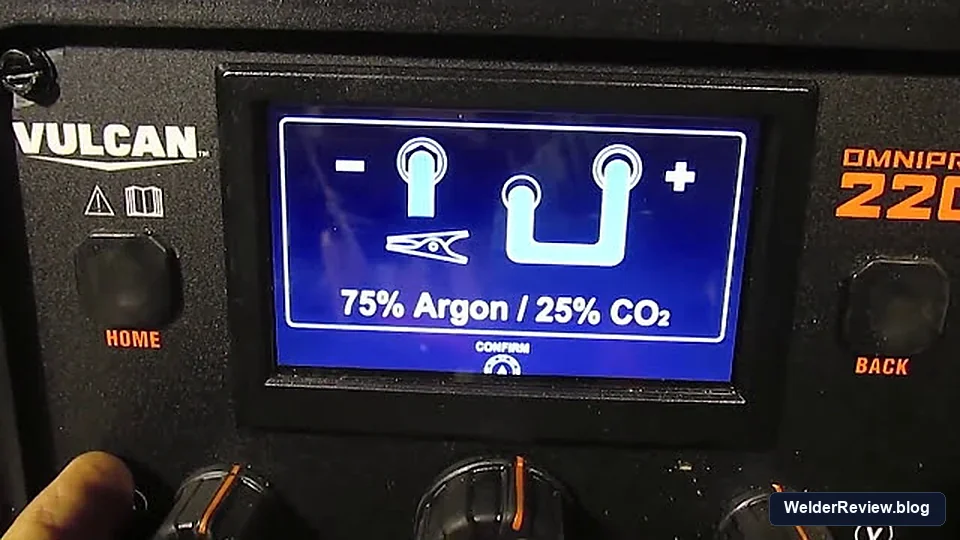
As outlined in the vulcan omnipro 220 review, the unit relies on a robust internal layout designed to handle heavy duty cycles and protect sensitive electronic boards from mechanical vibration.
Conversely, the Miller 215 utilizes precision engineering focused on smooth arc initiation. Its inverter module regulates arc voltage dynamically, reducing spatter across various shielding gas mixtures.
Both machines utilize advanced inverter-based topologies to reduce overall weight while maintaining high electrical efficiency. The OmniPro 220 incorporates a robust multi-voltage input board, whereas the Miller 215 features auto-calibration technology for seamless power switching.
Internal component layouts reveal distinct engineering priorities regarding thermal dispersion and circuit protection. Miller implements conformal coating on primary printed circuit boards to resist moisture and conductive debris inside harsh fabrication environments.
Transformer primary windings on the Vulcan unit are dimensioned to handle sustained industrial voltage fluctuations efficiently. Meanwhile, the Miller design prioritizes strict harmonic suppression to comply with sensitive generator power requirements on mobile job sites.
- Inverter efficiency converts raw input power into stable welding currents.
- Internal cooling fans prevent thermal overload during extended heavy fabrication runs.
- Chassis geometry impacts overall benchtop footprint and workshop mobility.
Power Input Flexibility
Dual-voltage capability allows both welding machines to operate on standard household circuits or heavy industrial lines. Users can switch between input voltages using specialized adapter plugs without internal rewiring.
The Vulcan OmniPro 220 maintains stable output even when voltage sags occur on long extension cords. This resilience protects internal rectifiers from premature electrical degradation under load.
- Automatic voltage sensing simplifies generator and wall outlet integration.
- Proper circuit breaker sizing ensures safe operation at maximum amperage.
Real-World Arc Performance and Multi-Process Versatility
Real-world performance testing reveals distinct differences in arc stability during MIG, TIG, and stick operations. Welders must evaluate how each machine handles root passes and cosmetic capping beads.
As detailed in our vulcan omnipro 220 review, the machine delivers a crisp, forceful arc that bites deep into thick carbon steel plates, easily handling heavy flux-cored wires without power drops.
The Miller 215 shines with exceptional puddle wetting action on thin gauge aluminum and stainless steel. Its waveform control minimizes burn-through on delicate automotive sheet metal.
Evaluating MIG, TIG, and stick modes highlights clear differences in arc stability under varying load conditions. The Vulcan delivers crisp arc starts during short-circuit MIG welding, benefiting from adjustable inductance control parameters for minimal spatter.
Miller counters with exceptional smooth arc characteristics in pulsed-TIG and standard stick configurations. Its built-in hot-start technology prevents electrode sticking, ensuring reliable ignition when striking on rusty or oxidized steel plates.
Transitioning between processes requires swapping polarity leads internally on both platforms, though tool-less connectors speed up the changeover. Operators tackling aluminum fabrication will appreciate the dedicated spool gun compatibility on both multi-process systems.
- MIG welding performance depends heavily on wire feed drive tension.
- Stick welding requires reliable hot-start circuitry to prevent electrode sticking.
- TIG functionality demands precise gas pre-flow and post-flow timer controls.
MIG and Flux-Cored Capabilities
Wire feeding mechanisms dictate the reliability of continuous MIG welding processes. Both units feature cast aluminum drive assemblies designed to prevent bird-nesting issues.
The Vulcan OmniPro 220 utilizes a heavy-duty gear train that pulls wire smoothly through long gun liners. This reduces friction and maintains consistent arc length over time.
- Quick-release tension arms simplify wire spool changes in the shop.
- Standard drive rolls accommodate multiple wire diameters without tools.
Digital Interfaces and Usability Metrics
Modern multi-process welders rely heavily on digital control panels to streamline parameter selection. Operators benefit from clear screen layouts that display voltage, wire speed, and amperage simultaneously.
The Vulcan OmniPro 220 features a high-contrast color LCD screen with memory storage slots. Welders can save favorite settings for rapid recall during production fabrication runs.
The Miller 215 incorporates Auto-Set Elite technology, allowing beginners to dial in material thickness quickly. Professional fabricators can easily override these presets for custom joint configurations.
User interfaces dictate how quickly operators can dial in exact wire feed speeds and voltage settings. The Vulcan features an expansive LCD screen displaying advanced menus, while Miller opts for an intuitive single-knob control scheme.
Setting material thickness automatically configures parameters for novice users, while notes inside our vulcan migmax 215 review explain how experienced fabricators utilize manual mode to fine-tune specific arc voltage drops.
Screen readability under direct sunlight remains a critical factor for field service technicians working outdoors. Both machines employ anti-glare panel overlays, but the Vulcan text layout provides superior legibility from oblique viewing angles.
- Digital displays remain readable under direct workshop lighting conditions.
- Menu navigation requires minimal button presses to adjust parameters.
- Preset libraries reduce setup time when switching between base metals.
Ergonomics and Control Layout
Physical dial placement and handle design dictate daily user comfort in professional environments. Operators wearing heavy leather welding gloves need tactile feedback from every control knob.
The Miller 215 positions its primary control encoder for rapid adjustments mid-weld. Its streamlined front panel prevents accidental parameter changes during busy fabrication shifts.
- Recessed digital screens prevent damage from flying metal spatter.
- Balanced carry handles ensure secure transport across uneven job sites.
Duty Cycles and Thermal Management
Understanding duty cycle ratings prevents unexpected thermal shutdowns during intensive structural welding projects. Both machines are rated at specific percentages based on a ten-minute operating window.
The Vulcan OmniPro 220 offers a competitive duty cycle that sustains medium plate fabrication. Its internal thermal overload protection safely pauses the machine before component damage occurs.
As evaluated in our miller 215 welder review, the machine utilizes advanced aerodynamic cooling channels to dissipate internal heat efficiently during prolonged MIG welding sessions.
Sustained output depends heavily on integrated cooling fans and robust internal heatsink designs. The Vulcan specifies a sixty percent duty cycle at 160 amps, allowing for extended runs on thick structural steel weldments.
Miller achieves balanced thermal performance with its fan-on-demand technology, reducing dust ingestion inside the chassis. When pushed past thermal thresholds, both machines trigger reliable over-temperature shutdown protections to prevent catastrophic transformer damage.
Ambient shop temperature directly impacts maximum operational duration during high-amperage MIG welding sessions. Proper clearance around side ventilation louvers ensures optimal airflow, preventing premature thermal throttling on demanding production shifts.
- Thermal sensors monitor transformer and rectifier temperatures continuously.
- Exhaust vents must remain clear of workshop debris and grinding dust.
- Higher ambient temperatures reduce the effective working duty cycle.
Cooling System Engineering
Internal fan longevity directly impacts the overall lifespan of modern welding power sources. Manufacturers employ demand-driven cooling fans that spin only when internal components require thermal relief.
This targeted airflow strategy reduces the ingestion of metallic grinding dust into sensitive circuit boards, enhancing long-term operational reliability across demanding industrial environments.
- Sealed electronic compartments keep conductive dust away from logic gates.
- Durable fan bearings withstand continuous vibration in mobile service trucks.
Maintenance, Consumables, and Long-Term Durability
Routine maintenance ensures consistent arc quality and extends the working lifespan of your investment. Operators must inspect contact tips, nozzles, and drive rolls regularly for wear.
The Vulcan OmniPro 220 utilizes widely available consumable parts, reducing ongoing operational overhead. Its robust housing resists impacts from accidental drops and heavy workshop traffic.
The Miller 215 features premium internal components engineered for decades of reliable service. Routine cleaning of the wire feed compartment keeps electrical resistance minimal.
Routine upkeep involves inspecting drive rolls, contact tips, and shielding gas lines for wear. The Vulcan employs a cast-aluminum wire drive assembly, whereas the Miller utilizes a comparable heavy-duty aluminum mechanism for consistent feeding.
Consumable availability differs based on regional supply chains and local welding distributor networks. Both welders accept standard MIG gun front-ends, ensuring users can easily source replacement nozzles and contact tips locally.
Long-term chassis durability relies heavily on side panel thickness and powder-coat finish quality. Regular blow-outs with compressed air remove metallic dust accumulation, protecting internal wiring harnesses from electrical short circuits.
- Inspect welding gun liners monthly for accumulated metal shavings.
- Blow out internal dust using compressed air at regulated pressures.
- Check ground clamp connections to prevent resistive heating losses.
Preventative Care Protocols
Establishing a strict preventative maintenance schedule prevents unexpected equipment failures during critical project deadlines. Technicians should verify calibration settings annually using calibrated multimeters.
Keeping wire feed rollers clean ensures steady wire delivery and prevents erratic arc behavior during long structural welding passes on heavy carbon steel weldments.
- Wipe down exterior polymer surfaces with mild industrial cleaners.
- Store welding guns in dry locations to prevent internal liner corrosion.
Workshop Fit and Final Buyer Decision
Selecting the ideal welding machine depends entirely on your specific fabrication requirements and workspace constraints. Hobbyists and professional contractors weigh upfront investment against long-term performance utility.
The Vulcan OmniPro 220 suits fabricators needing maximum amperage and rugged build quality. It handles heavy farm repairs and structural fabrication projects with absolute confidence.
The Miller 215 appeals to mobile service technicians and precision fabricators valuing portability. Its refined arc characteristics deliver flawless cosmetic results on intricate assemblies.
Deciding between these two multi-process welding power sources depends largely on application requirements. Shops prioritizing advanced digital customizability will gravitate toward the Vulcan, while operations valuing proven brand reliability choose Miller.
Physical footprint and weight characteristics also influence whether the unit remains stationary or travels. Both machines offer manageable portability for service trucks, fitting easily beneath standard workbench shelving in compact garage spaces.
Carefully assessing daily duty cycle demands alongside your typical material thicknesses ensures optimal equipment investment. Matching the right multi-process welder to your specific fabrication workflow guarantees maximum efficiency and long-term operational satisfaction.
- Assess available shop electrical service before purchasing heavy equipment.
- Consider primary materials welded when evaluating machine capabilities.
- Factor in local service network availability for warranty support.
Final Investment Summary
Both machines represent top-tier engineering within the portable multi-process welding market segment. Your final choice hinges on whether raw power or refined arc smoothness matters most.
Review your typical material thicknesses and duty cycle demands carefully before making your final purchasing decision to ensure optimal long-term workshop satisfaction.
- Match machine specifications directly to your daily fabrication workload.
- Invest in quality personal protective equipment to complete your setup.
Frequently Asked Questions
Can both welders run on standard household electrical outlets?
Yes, both machines feature dual voltage capabilities allowing operation on 120V household circuits. They also plug into 240V lines for maximum output.
Which welder is better suited for aluminum fabrication work?
The Miller 215 excels on aluminum due to its refined spool gun integration and smooth arc control. It prevents common burn-through issues effectively.
Are the consumable parts interchangeable between these units?
Most standard MIG gun consumables like contact tips and nozzles are universal. However, proprietary drive rolls and internal parts require brand-specific replacements.
Do these welding machines support TIG welding out of the box?
Both units support DC TIG welding using scratch-start or lift-arc methods. You must purchase a separate TIG torch and shielding gas bottle separately.
How do their physical weights compare for mobile service work?
The Miller 215 is slightly lighter and more compact for transport. The Vulcan offers a heavier build geared toward permanent shop bench placement.