Pure Argon vs 75 25 Argon Co2: Shielding Gas Guide
Selecting the correct shielding gas mix determines weld integrity, penetration depth, and spatter levels across different metal fabrication processes and material thicknesses.

Choose pure argon for aluminum TIG applications requiring stable arcs, while 75 25 argon co2 delivers superior carbon steel MIG penetration and reduced cleanup demands.
Compare all top models in our Best Welder: Top Home Shop & Jobsite Picks Tested.
Side-by-Side Breakdown
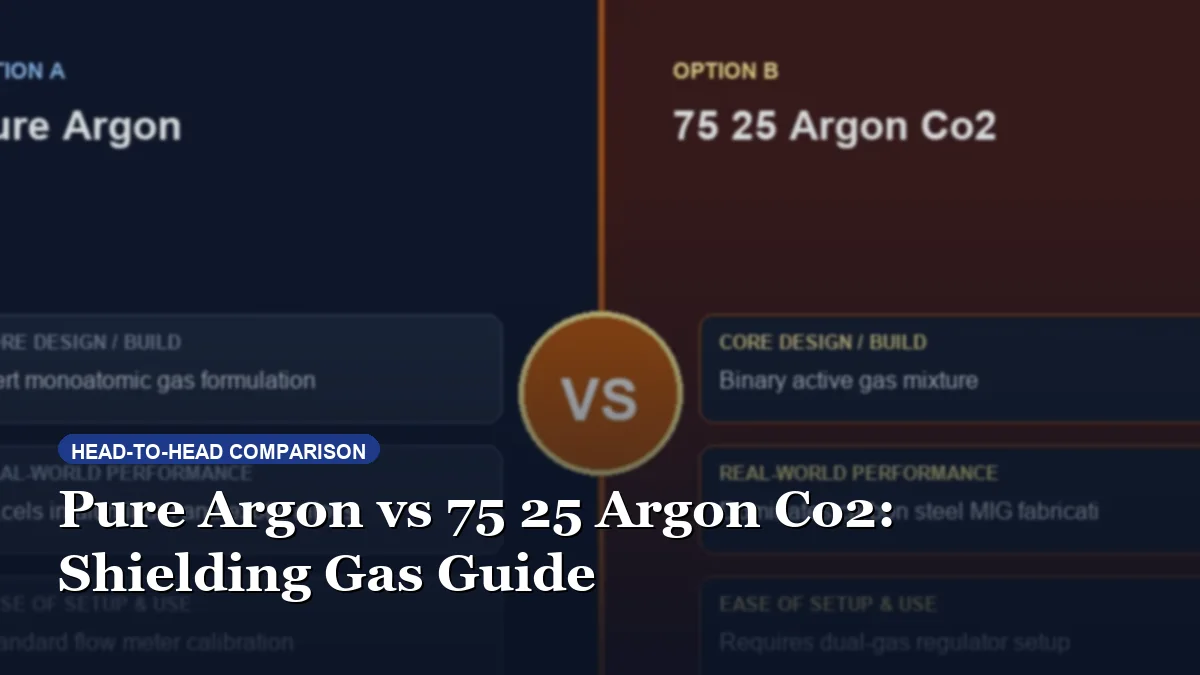
| Criteria | Pure Argon | 75 25 Argon Co2 | Edge |
|---|---|---|---|
| Core Design / Build | Inert monoatomic gas formulation | Binary active gas mixture | Depends on process |
| Real-World Performance | Excels in aluminum and exotic alloys | Dominates carbon steel MIG fabrication | Side B for Steel |
| Ease of Setup & Use | Standard flow meter calibration | Requires dual-gas regulator setup | Side A |
| Durability & Reliability | Stable arc characteristics without oxidation | Consistent bead profile with minor spatter | Tie |
| Efficiency / Operating Footprint | Standard cylinder storage footprint | Common commercial availability nationwide | Side B |
| Maintenance Requirements | Minimal tungsten contamination risks | Regular nozzle cleaning from spatter buildup | Side A |
| Best Ideal Use Case | TIG welding aluminum and stainless steel | MIG welding mild steel structural joints | Depends on Metal |
Core Chemical Properties and Gas Dynamics
Shielding gas selection dictates arc physics, thermal conductivity, and atmospheric protection during fusion welding. Pure argon acts as an inert barrier, preventing oxidation without altering the molten weld pool chemistry.
Conversely, 75 25 argon co2 introduces an active carbon dioxide component into the shielding stream. This chemical addition alters arc voltage characteristics when using the best welder for beginners on steel.
Understanding these foundational chemical differences allows fabricators to optimize their shielding strategies. Selecting the appropriate gas formulation prevents porosity, cracking, and premature mechanical failure in finished structural assemblies.
Pure argon is a monatomic inert gas featuring an atomic weight of 39.95 for a stable arc shield. Its high density displaces atmospheric oxygen efficiently, protecting the molten weld pool during heavy industrial fabrication processes.
Adding 25 percent carbon dioxide introduces active gas behavior into the shielding mix. This compound alters arc physics, increasing thermal conductivity and promoting deeper weld penetration compared to using pure inert shielding streams alone.
Managing gas flow rates requires precise calibration to prevent turbulence. Maintaining flow meters between 20 and 30 cubic feet per hour ensures proper atmospheric displacement without pulling ambient nitrogen into the active welding zone.
- Argon provides dense atmospheric displacement due to high molecular weight.
- Carbon dioxide promotes deep center-line weld penetration profiles.
- Binary mixtures alter arc plasma temperature and droplet transfer.
Inert vs Active Shielding Mechanics
Inert shielding gases remain chemically non-reactive even at extreme welding temperatures. This property makes pure argon mandatory for non-ferrous metals like aluminum, titanium, and magnesium.
Active gas mixtures utilize reactive components to stabilize metal transfer and enhance arc focus. The carbon dioxide fraction breaks down in the arc column, releasing free oxygen for heat transfer.
- Inert gases protect tungsten electrodes from rapid thermal degradation.
- Active gases improve wetting action on heavy carbon steel plates.
Real-World Performance on Carbon Steel
Carbon steel fabrication demands specific shielding dynamics to achieve adequate structural fusion. Pure argon fails miserably when used for mild steel MIG welding, producing globular transfer and excessive spatter.
The addition of carbon dioxide transforms the arc into a smooth short-circuiting or spray transfer mode. Welders rely on 75 25 argon co2 to achieve flat bead profiles and strong mechanical properties.
Production environments require reliable arc starts and minimal downtime for equipment adjustments. This specific gas blend delivers consistent results across varying material thicknesses and joint configurations.
When joining carbon steel plates using short-circuit GMAW, the 75/25 argon blend delivers superior arc stability. The carbon dioxide content reduces surface tension, allowing smoother droplet transfer across the arc gap consistently.
Attempting to weld structural carbon steel with pure argon causes severe undercut and irregular bead profiles. Pure inert gas lacks the active thermal input needed to wet out the toes of carbon steel fillet welds properly.
Plate thickness dictates your voltage and wire feed parameters when running mixed gas. Operators should adjust parameters to maintain a crisp crackling sound, which indicates proper arc stability and minimal stray spatter generation.
- Eliminates cold lap defects common with pure inert shielding.
- Provides optimal balance between penetration and bead appearance.
- Supports high travel speeds in automated robotic welding cells.
Penetration Profiles in Mild Steel
Achieving proper root penetration requires sufficient thermal input at the joint interface. The carbon dioxide percentage in the mix ensures deep, finger-like penetration patterns in thick plates.
Inadequate gas mixtures result in shallow fusion zones and potential structural delamination. Proper selection guarantees compliance with rigorous structural engineering standards and safety codes.
- Deep centerline penetration improves joint shear strength ratings.
- Controlled cooling rates prevent brittle microstructures in steel.
Aluminum and Non-Ferrous TIG Applications
Aluminum welding presents unique challenges due to its stubborn surface oxide layer. Pure argon is the undisputed industry standard for TIG welding aluminum because it prevents tungsten oxidation.
Using carbon dioxide on aluminum results in immediate electrode destruction and severe weld contamination. The reactive gas destroys the cleaning action necessary to remove surface oxides effectively.
Precision fabricators prioritize gas purity to ensure radiographic-quality welds in aerospace and marine applications. Maintaining consistent flow rates prevents atmospheric turbulence from degrading the molten pool.
TIG welding aluminum demands pure argon due to its complete chemical inertness. Active gases like carbon dioxide contaminate tungsten electrodes instantly, causing rapid erosion, erratic arc wander, and severe weld porosity issues.
The cleaning action of an AC TIG arc relies entirely on pure argon ionization. This process strips oxide layers while protecting your multi process welder from thermal degradation during prolonged fabrication sessions.
Non-ferrous metals such as copper and titanium also require pure inert shielding. Utilizing precise gas lens setups with argon maximizes laminar flow, safeguarding reactive metals from detrimental atmospheric embrittlement during cooling phases.
- Stabilizes AC arc cleaning action on aluminum surfaces.
- Prevents tungsten spitting during high-amperage TIG operations.
- Ensures corrosion resistance in marine-grade aluminum alloys.
Stainless Steel Considerations
Stainless steel fabrication often requires specialized shielding gas formulations to prevent carbide precipitation. While pure argon works well for TIG, MIG applications often require tri-mix gases.
Applying 75 25 argon co2 to stainless steel can cause slight carbon pickup at the weld surface. Welders must evaluate corrosion resistance requirements before selecting this blend for stainless projects.
- Pure argon prevents oxidation during thin-gauge stainless TIG runs.
- Carbon pickup may reduce corrosion resistance in harsh chemical environments.
Spatter Control and Post-Weld Cleanup
Post-weld cleanup consumes valuable labor hours in commercial fabrication shops. Pairing your gas with the best starter welder produces manageable spatter levels that are easily removed with a chipping hammer.
Higher concentrations of carbon dioxide increase spatter exponentially, leading to excessive grinding requirements. Balancing the gas mixture minimizes spatter while maintaining high deposition rates on steel.
Efficient manufacturing depends on reducing secondary finishing operations to maximize overall workshop profitability. Choosing the correct shielding gas directly impacts labor allocation and project turnaround times.
Dual-element shielding gas mixtures inherently increase droplet transfer turbulence compared to pure argon streams. Utilizing a 75/25 gas ratio generates moderate spatter that requires mechanical removal using chipping hammers or angle grinders.
Pure argon produces virtually zero spatter during GTAW operations, significantly reducing post-weld cleanup time. However, using pure argon for GMAW carbon steel creates erratic globules that result in excessive BB accumulation around the joint.
Minimizing weld cleanup involves maintaining correct contact tip to work distance. Operators should apply anti-spatter spray adjacent to the joint line to streamline post-fabrication grinding and prepare surfaces efficiently for painting or coating.
- Reduces time spent grinding stubborn weld spatter beads.
- Minimizes consumable nozzle wear from accumulated weld spatter.
- Lowers overall fabrication costs by streamlining finishing tasks.
Minimizing Post-Processing Labor
Surface preparation and cleanup represent significant hidden costs in metal manufacturing. Utilizing optimized gas blends reduces the need for chemical pickling and mechanical sanding operations.
Welders achieve clean toes and smooth transitions, reducing stress concentration points. This attention to detail enhances the fatigue life of dynamic structural steel components.
- Smooth bead transitions eliminate stress risers under cyclic loads.
- Clean weld profiles require less primer paint preparation.
Efficiency, Cost, and Gas Delivery Systems
Cylinder management and gas delivery logistics impact daily operations in any fabrication facility. Pure argon cylinders are universally available but generally command a higher price per cubic foot.
The standard 75 25 argon co2 blend offers an economical alternative for high-volume steel shops. Bulk gas systems and standard cylinders make this mixture readily accessible worldwide.
Proper regulator calibration ensures consistent flow rates without pressure spiking or gas wastage. Technicians must inspect hoses and fittings regularly to prevent expensive leaks in the delivery line.
Purchasing pure argon typically involves higher upfront costs than standard dual-mix cylinders. Balancing operational expenditure against weld quality requirements dictates which shielding gas cylinder you select for your specific production environment.
Dual-cylinder setups and mixing manifolds allow shops to adjust gas ratios dynamically. Implementing strict leak detection protocols on regulators and hoses prevents costly shielding gas waste during high-volume manufacturing shifts.
Cylinder storage must comply with OSHA safety standards regarding chain restraints. Proper pressure relief valves and certified flow regulators ensure delivery systems operate safely under high internal tank pressures without unexpected failures.
- Optimizes operating budgets through cost-effective gas blending.
- Standardized cylinder connections simplify equipment interchangeability.
- Reduces cylinder rental overhead via high inventory turnover.
Regulator Calibration and Flow Rates
Accurate flow meters prevent atmospheric contamination caused by insufficient gas coverage. Excessive flow rates create turbulence that actually draws ambient air into the welding zone.
Setting the correct cubic feet per hour ensures stable arc dynamics and sound welds. Operators should adjust flow rates based on nozzle diameter and environmental draft conditions.
- Prevents venturi effect turbulence from improper pressure settings.
- Conserves shielding gas during prolonged structural welding sequences.
Maintenance, Equipment Longevity, and Safety
Shielding gas selection influences equipment wear and long-term maintenance schedules. Pure argon extends tungsten electrode life by eliminating reactive chemical attack during high-frequency arc starts.
Using 75 25 argon co2 requires routine contact tip cleaning and nozzle replacement due to minor spatter accumulation. Proactive maintenance prevents erratic arc behavior and premature torch body failure.
Safety protocols must be strictly enforced when handling compressed gas cylinders in confined workspaces. Proper storage and secure chain restraints prevent catastrophic tipping hazards during daily operations.
Routine maintenance of MIG guns and TIG torches extends consumable lifespan substantially. Inspecting O-rings and diffuser ports prevents ambient air aspiration, which causes hidden porosity and structural weakness in finished welds.
Shielding gases displace breathable oxygen in confined spaces, presenting serious asphyxiation hazards. Welders must ensure adequate mechanical ventilation systems are active whenever working with heavy shielding gases in enclosed fabrication booths.
Regulator diaphragms degrade over time and require periodic calibration checks. Replacing faulty gauges prevents inaccurate flow readings that could compromise weld puddle integrity and lead to costly rework or structural joint failure.
- Extends MIG gun consumable life through proper gas cooling.
- Requires secure cylinder storage compliant with OSHA standards.
- Minimizes electrical resistance issues in worn torch heads.
Ventilation and Asphyxiation Risks
Heavy shielding gases displace oxygen in enclosed spaces, creating severe asphyxiation hazards. Adequate ventilation systems must be installed to protect workers from accumulating argon or carbon dioxide.
Monitoring ambient air quality ensures compliance with industrial hygiene regulations and worker safety. Safety officers should conduct periodic air checks in confined welding booths and pits.
- Argon pools in low-lying areas due to high molecular density.
- Exhaust fans remove toxic fumes and displaced air effectively.
Choosing the Right Shielding Gas for Your Setup
Selecting the ideal shielding gas depends entirely on your specific manufacturing requirements. Pure argon remains essential for non-ferrous TIG projects requiring pristine metal purity.
For general carbon steel MIG fabrication, 75 25 argon co2 provides the ultimate balance of performance and economy. Assess your primary materials before investing in dedicated cylinder inventory.
Consulting material safety data sheets and manufacturer recommendations ensures optimal equipment performance. Choosing the best welder for your shop elevates weld quality and reinforces structural integrity across every completed project.
Selecting the ideal shielding gas depends heavily on your base metal composition. Ferrous metals generally require active gas additions, whereas non-ferrous materials demand strictly inert atmospheres to prevent severe metallurgical defects.
Matching your welding process, whether GMAW or GTAW, dictates gas selection. Utilizing a 75/25 argon blend suits steel short-circuiting, while pure argon remains mandatory for aluminum TIG welding applications across industries.
Consult material safety data sheets and AWS standards before finalizing gas choices. Implementing rigorous quality control procedures guarantees that your shielding gas selection aligns with structural engineering codes and project specifications.
- Match gas chemistry directly to the parent metal alloy.
- Evaluate expected production volume before purchasing bulk gas.
- Prioritize safety and ventilation in all workshop layouts.
Making the Final Selection
Evaluating project scopes helps fabricators determine whether an inert or active gas is necessary. Reviewing joint designs and welding positions simplifies the final gas selection process.
Investing in dual-gas capability allows shops to tackle diverse metal fabrication contracts successfully. Versatility in gas management ensures long-term competitiveness in the modern welding industry.
- Versatile gas setups expand commercial fabrication capabilities.
- Strategic planning reduces material waste and rework frequency.
Frequently Asked Questions
Can I use pure argon to MIG weld mild steel?
Using pure argon for steel MIG welding causes severe globular transfer and heavy spatter. Always use an active mix like argon and carbon dioxide for proper steel fusion.
Why is 75 25 argon co2 the standard for steel MIG?
This specific blend provides the optimal balance of arc stability and deep penetration. It reduces spatter while ensuring strong mechanical properties in carbon steel welds.
What happens if I use carbon dioxide on aluminum?
Carbon dioxide destroys tungsten electrodes and prevents necessary surface oxide cleaning. Pure argon is mandatory for all aluminum TIG and MIG welding applications.
How does gas flow rate affect weld quality?
Incorrect flow rates cause atmospheric contamination or turbulent air entrainment. Proper regulator calibration ensures complete shielding coverage without wasting expensive gas.
Is pure argon required for stainless steel TIG welding?
Pure argon provides excellent shielding for thin stainless steel TIG joints. Specialized gas mixes are sometimes utilized for heavy-section stainless MIG applications.