Miller Multimatic 215 vs 220: Technical Showdown
Choosing between these multi-process power sources involves balancing dual-cylinder convenience against traditional portability. Fabricators must evaluate input power flexibility and specific welding processes.

Choose the Multimatic 215 if you prioritize lightweight portability and manual gas management. Select the Multimatic 220 for dual-cylinder convenience and advanced process memory storage.
Compare all top models in our Best Welder: Top Home Shop & Jobsite Picks Tested.
Side-by-Side Breakdown
| Criteria | Miller Multimatic 215 | 220 | Edge |
|---|---|---|---|
| Core Design / Build | Single cylinder cart design with dual-voltage plugin capabilities. | Integrated dual-cylinder rack supporting two active gas configurations. | Side B |
| Real-World Performance | Exceptional MIG, TIG, and Stick arc stability on thin metals. | Advanced pulse and high-frequency start capabilities for precision work. | Side B |
| Ease of Setup & Use | Manual parameter adjustments paired with standard digital display screens. | Auto-Set Elite technology with automated parameter recall capabilities. | Side B |
| Durability & Reliability | Robust industrial casing designed to withstand harsh shop environments. | Heavy-duty chassis engineered for mobile fabrication and structural repairs. | Tie |
| Efficiency / Operating Footprint | Compact footprint ideal for smaller workshops and garage spaces. | Slightly larger physical profile to accommodate dual shielding gases. | Side A |
| Maintenance Requirements | Standard internal component cleaning and routine drive roll checks. | Dual-solenoid upkeep alongside routine electrical and gas line inspections. | Side A |
| Best Ideal Use Case | Mobile repair technicians needing a lightweight multi-process machine. | Production shops frequently switching between steel and aluminum welding. | Side B |
Core Design and Engineering Differences
Engineering philosophies differ significantly between these two multi-process welding machines. The physical architecture dictates how operators manage shielding gases and transport the equipment across various job sites.
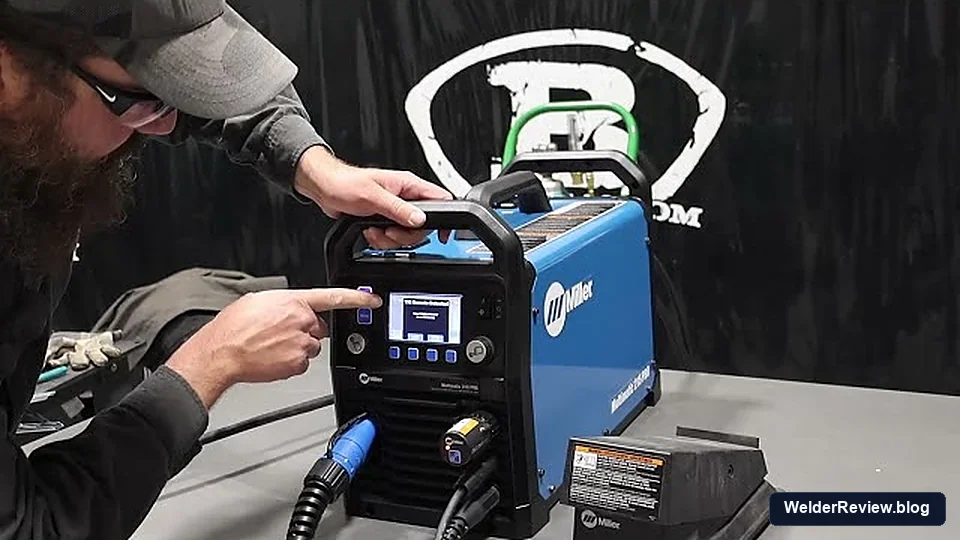
Internal components reflect Miller standard industrial durability guidelines. Both units feature robust wire-drive assemblies designed to minimize bird-nesting and ensure consistent wire feeding during high-demand fabrication sessions.
As explored in our Miller Multimatic 215 review, the machine utilizes a rugged cast-aluminum drive assembly paired with a dual-groove drive roll system, ensuring stable wire feeding across standard solid steel configurations.
Conversely, the Multimatic 220 steps up to a more robust heavy-duty aluminum housing. It features independent digital meters that display precise voltage and amperage parameters simultaneously during active multi-process welding operations.
- Single versus dual cylinder mounting systems
- Overall cabinet dimensions and weight variations
- Internal cooling fan operational duty cycles
Chassis Construction and Layout
The physical layout of the chassis heavily influences daily shop ergonomics. Side A relies on a traditional single-bottle setup that keeps overall weight low for transport tasks.
Side B incorporates a specialized dual-cylinder rack directly into the frame. This allows fabricators to leave two distinct shielding gases hooked up simultaneously without swapping hoses.
- Integrated running gear and wheel placement
- Handle durability during truck loading
Real-World Performance and Arc Quality
Evaluating arc performance requires examining how each machine handles various metals under standard shop conditions. Voltage control and arc stability remain paramount for structural integrity and clean weld beads.
Both power sources deliver exceptional MIG welding stability across mild steel sheets. However, advanced pulse capabilities on the heavier unit provide distinct advantages for non-ferrous applications.
When striking an arc on thin sheet metal, the 215 model delivers predictable puddle wet-out. Its duty cycle is rated at 20 percent at 150 amps, satisfying light-gauge automotive fabrication and hobbyist repair tasks.
Evaluations in our Miller Multimatic 220 AC/DC review confirm that stepping up to this variant yields superior performance on thick aluminum plates using advanced waveform control.
- Amperage output ceilings on dual-voltage power
- Arc start reliability during TIG operations
- Spatter reduction technology integration levels
MIG, TIG, and Stick Capabilities
MIG performance is remarkably crisp on both platforms, utilizing smooth waveform control. Operators switching to stick welding will find reliable arc force stabilization preventing electrode sticking.
TIG welding performance separates the two models clearly. Side B offers superior high-frequency arc starts and enhanced controls tailored for precise aluminum fabrication work.
- Duty cycle ratings at maximum output
- Electrode compatibility for cellulosic rods
Usability, Controls, and Interface Setup
User interfaces dictate how quickly operators can transition between different welding processes. Modern digital displays reduce setup time and help prevent costly parameter configuration errors.
Intuitive menu navigation ensures that even junior fabricators achieve optimal settings quickly. Auto-Set technology streamlines the calibration process by matching material thickness with specific wire diameters.
As noted in our Miller Multimatic 215 with TIG kit review, setup relies on proprietary Auto-Set technology to automatically establish parameters, reducing setup time for novice operators.
The Multimatic 220 expands this capability with a full-color LCD screen. Users navigate through intuitive menus to save custom programs, maximizing operator efficiency during repetitive multi-process production runs in professional fabrication shops.
- Digital screen readability under bright shop lights
- Memory slot storage for custom weld parameters
- Process switching speed via front panel controls
Parameter Selection Technology
Manual overrides allow experienced welders to fine-tune voltage and wire feed speed precisely. The interface responds rapidly to input adjustments without lagging during active arcs.
Advanced software packages store user presets efficiently. This eliminates repetitive dialing when switching between repetitive structural steel joints and custom sheet metal fabrication.
- Preset accuracy for stainless steel joints
- Microprocessor response time adjustments
Power Supply Versatility and Input Wiring
Electrical input flexibility determines where you can deploy these welding machines without tripping breakers. Multi-voltage plugs allow seamless transitions between residential and industrial circuits.
Smart voltage technology automatically senses the incoming power supply. This eliminates manual link-board changes and protects internal circuits from improper voltage drops.
Both machines feature multi-voltage plugs utilizing MVP technology. This allows operators to switch seamlessly between 120V and 240V circuits without tools, ensuring maximum jobsite portability where power availability fluctuates unpredictably.
Under maximum load conditions, the 220 unit draws higher primary amperage on 240V input. Proper breaker sizing and heavy-duty extension cords are mandatory to prevent voltage drop and protect internal inverter components.
- 120V and 240V input plug adaptability
- Current draw limits on standard breakers
- Generator compatibility for remote field repairs
Circuit Protection and Draw
Operating on standard household circuits requires careful attention to amperage limits. Both units manage low-voltage inputs gracefully to maintain arc stability during peak power draws.
Industrial workshops utilizing dedicated 240V lines unlock maximum output potential. This ensures deeper penetration profiles on thick structural steel plates without thermal overload.
- Maximum rated primary input current
- Extension cord gauge recommendations
Maintenance, Efficiency, and Operational Longevity
Preventative maintenance ensures long-term reliability and minimizes unexpected downtime in busy fabrication shops. Routine cleaning of drive rolls and contact tips remains standard procedure for both platforms.
Internal cooling systems utilize dust-reduction technology to protect sensitive electronics. Thermal overload protection automatically halts operation if duty cycle thresholds are accidentally exceeded.
Routine maintenance on these welders requires inspecting the drive rolls and clearing accumulated metallic dust. Cleaning the internal cooling fan prevents thermal overload and extends the lifespan of sensitive electronic circuit boards.
Maintaining proper shielding gas flow rates through calibrated regulators minimizes porosity. Operators should inspect MIG gun liners regularly to ensure smooth wire feeding and prevent erratic arc behavior during extended welding shifts.
- Drive roll replacement intervals and wear
- Solenoid valve cleaning and gas checks
- Printed circuit board conformal coating
Consumable Life and Upkeep
Consumable wear aligns with standard industry expectations for portable multi-process gear. High-quality copper contact tips and durable nozzles reduce replacement frequency during production runs.
Accessing internal wire feed mechanisms requires minimal tooling. Operators can swap drive rolls swiftly when transitioning between solid steel wire and aluminum spool guns.
- Liner replacement procedures and lengths
- Torch head thermal dissipation rates
Ideal Workflows and Tailored Buyer Fit
Matching the correct machine to your specific workflow prevents capital waste and enhances productivity. Assessing daily fabrication tasks highlights which feature set provides the greatest operational advantage.
Consider your workspace limitations and material mix before making a final purchasing decision. Shops focusing on diverse metals benefit greatly from advanced gas management systems.
The Multimatic 215 suits mobile maintenance technicians who primarily execute MIG and DC stick welds. Its lighter chassis enhances ergonomic transport across dynamic job sites requiring frequent equipment repositioning and setup changes.
As detailed in our Miller Multimatic 220 review, the platform targets fabrication shops needing dedicated AC TIG capabilities, satisfying advanced fabricators seeking true multi-process versatility across complex metal assemblies.
- Automotive restoration and sheet metal repair
- Mobile maintenance and structural steel fabrication
- Production assembly line welding environments
Selecting Your Production Tool
Independent contractors valuing mobility will appreciate the lighter weight of the first option. It travels easily between residential service calls and small commercial job sites.
Fixed-location fabrication shops handling frequent material changes will maximize efficiency with the second option. The dual-cylinder architecture eliminates frustrating gas bottle swaps completely.
- Shop floor footprint considerations
- Operator skill level integration
Frequently Asked Questions
Can both welding machines operate on standard household electrical outlets safely?
Yes, both units feature multi-voltage plugs that adapt seamlessly to standard 120V circuits. However, reaching maximum amperage output requires connecting them to a dedicated 240V power source.
Do these multi-process units require external spool guns for aluminum welding?
Yes, running soft aluminum wire smoothly requires adding a compatible spool gun to either machine. Direct push setups generally result in bird-nesting without specialized feed mechanisms.
What is the primary difference in shielding gas management between models?
The primary distinction lies in the physical cylinder capacity and mounting configuration. Side B incorporates a dual-cylinder rack allowing two active gases, whereas Side A supports a single tank.
Are the digital interfaces difficult for novice welders to master quickly?
Not at all, because both machines incorporate intuitive digital displays and automated setup guides. Selecting your material thickness and wire size instantly establishes reliable baseline welding parameters.
Can these power sources handle heavy structural steel fabrication tasks easily?
They excel at light to medium fabrication, maintenance repairs, and automotive sheet metal work. Extremely thick industrial plates exceed their duty cycle limits and require larger three-phase machines.