Mig Welder vs Flux Welder: Technical Comparison
Choosing the right wire-feed process dictates bead integrity and gas shielding. Master these parameters to optimize your fabrication workflow.

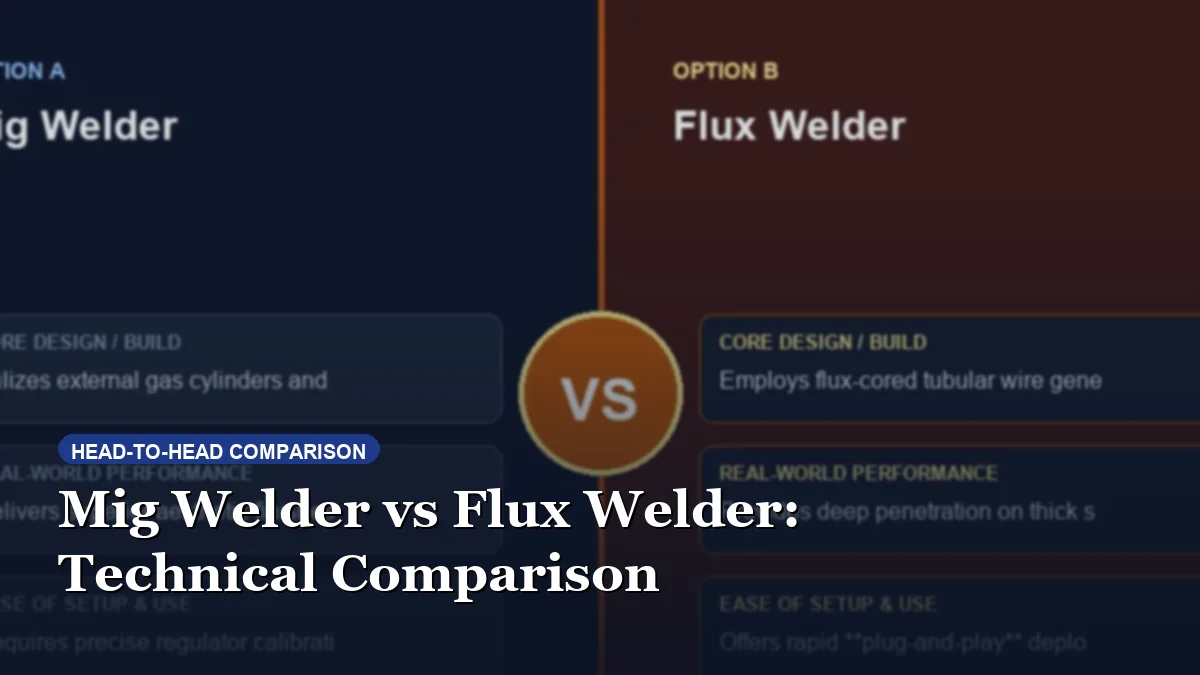
Choose a mig welder for clean, indoor sheet metal work requiring minimal cleanup. Select a flux welder when tackling outdoor repairs where wind disrupts shielding gas.
Compare all top models in our Best Welder: Top Home Shop & Jobsite Picks Tested.
Side-by-Side Breakdown
| Criteria | Mig Welder | Flux Welder | Edge |
|---|---|---|---|
| Core Design / Build | Utilizes external gas cylinders and solid wire for stable arcs. | Employs flux-cored tubular wire generating its own internal gas shield. | Depends on environment |
| Real-World Performance | Delivers superior aesthetic finishes on thin automotive sheet steel. | Provides deep penetration on thick structural steel plates and rust. | Flux Welder |
| Ease of Setup & Use | Requires precise regulator calibration and gas line connections. | Offers rapid plug-and-play deployment without heavy gas cylinders. | Flux Welder |
| Durability & Reliability | Sensitive to wind drafts blowing away exterior shielding gas. | Highly resilient outdoors against adverse weather and heavy drafts. | Flux Welder |
| Efficiency / Operating Footprint | Bulky tank setups reduce portability around the shop floor. | Compact footprint enhances jobsite mobility and tight-space access. | Flux Welder |
| Maintenance Requirements | Minimal slag cleanup but requires regular contact tip inspections. | Requires rigorous slag chipping, wire brush cleanup, and tip clearing. | Mig Welder |
| Best Ideal Use Case | Precision indoor fabrication, body shops, and decorative arts. | Heavy structural field repairs, farm maintenance, and rusty steel. | Depends on project |
Manufacturing Standards and Machine Architecture
Industrial fabrication equipment must adhere to strict National Electrical Manufacturers Association standards. Engineering teams design these power sources to deliver stable arc characteristics under continuous operational loads.
Internal transformer designs dictate duty cycles and thermal overload protection thresholds. Selecting proper internal components ensures long-term reliability across demanding manufacturing environments and heavy fabrication shops.
Modern welding machines must comply with strict NEMA standards and UL safety protocols to ensure operator protection in industrial environments. Internal transformers utilize heavy copper windings to maintain thermal stability during extended fabrication cycles.
When shopping for entry-level fabrication equipment, reviewing options in our best budget mig welder guide helps operators select machines featuring durable drive roll assemblies and reliable internal gear ratios.
- Heavy-duty copper wound transformers improve overall electrical efficiency.
- Robust drive rolls prevent wire deformation during continuous feeding operations.
Power Source Engineering
Inverter-based power sources reduce overall machine weight significantly. This modern architectural shift allows technicians to transport welding units easily between remote field installation sites.
- Digital signal processors regulate voltage fluctuations instantly.
- Advanced cooling fans extend continuous operational duty cycles.
Welding Physics and Shielding Dynamics
Understanding arc physics helps operators select correct shielding methodologies. Gas metal arc welding relies on bottled shielding gas to protect the molten weld pool from atmospheric contamination.
Conversely, flux-cored processes utilize chemical compounds inside the tubular wire. These core ingredients vaporize during combustion to create an effective gaseous shield automatically.
Gas metal arc welding relies on an external shielding gas like argon and carbon dioxide to displace atmospheric nitrogen. This protective envelope prevents weld porosity and ensures smooth droplet transfer across the established electric arc column.
Self-shielded flux-cored wires generate their own gaseous protection via the core flux vaporization inside the arc zone. Slag systems form concurrently over the molten puddle, solidifying rapidly to protect the metal during controlled atmospheric cooling.
- Argon and carbon dioxide blends prevent weld porosity effectively.
- Flux components scavenge oxygen and nitrogen from the molten pool.
Arc Stability Parameters
Voltage stability directly influences spatter levels and bead profile consistency. Maintaining optimal arc length ensures minimal post-weld cleanup across varying material thicknesses.
- Inductance controls puddle fluidity and wet-in characteristics.
- Wire feed speed dictates ultimate amperage output and penetration.
Operational Efficiency and Workflow Integration
Minimizing downtime remains critical for profitable manufacturing operations and fabrication workshops. Equipment that streamlines setup procedures directly impacts daily output metrics and operator fatigue levels.
Integrating wire-feed systems into existing production lines requires evaluating consumable costs and gas management. Balancing these operational factors maximizes overall throughput while controlling recurring consumable expenses.
Selecting equipment like a reliable 110v mig welder streamlines smaller fabrication tasks. Minimizing post-weld cleanup directly impacts shop floor profitability by allowing operators to apply coatings immediately after completing the inter-pass cleaning phase.
Flux-cored operations involve frequent chipping hammer use and wire brush detailing between passes. However, eliminating heavy gas cylinders dramatically improves mobility within cramped industrial spaces, reducing setup downtime during rapid site changes.
- Quick-release drive mechanisms speed up wire spool changes.
- Optimized torch ergonomics reduce wrist strain during long shifts.
Consumable Lifecycle Management
Contact tips and nozzles wear down rapidly under high amperage conditions. Implementing routine inspection schedules prevents unexpected burnbacks and costly production line stoppages.
- Copper contact tips dissipate heat efficiently during extended runs.
- Anti-spatter gels prolong nozzle life in high-duty environments.
Outdoor Performance and Environmental Adaptability
Field repairs often expose welding operations to severe environmental challenges like wind and rain. Standard gas-shielded processes struggle outdoors because wind currents easily disperse shielding gas layers.
Flux-cored wires excel in outdoor conditions because the internal shielding mechanism operates independently of ambient air movement. This fundamental difference makes self-shielding systems indispensable for construction crews.
Field fabrication exposes welding zones to wind currents disrupting gas shielding. While options in our mig welder for home use roundup suit indoor shops, field tasks require protective windbreaks around the immediate weld joint.
Flux-cored wires excel in outdoor environments because their internal shielding compounds remain unaffected by moderate crosswinds. This inherent adaptability makes self-shielded processes indispensable for structural erection and heavy pipeline maintenance projects.
- Wind speeds exceeding five miles per hour disrupt gas shielding.
- Self-shielded wires penetrate thick, oxidized steel plates reliably.
Weather Resistance Strategies
Moisture on base metals causes severe hydrogen cracking in structural welds. Technicians must preheat damp materials thoroughly before initiating any heavy structural repair work.
- Propane torches remove surface moisture before arc ignition.
- Enclosed portable welding tents protect operators from rain.
Advanced Controls and Automation Features
Modern welding machines incorporate digital microprocessors to assist less experienced operators. These advanced control systems automatically match wire feed speed to preselected voltage settings.
Synergic control panels reduce human error and guarantee consistent weld parameters across repetitive tasks. Such automation features enhance overall shop productivity and reduce scrap rates.
Modern inverter power sources integrate synergic control loops that automatically adjust wire feed speed relative to voltage changes. This microprocessor regulation helps operators maintain a stable arc length despite minor gun distance variations.
Programmable inductance settings allow precise tuning of the arc puddle fluidity during short-circuit transfer modes. Welders can modify pinch dynamics to minimize spatter generation when joining thin carbon steel sheet assemblies.
- Digital displays show precise voltage and amperage readouts.
- Memory presets store ideal settings for various joint configurations.
Parameter Optimization
Fine-tuning arc dynamics allows operators to minimize excessive spatter generation. Precise electronic regulation ensures smooth metal transfer across short-circuit and spray transfer modes.
- Voltage trim adjustments customize the arc harshness profile.
- Burnback controls prevent wire sticking inside contact tips.
Maintenance Protocols and Equipment Longevity
Routine preventative maintenance guarantees long equipment lifespans and consistent electrical performance. Technicians should regularly inspect internal circuitry, drive rolls, and liner assemblies for wear.
Accumulated metal dust inside the chassis can cause electrical shorts or component overheating. Establishing a scheduled cleaning protocol protects your investment against premature equipment failure.
Routine maintenance ensures consistent wire feeding and prevents premature wear on critical gun consumables. Technicians must inspect contact tips, gas diffusers, and liner integrity regularly to avoid excessive electrical resistance and erratic arc performance.
Flux-cored welding deposits heavy metallic dust and residual flux inside the torch neck and drive cabinet. Compressed air blowouts and periodic liner replacement are vital for maintaining optimal electrical continuity throughout long operational shifts.
- Compressed air clears conductive dust from internal transformers.
- Drive roll grooves must match the specific wire diameter.
Torch and Liner Upkeep
Worn gun liners cause erratic wire feeding and frustrating birdnesting issues. Replacing steel or Teflon liners periodically restores smooth wire delivery to the contact tip.
- Regularly blow out welding liners with filtered compressed air.
- Inspect power pins for secure connections and heat damage.
Industry Applications and Project Deployment
Selecting the correct welding process depends heavily on your specific industry sector. Automotive restoration shops prioritize clean, low-distortion joints achievable through gas-shielded wire systems.
Conversely, heavy civil construction and agricultural repair operations rely on self-shielded wires. These robust applications demand deep penetration and resilience against rust and mill scale.
Automotive manufacturing relies on advanced machines, much like the units analyzed in our hobart 190 mig welder review, to join lightweight aluminum body frames while meeting rigorous structural integrity benchmarks demanded by engineers.
Heavy civil construction projects utilize self-shielded flux-cored wires for joining thick structural steel beams on high-rise buildings. The deep penetration profiles handle thick plate geometries effectively under extreme load conditions.
- Sheet metal fabrication requires precise heat control to prevent warping.
- Structural steel erection demands high tensile strength weld deposits.
Jobsite Deployment Factors
Portability requirements often dictate whether bottled gas is practical. Remote installation sites favor self-shielded setups to eliminate heavy gas cylinder logistics.
- Compact multi-process units handle diverse fabrication demands.
- Generator power compatibility ensures reliable remote operation.
Frequently Asked Questions
Can a mig welder be used outdoors without a wind screen?
Operating a mig welder outdoors without wind protection causes severe porosity. Strong air currents blow away the shielding gas envelope, exposing the molten weld puddle.
Why does flux cored welding produce heavy slag?
Flux cored wires contain chemical compounds designed to shield the arc. These compounds solidify into a protective slag layer that requires manual chipping after welding.
Is flux core wire more expensive than solid wire?
Specialized tubular flux core wires generally cost more per pound than standard solid wires. However, eliminating shielding gas cylinder rentals often offsets this consumable expense.
Can you weld aluminum using a flux cored process?
Welding aluminum with standard flux cored wire is not practical or effective. Aluminum fabrication requires specialized spool guns and pure argon shielding gas environments.
What is the primary advantage of dual shield welding?
Dual shield processes combine flux cored wire with external shielding gas. This method delivers exceptionally high deposition rates and deep structural penetration.