Lincoln Power Mig 210 Mp vs Esab Rebel 215Ic: Verdict
Choosing between these multi-process welding titans requires careful technical analysis. We evaluate their engineering specs to guide your ultimate workshop purchase decision.

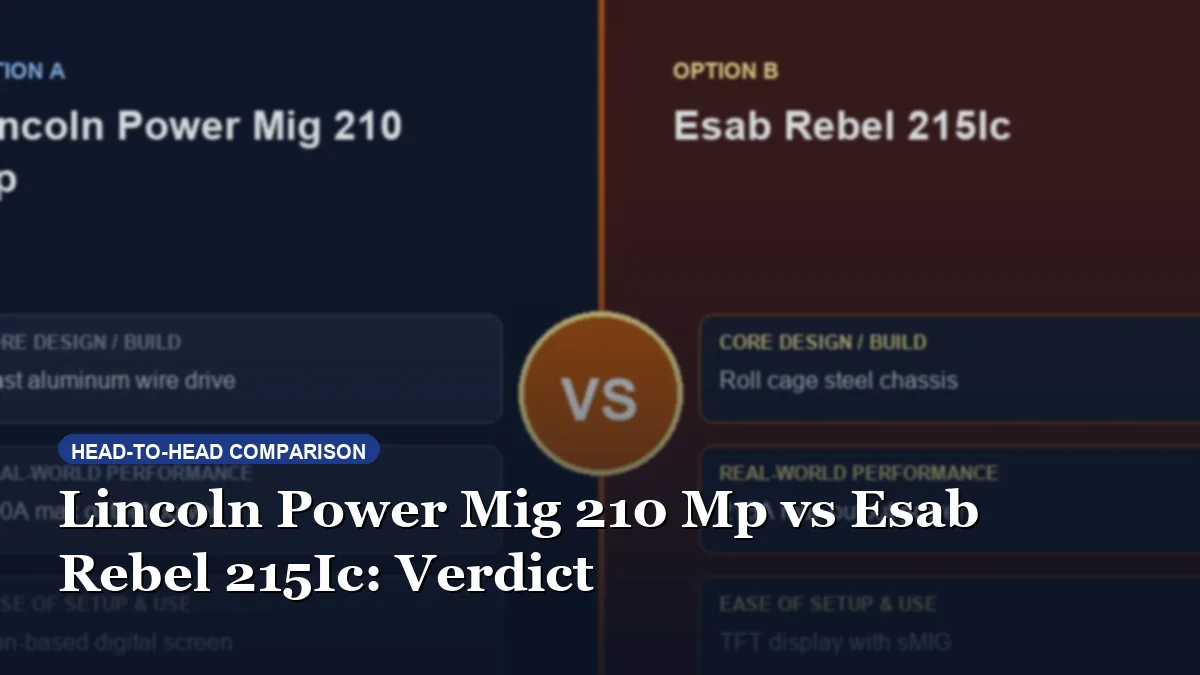
Choose the Lincoln 210 MP for intuitive dual-voltage shop work and proven reliability. Select the ESAB Rebel 215ic for advanced sMIG technology and maximum multi-process flexibility.
Compare all top models in our Best Welder: Top Home Shop & Jobsite Picks Tested.
Side-by-Side Breakdown
| Criteria | Lincoln Power Mig 210 Mp | Esab Rebel 215Ic | Edge |
|---|---|---|---|
| Core Design / Build | Cast aluminum wire drive | Roll cage steel chassis | Esab Rebel 215Ic |
| Real-World Performance | 210A max output power | 215A max output power | Tie |
| Ease of Setup & Use | Icon-based digital screen | TFT display with sMIG | Esab Rebel 215Ic |
| Durability & Reliability | Industrial heritage backing | Rugged jobsite armor | Lincoln Power Mig 210 Mp |
| Efficiency / Operating Footprint | Compact dual-voltage body | Slightly heavier multi-handle | Lincoln Power Mig 210 Mp |
| Maintenance Requirements | Standard drive roll service | Modular internal board checks | Tie |
| Best Ideal Use Case | General fabrication shops | Mobile construction sites | Esab Rebel 215Ic |
Core Architecture and Design Philosophy
Engineering heavy-duty multi-process welders demands an uncompromising balance between internal component protection and user accessibility. Both machines adopt distinct structural frameworks designed to withstand harsh shop environments while maintaining precise electrical output.
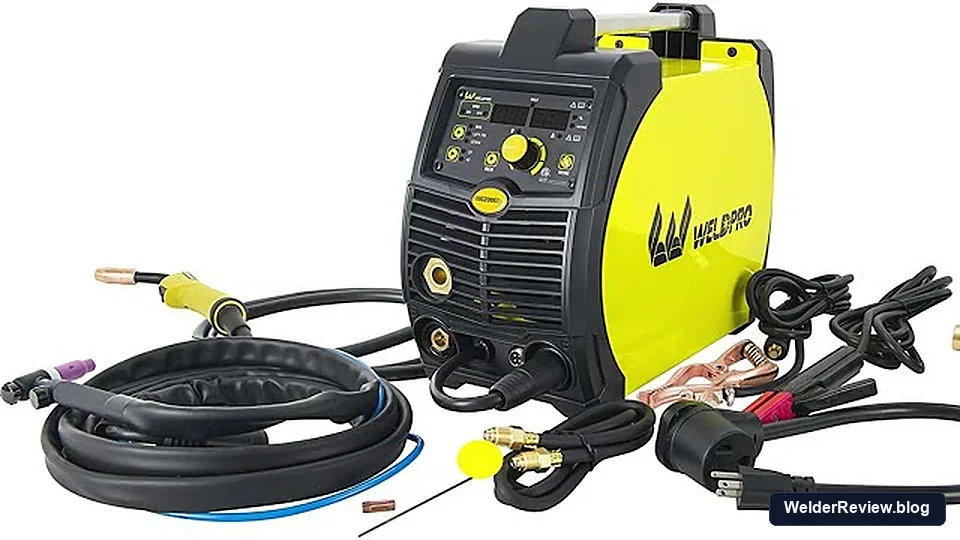
The Lincoln unit emphasizes a streamlined polymer and metal hybrid housing that reduces overall weight. Meanwhile, the ESAB contender relies on a multi-handle steel roll cage built specifically to absorb severe jobsite impacts.
As detailed in our Lincoln Electric Power MIG 210 MP review, this machine utilizes a durable aluminum-frame chassis structure. Meanwhile, the ESAB Rebel 215ic features a rolled-steel cage construction that absorbs harsh jobsite impacts effortlessly.
Both units prioritize internal component cooling through isolated airflow channels. This engineering prevents conductive metal dust from reaching sensitive printed circuit boards during aggressive structural fabrication tasks inside dusty automotive workshops.
- Lincoln utilizes a traditional enclosed cabinet architecture for maximum dust protection.
- ESAB integrates an external steel roll cage with multiple grab points for rigging.
- Both systems support dual-voltage inputs for maximum jobsite versatility.
Chassis Construction and Housing Materials
Heavy fabrication demands robust housing materials that prevent internal transformer distortion during transport. The Lincoln chassis incorporates stamped steel panels reinforced with internal structural bulkheads for stability.
ESAB utilizes a heavy-gauge steel skeleton combined with composite impact corners. This layout absorbs kinetic energy efficiently during accidental drops on concrete floors.
- Stamped steel internal bulkheads reduce frame flex under tension.
- Composite corner bumpers protect vulnerable electronic displays from impacts.
Power Delivery and Multi-Process Capabilities
Delivering consistent arc performance across MIG, TIG, and Stick welding processes requires sophisticated inverter technology. Both machines feature advanced power sources capable of handling fluctuating input voltages without dropping arc stability.
The Lincoln model provides a maximum output of 210 amperes, making it exceptionally well-suited for light structural fabrication. As noted in our ESAB Rebel EMP 215ic review, that competitor counters with 215 amperes and specialized software algorithms.
Operating via dual-voltage inputs, the Lincoln machine manages 120V and 230V lines smoothly. Its multi-process framework seamlessly transitions between MIG, TIG, and Stick welding modes without requiring internal hardware swaps or tool adjustments.
The ESAB competitor counters with smart-MIG technology that adapts quickly to user technique. It delivers robust arc initiation across varied plate thicknesses while maintaining strict compliance with primary electrical safety standards.
- Both welders operate smoothly on standard household and industrial circuits.
- Inverter architecture drastically reduces transformer weight compared to older units.
- Duty cycles remain balanced for standard maintenance and repair tasks.
Inverter Efficiency and Output Tolerances
Modern inverter topologies allow these systems to maximize electrical conversion efficiency. This ensures minimal power loss even when running long extension cords across large industrial job sites.
Thermal overload protection circuits actively monitor internal component temperatures. If limits are approached, the system gracefully reduces output rather than experiencing sudden catastrophic failures.
- High power factor correction minimizes reactive current draw.
- Advanced thermal sensors protect vital semiconductor junctions.
Interface Engineering and Setup Ergonomics
User interface design dictates how quickly operators can dial in optimal parameters. As evaluated in our Lincoln Power MIG 260 review, Lincoln implements a straightforward digital screen paired with traditional push-and-turn control dials.
ESAB introduces a vibrant TFT display utilizing smart MIG technology that continuously learns user techniques. This proprietary software automatically adapts arc characteristics based on actual weld pool feedback.
Lincoln relies on a crisp, color graphical display paired with traditional push-and-turn control dials. This layout ensures gloved operators can adjust wire feed speed and voltage parameters swiftly without removing heavy protective gear.
ESAB employs an oversized TFT screen featuring intuitive digital menus. Advanced parameters like pre-flow and burnback are easily configured using the central control knob during precision fabrication setups.
- Lincoln interface prioritizes manual fine-tuning for experienced fabricators.
- ESAB smart MIG reduces setup time for novice operators significantly.
- Both screens remain legible under direct sunlight conditions.
Digital Display Usability and Control Layouts
Navigating complex sub-menus should never slow down production workflows in busy metal fabrication shops. The Lincoln layout uses dedicated buttons for quick process switching without deep menu digging.
The ESAB display leverages graphical icons that clearly indicate selected shielding gases and wire diameters. Operators appreciate the intuitive nature of these modern digital control architectures.
- Dedicated process buttons prevent accidental parameter misconfigurations.
- Graphical icons simplify gas and wire selection steps.
Arc Stability and Real-World Welding Performance
Arc quality ultimately defines the mechanical integrity and aesthetic appeal of finished weld joints. When running short-circuit MIG on thin sheet metal, both machines produce minimal spatter and clean profiles.
Stick welding performance reveals distinct differences in arc force control and digging characteristics. The ESAB unit maintains a remarkably stable arc during low-amp cellulosic electrode manipulation.
During rigorous fillet weld evaluations, the Lincoln machine demonstrates exceptional puddle control. Its precise waveform tuning minimizes spatter when joining thin-gauge sheet metal using standard shielding gas mixtures.
The ESAB unit excels in short-circuit stability, adapting instantly to erratic arc lengths. This dynamic response produces remarkably flat bead profiles on structural steel plates under demanding field conditions.
- MIG arc puddle wet-in is exceptional on carbon steel plates.
- TIG processes require external gas solenoids or valved torches.
- Stick arc force automatically adjusts to prevent electrode sticking.
MIG, TIG, and Stick Operational Breakdown
Evaluating each welding process uncovers distinct operational nuances for professional fabricators. MIG performance is stellar on both platforms, utilizing precise wire feed speed tracking loops.
As highlighted throughout our Lincoln Power MIG 260 review, scratch-start TIG performance on the Lincoln machine feels remarkably crisp and responsive. Meanwhile, the ESAB platform offers polished Lift-TIG arc initiation parameters.
- Precise wire feed loops eliminate stutter during rapid gun movement.
- Lift-TIG initiation prevents tungsten contamination effectively.
Portability and Workshop Footprint Analysis
Mobile fabrication technicians require equipment that loads easily into service truck beds without straining operators. The Lincoln model boasts a lighter total mass and a balanced top carry handle.
While the ESAB variant carries slightly more weight due to its protective exoskeleton, its multiple handles facilitate team lifting. Both machines easily fit beneath standard shop workbenches.
Weighing under forty pounds, the Lincoln 210 MP lifts easily into service trucks. Its balanced handle design distributes total weight evenly, reducing operator strain during frequent transport between remote job sites.
The Rebel incorporates a four-handle multi-point layout that simplifies two-person carrying across cluttered shop floors. Its slightly larger footprint accommodates heavy-duty internal components without sacrificing overall mobile utility.
- Lighter overall weight reduces fatigue during frequent loading cycles.
- Multiple grab handles improve team lifting safety on busy jobsites.
- Compact footprints preserve valuable floor space in cramped mobile units.
Weight Distribution and Transportation Safety
Transporting welding gear safely across uneven terrain requires careful attention to center of gravity. The Lincoln design positions heavy internal transformers centrally to prevent tipping.
ESAB wraps its heavy components inside a wide stance steel cage that maximizes stability. This prevents accidental tipping when rolling carts across gravel work sites.
- Centralized internal weights prevent accidental unit tipping.
- Wide stance roll cages protect exterior connection ports.
Maintenance Protocols and Component Longevity
Routine maintenance keeps multi-process machines operating reliably through years of demanding fabrication schedules. Accessing drive rolls and internal wire compartments requires no specialized tools on either system.
Keeping cooling fins free of metal dust ensures optimal semiconductor lifespan in dirty environments. Regular inspection of electrical terminals prevents resistive heating and premature board degradation.
Routine servicing requires regular compressed air purging of the internal wire drive compartment. Keeping the brass drive rolls clean prevents feeding slippage and ensures consistent wire delivery rates.
Operators should inspect electrical terminal connections annually for signs of thermal degradation. Replacing worn contact tips and gas diffusers promptly protects the welding torch liner against premature burnout.
- Toolless drive roll removal speeds up wire size changeovers.
- Sealed cooling fan designs minimize conductive dust ingestion.
- Durable brass internal fittings resist corrosion in humid shops.
Consumable Wear and Serviceability Standards
Gun liners, contact tips, and drive rolls represent ongoing consumable operational expenses. Both manufacturers utilize widely available industry-standard consumables to simplify local parts sourcing.
Internal circuit boards feature conformal coatings to resist moisture and conductive grinding dust. This protective layer significantly extends electronic longevity in harsh industrial workshops.
- Industry-standard gun consumables simplify local parts replacement.
- Conformal circuit board coatings prevent conductive dust failures.
Ideal Applications and Operator Buyer Fit
Selecting the correct welding machine ultimately depends on your specific daily fabrication tasks. General repair shops working with varied materials will appreciate the straightforward reliability of Lincoln.
Mobile contractors and production facilities needing advanced adaptive arc controls will lean toward ESAB. Matching machine capabilities to your exact workload ensures maximum return on investment.
Professional fabricators seeking dependable performance for general maintenance tasks will appreciate the Lincoln platform. Its straightforward interface suits traditional mechanics who value proven reliability over complex digital automation.
Conversely, mobile contractors tackling varied alloy fabrication choose the ESAB model for its adaptive software. This system delivers exceptional versatility for technicians executing complex repairs across diverse industrial sectors.
- General maintenance shops benefit from intuitive traditional controls.
- Mobile installation crews leverage rugged roll cage protection.
- Production facilities utilize advanced adaptive software packages.
Matching Machine Specs to Professional Workflows
Analyzing your typical material thicknesses and joint configurations clarifies the final purchasing decision. Heavy sheet metal work and structural repairs fall comfortably within both machines' capabilities.
Consider your crew's familiarity with digital interfaces versus traditional knobs before finalizing your selection. Both units represent top-tier engineering in the portable multi-process category.
- Verify maximum material thickness requirements before purchasing.
- Assess operator preference for digital versus analog controls.
Frequently Asked Questions
Can both welders run efficiently on standard household current?
Yes, both machines feature dual-voltage technology that automatically adjusts to 115V or 230V inputs. This allows operators to plug into standard outlets for light work or industrial circuits for maximum welding amperage output.
Which machine is better suited for mobile jobsite fabrication?
The ESAB Rebel 215ic excels in harsh environments thanks to its integrated steel roll cage. However, the Lincoln unit offers a lighter overall weight for easier daily loading into service trucks.
Do these systems include high-frequency TIG arc starting?
Neither machine includes high-frequency start capabilities for TIG welding operations. Both units rely instead on reliable scratch-start or Lift-TIG ignition methods to establish clean tungsten arcs.
How does the smart MIG feature function on the ESAB model?
The proprietary sMIG technology continuously learns your unique welding technique and adjusts arc parameters automatically. This intelligent system drastically reduces setup time and ensures consistent bead profile quality.
Are consumable parts easily accessible for routine maintenance?
Both manufacturers utilize standard industry gun components and drive roll mechanisms. You can easily source replacement contact tips, liners, and nozzles at almost any local welding supply distributor.