Laser Welding vs Tig Welding: Professional Comparison
Choosing between modern optical fusion and classical tungsten arc processes requires careful evaluation of production speed, joint metallurgy, equipment expense, and operational complexity.

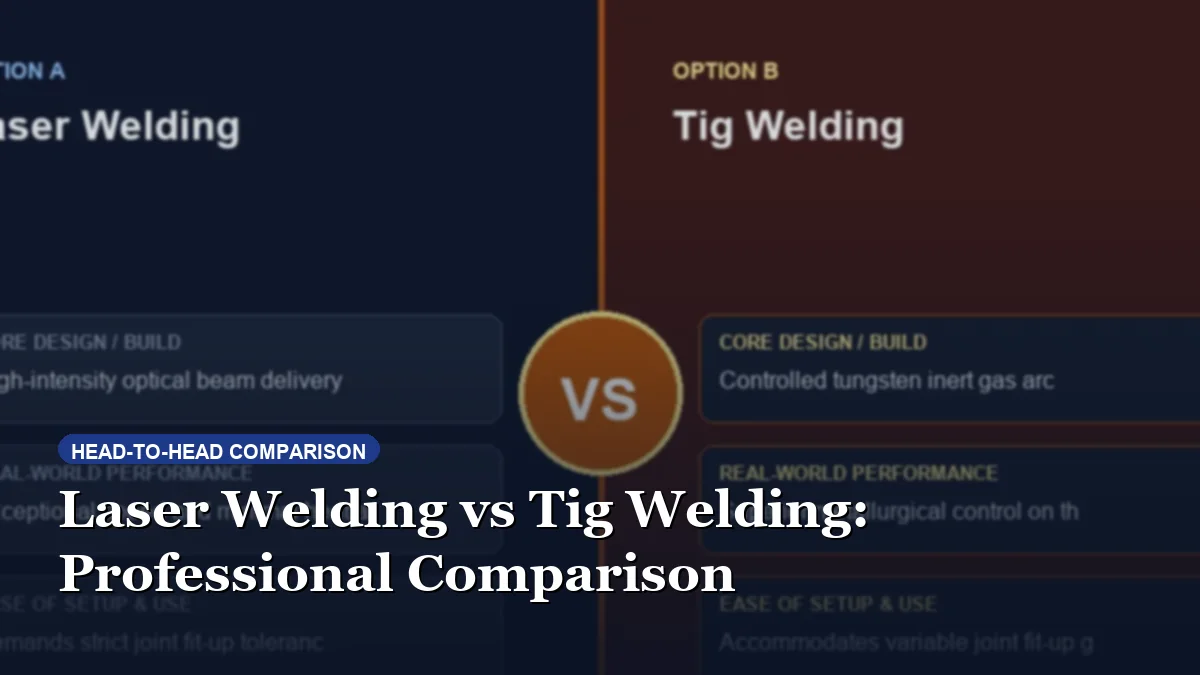
Choose laser welding for high-throughput automated sheet metal production requiring minimal distortion. Select TIG welding for versatile structural fabrication, thicker materials, and complex field repairs requiring deep penetration.
Compare all top models in our Best Welder: Top Home Shop & Jobsite Picks Tested.
Side-by-Side Breakdown
| Criteria | Laser Welding | Tig Welding | Edge |
|---|---|---|---|
| Core Design / Build | High-intensity optical beam delivery | Controlled tungsten inert gas arc | Laser Welding |
| Real-World Performance | Exceptional speed and minimal heat affected zone | Superior metallurgical control on thick sections | TIG Welding |
| Ease of Setup & Use | Demands strict joint fit-up tolerances | Accommodates variable joint fit-up gaps | TIG Welding |
| Durability & Reliability | Solid-state fiber generators require clean rooms | Robust transformers endure harsh shop floors | TIG Welding |
| Efficiency / Operating Footprint | High electrical-to-optical conversion efficiency | Lower initial power draw with traditional setups | Laser Welding |
| Maintenance Requirements | Regular optics cleaning and chiller upkeep | Frequent tungsten grinding and torch parts swap | Laser Welding |
| Best Ideal Use Case | Automated high-speed thin gauge production | Manual aerospace and custom fabrication work | TIG Welding |
Core Design and Engineering Principles
Industrial manufacturing relies heavily on distinct thermal energy sources to fuse metals securely. Laser systems concentrate intense photons into a microscopic spot, vaporizing metal instantly to create deep keyhole welds.
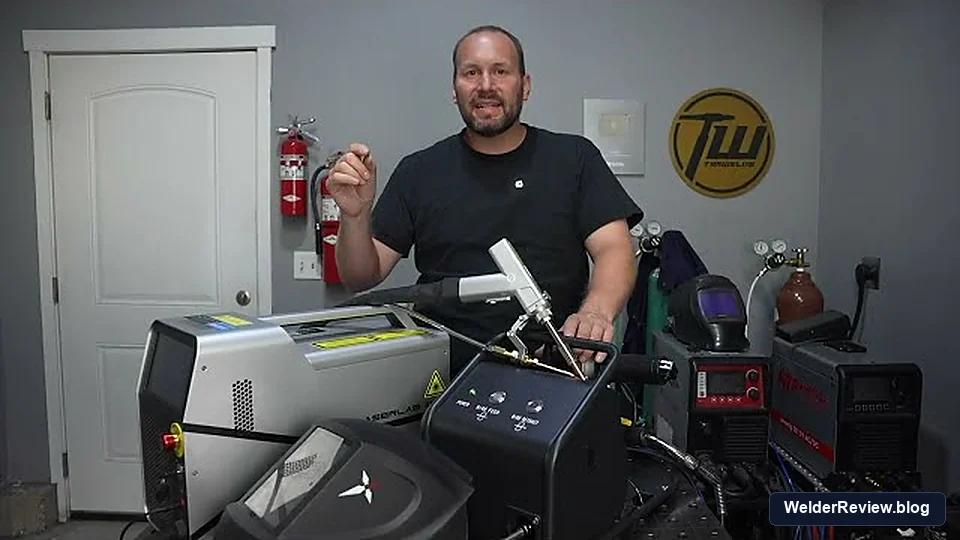
Conversely, traditional tungsten inert gas technology establishes an electric arc between a non-consumable electrode and the workpiece. This classic method melts the base material steadily while shielding the molten pool with inert gas.
Engineering teams must analyze these fundamental physics differences before integrating new machinery. Each thermal delivery mechanism alters grain structures and demands specific electrical infrastructure within the fabrication facility layout.
Fiber lasers focus monochromatic coherent light through optics, while TIG setups require precise preparation using our guide on tungsten sharpening to maintain a stable arc.
Laser systems demand strict focal point alignment and precise joint fit-up due to the narrow beam width, whereas TIG offers wider bridging capabilities for uneven manual gaps.
Thermal conduction mechanics differ vastly between processes, with lasers producing minimal heat-affected zones while traditional TIG introduces broader thermal inputs that alter surrounding grain structures.
- Photon concentration drives extreme localized energy density.
- Electric arcs rely on stable plasma columns for heat transfer.
- Inert shielding gases protect reactive molten pools from oxidation.
Optical Physics versus Tungsten Arcs
Advanced fiber optics direct coherent light beams with remarkable precision across the workpiece. This optical delivery minimizes wasted thermal energy and focuses power exactly where joint fusion is necessary.
Traditional arc systems radiate heat outward from the tungsten tip, producing a wider thermal footprint. Operators manipulate this broader arc cone manually to bridge minor gaps in imperfectly fitted joints.
- Coherent light delivers exceptional power density.
- Tungsten arcs offer intuitive visual feedback during manipulation.
Real-World Joint Performance and Metallurgy
Evaluating joint integrity under mechanical stress reveals significant behavioral differences between these two welding methodologies. Laser fusion produces narrow, deep welds with exceptional tensile strength in controlled environments.
TIG joints provide superior ductility and fracture toughness when handling complex alloy compositions. The slower cooling cycle associated with electric arcs allows entrapped gases to escape before complete solidification occurs.
Metallurgical analysis consistently demonstrates that beam-based processes reduce grain growth risks. However, traditional arc welding remains the preferred choice for thick structural plates requiring maximum impact resistance.
High cooling rates in laser welds often yield increased tensile strength but can induce brittleness in high-carbon steels without appropriate post-weld heat treatment protocols.
TIG joints experience slower cooling cycles, promoting better ductility and toughness while requiring proper shielding gas coverage using our top cup picks for aluminum.
Microfissuring risks increase under rapid laser solidification, requiring exact filler wire chemistry matching to preserve the long-term fatigue resistance of the finished assembly.
- Narrow fusion zones minimize total heat input.
- Slower cooling rates enhance metallurgical homogeneity in heavy plates.
- Alloy-specific filler metals adjust final weld chemistry effectively.
Heat Affected Zones and Distortion Control
Rapid thermal cycling from concentrated photon beams drastically limits surrounding material distortion. Thin sheet assemblies require virtually no straightening operations after laser processing finishes completely.
Broad thermal inputs from electric arcs introduce substantial residual stresses into welded assemblies. Fabricators frequently utilize clamping jigs and pre-bending techniques to counteract inevitable angular distortion.
- Minimal heat affected zones prevent thermal warping.
- Controlled cooling fixtures mitigate severe structural distortion risks.
Setup, Usability, and Operator Ergonomics
Production floor integration requires evaluating operator skill prerequisites and daily ergonomic factors. Beam delivery systems often incorporate automated motion controllers, reducing manual dexterity demands during routine manufacturing runs.
Manual tungsten arc procedures demand exceptional hand-eye coordination and steady physical posture. Welders must manipulate the torch, filler rod, and foot pedal simultaneously while observing the molten puddle closely.
Safety equipment requirements also diverge sharply between manufacturing processes, often starting with reliable power sources evaluated in our Miller Diversion review for workshop environments.
Handheld laser welding guns incorporate heavy optical cables and safety interlocks, requiring operators to master steady travel speeds to prevent surface undercut defects.
Traditional TIG torches demand precise manual dexterity, balancing torch angle, arc length, and filler rod feeding simultaneously within tight spatial assembly constraints.
Laser enclosures require Class 4 laser safety curtains and protective eyewear, whereas TIG operations necessitate standard shade filters and adequate shop ventilation systems.
- Automated gantries streamline repetitive production workflows.
- Manual arc control requires years of specialized training.
- Enclosed laser cells protect personnel from harmful radiation.
Skill Demands and Safety Protocols
Programming optical CNC paths demands software proficiency rather than traditional manual dexterity. Maintenance technicians must understand beam alignment protocols and safety interlock circuits thoroughly.
Mastering arc manipulation relies heavily on muscle memory and visual weld pool interpretation. Strict ventilation measures are mandatory to remove ozone and metal fumes generated during arc processes.
- CNC programming replaces manual torch manipulation skills.
- Exhaust ventilation protects workers from hazardous fumes.
Efficiency, Shielding Gas, and Consumables
Operating expenditures depend heavily on electrical consumption rates and consumable replacement frequencies. Fiber laser units achieve remarkable electrical conversion efficiencies, lowering long-term utility expenses significantly.
Traditional power sources consume substantial electrical current while generating arc plasma across the tungsten gap. Furthermore, ongoing expenses include regular purchases of tungsten electrodes, gas cups, and collet bodies.
Shielding gas utilization also varies based on the specific thermal delivery method chosen. High-speed optical applications require precise gas delivery nozzles to prevent oxidation without creating turbulence.
Laser systems consume high electrical power during operation but deliver exceptional travel speeds that drastically reduce total labor hours per manufactured production unit.
Shielding gas selection for lasers typically involves pure argon to prevent plasma suppression, while TIG mixtures often incorporate helium blends for increased penetration.
Consumable costs diverge sharply since lasers require periodic protective window replacements, whereas TIG operations rely on constant tungsten electrode grinding and ceramic cup changes.
- High electrical efficiency reduces facility power demands.
- Consumable torch parts require frequent scheduled replacements.
- Inert gases protect hot metal from atmospheric contamination.
Operational Costs and Power Consumption
Initial capital investment for beam generators remains considerably higher than standard inverter power sources. However, reduced labor hours and higher throughput offset equipment acquisition costs over time.
Traditional arc equipment involves modest upfront capital expenses paired with higher ongoing consumable overhead. Shops must balance initial equipment budgets against long-term production volume projections.
- Capital expenditures favor traditional arc welding machines.
- High production volumes justify expensive optical generator investments.
Maintenance Routines and Equipment Longevity
Maximizing equipment uptime requires adherence to rigorous preventive maintenance schedules tailored to each technology. Optical components demand pristine environments to prevent catastrophic laser damage from microscopic dust particles.
Torch maintenance in traditional setups involves routine tungsten grinding and nozzle cleaning. Technicians simply replace inexpensive consumable components when arc instability or contamination signs appear.
Chiller systems require regular coolant flushes to maintain stable operating temperatures in both setups. Neglecting thermal management leads directly to premature diode degradation or power source thermal faults.
Preventive maintenance for fiber lasers involves checking chiller water purity levels and inspecting optical delivery fibers for microscopic dust or particulate contamination.
TIG welder upkeep focuses primarily on cleaning internal contactors, clearing dust from cooling fans, and maintaining gas torch collets for stable electrical conductivity.
Regular calibration of power sources ensures consistent output, preventing premature diode degradation in lasers and erratic arc initiation during high-frequency TIG starts.
- Cleanroom standards protect sensitive delivery optics.
- Routine torch servicing restores stable arc characteristics.
- Coolant maintenance prevents catastrophic thermal overload events.
Optical Care versus Torch Maintenance
Protective cover slides on optical heads require frequent inspection and cleaning routines. Technicians use specialized solvents to remove spatter before it burns into expensive quartz lenses.
Tungsten electrodes demand precise tip geometry maintenance to ensure consistent arc initiation. Operators use dedicated diamond wheel grinders to shape tungsten points without contaminating the material.
- Protective lenses prevent permanent optical damage.
- Diamond grinders shape tungsten electrodes for stable arcs.
Material Thickness and Joint Geometry Limits
Physical workpiece dimensions dictate which thermal process delivers optimal structural results. High-power optical beams excel at penetrating thin to medium gauge sheets with minimal angular distortion.
Thicker structural plates and multi-pass groove joints favor traditional arc welding methods. Welders can easily feed filler wire into wide joint preparations to build up robust reinforcement profiles.
Joint fit-up tolerances represent another critical limitation during production engineering reviews. Beam processes demand tight component mating surfaces, whereas arc methods easily bridge minor assembly gaps.
Deep penetration keyhole laser welding excels on thin to medium sheets, successfully joining materials up to half an inch thick in single passes.
TIG welding handles unlimited maximum thicknesses through multi-pass preparations, though production times increase requiring top-rated AC/DC tig machines to manage heavy structural fabrication workloads.
Complex joint geometries with varying fit tolerances favor TIG flexibility, while automated laser cells demand strict part consistency to maintain reliable seam tracking.
- Thin sheet assemblies benefit from high power density.
- Heavy plate structures require multi-pass arc filling.
- Tight fit-up tolerances are mandatory for optical fusion.
Access Constraints and Fit-Up Tolerances
Optical delivery heads require clear line-of-sight access to the target joint interface. Complex internal geometries can restrict physical maneuverability of rigid focusing optics.
Manual torches offer superior access inside tight structural nodes and pipe intersections. Welders adjust torch angles dynamically to navigate restricted spatial clearance constraints successfully.
- Line-of-sight requirements restrict optical head positioning.
- Manual torches navigate complex structural clearance limits.
Selecting the Right Process for Your Shop
Choosing the ideal manufacturing technology requires aligning equipment capabilities with specific business goals. Automated optical systems suit high-volume sheet metal fabrication facilities seeking maximum speed.
Job shops handling varied repair work and custom structural assemblies benefit from versatile arc equipment. The flexibility to switch materials and handle poor fit-ups justifies traditional machine selection.
Facility managers must evaluate throughput targets, available floor space, and operator skill levels carefully. Making an informed decision ensures optimal productivity and long-term operational profitability.
High-volume manufacturing plants benefit immensely from laser automation, achieving rapid ROI through minimized post-processing and exceptional parts per hour metrics.
Custom fabrication and repair shops find TIG welding more adaptable due to lower capital entry costs and superior handling of miscellaneous alloy repairs.
Evaluating your shop volume, joint tolerances, and available safety infrastructure will ultimately determine whether laser speed or TIG versatility best serves production.
- High-volume plants maximize output with automated optics.
- Custom job shops rely on versatile arc equipment.
- Skill availability dictates technology adoption feasibility.
Production Volume and Application Matching
Mass production environments amortize high equipment acquisition costs through relentless daily output. Automated optical cells eliminate bottlenecks associated with manual welding speeds.
Low-volume specialized manufacturing thrives on adaptable tools that handle diverse project demands. Traditional arc systems provide the versatility required for unpredictable custom fabrication schedules.
- Mass production favors automated optical efficiency.
- Custom fabrication demands adaptable arc equipment versatility.
Frequently Asked Questions
Can laser systems weld thick structural steel plates?
High-power generators handle thick sections effectively, but multi-pass arc welding remains standard for heavy construction projects due to lower capital expenses and forgiving joint tolerances.
Why is joint fit-up critical for optical beam welding?
Concentrated photon beams require precise alignment because microscopic gaps let energy pass right through without fusing the abutting metal edges together properly.
Does optical fusion eliminate the need for filler wire?
Many butt joints fuse successfully without filler metal, but automated wire feeders are often integrated to fill gaps and reinforce structural connections.
Which process creates a smaller heat affected zone?
Coherent light delivery produces an exceptionally narrow thermal footprint, making laser welding ideal for preventing workpiece distortion on thin sheets.
Is specialized training required to operate optical welding cells?
Operators must learn software programming and safety protocols, whereas traditional arc welding demands extensive hands-on manual dexterity practice.