Laser Welder vs MIG: Definitive Technical Comparison
Choosing between advanced optical energy and consumable wire welding transforms your fabrication workflow. Understanding the core physics and operational overhead ensures optimal structural integrity across demanding industrial environments.

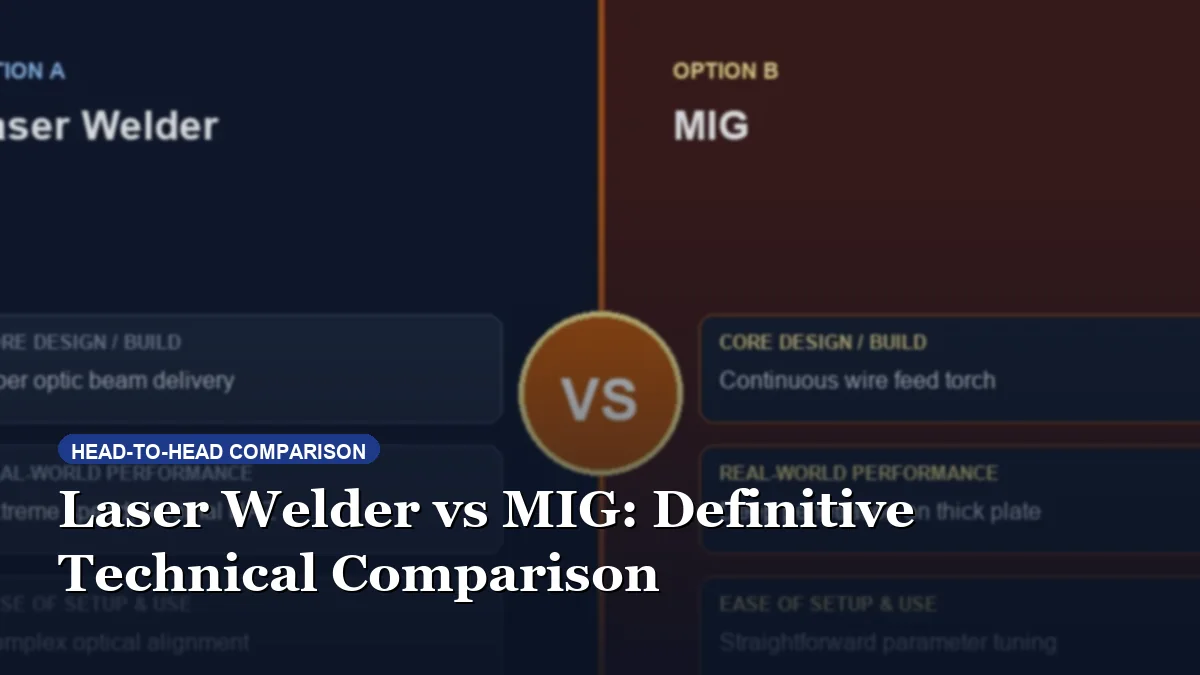
Select the laser welder for high-speed precision on thin metals with minimal distortion, but choose a MIG setup for heavy structural steel fabrication and general-purpose versatility.
Compare all top models in our Best Welder: Top Home Shop & Jobsite Picks Tested.
Side-by-Side Breakdown
| Criteria | Laser Welder | MIG | Edge |
|---|---|---|---|
| Core Design / Build | Fiber optic beam delivery | Continuous wire feed torch | Laser Welder |
| Real-World Performance | Extreme speed, minimal HAZ | Deep penetration on thick plate | MIG |
| Ease of Setup & Use | Complex optical alignment | Straightforward parameter tuning | MIG |
| Durability & Reliability | Solid-state diode longevity | Robust mechanical wire feeders | MIG |
| Efficiency / Operating Footprint | High electrical conversion efficiency | Standard workshop power draw | Laser Welder |
| Maintenance Requirements | Optics cleaning and chiller checks | Contact tips and liner replacement | MIG |
| Best Ideal Use Case | Precision sheet metal electronics | Structural steel and heavy frames | MIG |
Core Engineering and Beam Delivery Mechanisms
Advanced optical systems utilize concentrated photon energy to melt joint interfaces. This concentrated thermal input minimizes surrounding material degradation.
Traditional wire feed systems rely on consumable metallic electrodes bridged by shielding gas. An electric arc creates the necessary heat to fuse base metals.
Engineering differences dictate distinct workshop integration strategies, balancing high initial investment against proven mechanical reliability in daily production cycles.
Fiber laser systems utilize yttrium-aluminum-garnet or diode sources to generate concentrated photonic energy. This intense thermal density creates a narrow keyhole compared to the broad arc cone of traditional GMAW equipment.
When setting up a fabrication shop, reviewing our best budget mig welder guide helps compare standard wire-feed equipment against expensive fiber lasers. MIG utilizes a continuous consumable electrode shielded by gas.
Beam focusing optics determine the final spot size, typically ranging from 0.2 millimeters to 2.0 millimeters. This precise optical manipulation allows operators to concentrate extreme energy precisely where joint fusion is required on assembly lines.
- Fiber optic delivery cables concentrate coherent light beams onto microscopic focal points.
- Consumable electrode spools feed continuously through motorized drive rolls and contact tips.
- Shielding gas coverage prevents atmospheric contamination during the molten puddle formation phase.
Thermal Dynamics and Heat Affected Zones
Laser systems produce an exceptionally narrow heat affected zone due to high power density. This prevents warping in thin sheet components.
Consumable arc welding distributes heat across a broader surface area, which suits thicker structural joints but increases distortion risks.
- Narrow thermal footprints protect delicate metallurgical structures from excessive grain growth.
- Broader arc dispersion accommodates wider joint fit-up tolerances without failing.
Power Source Architecture and Efficiency
Modern fiber sources convert electrical input into coherent light with remarkable efficiency ratings. Solid-state diodes require specialized internal cooling systems to maintain stable operational temperatures.
Standard transformer and inverter power sources manage constant voltage outputs for stable arc characteristics across varying stick-out distances.
- High electrical-to-optical conversion rates reduce long-term operational power consumption significantly.
- Robust transformer designs withstand harsh workshop conditions without complex electronic shielding.
Real-World Performance Across Material Gauges
Evaluating real-world throughput requires analyzing travel speeds and penetration profiles across diverse metal thicknesses. Precision optics excel on thin stainless steel and aluminum sheets.
Consumable wire processes dominate heavy fabrication shops welding thick structural carbon steel plates. Deep weld penetration ensures structural compliance under extreme load-bearing conditions.
Operators must match machine capabilities to specific project demands to maximize daily output and reduce costly rework rates.
Laser welding excels on thin-gauge metals like 24-gauge stainless steel by minimizing total heat input. Reviewing our best mig welder for home use guide helps hobbyists avoid burn-through on ultra-thin sheets.
When processing thick structural plates exceeding quarter-inch carbon steel, MIG processes retain a distinct advantage. Multi-pass GMAW efficiently fills wide joint bevels, whereas standard handheld laser setups struggle without automated wire feed assistance.
Aluminum fabrication highlights stark operational differences between both technologies. Lasers combat highly reflective aluminum surfaces using high peak power pulses, whereas MIG requires dedicated spool guns or push-pull systems to feed soft filler wire reliably.
- High travel speeds on thin metals drastically reduce overall manufacturing production timelines.
- Deep penetration profiles satisfy rigorous structural engineering codes for heavy plate assembly.
- Versatility across joint configurations allows seamless transitions between varying plate thicknesses.
Thin Gauge Precision and Distortion Control
Fabricating enclosures and automotive panels demands minimal post-processing distortion. Optical welding achieves clean joints without requiring extensive grinding or straightening operations.
Controlling heat input on delicate materials prevents burn-through and preserves aesthetic surface finishes required in modern commercial product manufacturing.
- Eliminates secondary finishing operations by preventing severe thermal warping.
- Preserves original material properties right up to the immediate weld boundary.
Heavy Plate Joining and Structural Integrity
Heavy structural fabrication relies on robust deposition rates to fill wide joint bevels efficiently. Wire feed technology provides reliable tie-ins on thick carbon steel sections.
Deep root penetration guarantees structural resilience in load-bearing applications like bridge components and heavy machinery chassis.
- High deposition rates fill thick joint preparations rapidly and securely.
- Excellent mechanical properties withstand heavy cyclic loading in structural applications.
Ease of Setup, Calibration, and Operator Usability
Operating advanced optical systems demands rigorous safety training and precise focal distance calibration. Even minor alignment errors can compromise weld quality severely.
Wire feed equipment offers straightforward parameter tuning through voltage and wire speed dials. Operators can achieve acceptable results with minimal introductory training.
Balancing workforce skill levels against equipment complexity determines overall shop productivity and operator retention rates.
Configuring a modern laser welder involves programming specific joule outputs, wobble frequencies, and focal distances via touchscreen digital interfaces. Operators require specialized safety training due to Class 4 radiation hazards, unlike standard arc welding setups.
MIG calibration focuses on balancing wire feed speed with voltage parameters. Browsing our best 110v mig welder options highlights machines that simplify adjustments for novice fabrication shop operators needing reliable garage setups.
Joint fit-up tolerances are far more demanding when utilizing laser welding systems. Because the beam diameter is exceptionally fine, poor gap alignment often results in incomplete fusion, whereas conventional MIG fills minor structural gaps easily.
- Precise focal distance adjustment requires specialized fixtures and meticulous alignment protocols.
- Intuitive wire feed controls simplify daily machine setup for novice operators.
- Comprehensive safety interlocks protect personnel from hazardous invisible beam reflections.
Optical Alignment and Precision Fixturing
Maintaining tight joint fit-up is mandatory when using concentrated photon beams because gaps cause lack of fusion defects. Specialized clamping fixtures ensure consistent alignment.
Operators must calibrate focal lenses regularly to prevent beam scattering and maintain optimal power density at the workpiece surface.
- Zero-gap joint fit-up requirements demand precision laser cutting preparation.
- Regular lens inspection prevents catastrophic optic damage from metal spatter.
Parameter Tuning and Operator Adaptation
Adjusting wire feed speed and voltage parameters allows technicians to dial in stable arcs quickly. This forgiving nature accommodates minor variations in joint fit-up.
Streamlined interface panels help workshop staff adapt rapidly to changing material thicknesses without consulting complex technical manuals.
- Forgiving arc characteristics compensate for minor joint fit-up imperfections.
- Simplified control panels reduce training curves for new fabrication personnel.
Maintenance, Efficiency, and Equipment Longevity
Maintaining optical systems involves checking water chillers, cleaning protective cover glasses, and inspecting fiber delivery cables for micro-bends. Preventive care prevents costly component failures.
Consumable arc systems require routine replacement of contact tips, nozzles, drive rolls, and gun liners. These mechanical wear items are inexpensive and easily swapped.
Understanding lifecycle maintenance costs helps shop managers optimize equipment uptime and budget effectively for ongoing operational expenses.
Laser welding units require regular inspection of protective cover glass optics to prevent catastrophic residue damage. Cooling systems also demand routine coolant flushes, contrasting sharply with the simpler maintenance routines typical of standard transformer-based machines.
Standard MIG equipment maintenance centers on replacing consumable contact tips, nozzles, and drive rolls. As detailed in our hobart 190 mig welder review, these mechanical components remain inexpensive and simple to swap out.
Electrical efficiency heavily favors fiber laser technology, which often exceeds thirty percent wall-plug efficiency. Traditional constant-voltage MIG power sources consume considerably more electricity to sustain stable welding arcs across demanding industrial work cycles.
- Protective cover glass replacement shields expensive internal focusing optics from spatter.
- Routine cooling system flushes maintain stable laser diode operating temperatures.
- Consumable contact tips and liners ensure smooth wire feeding during long shifts.
Optical Maintenance and Chiller Upkeep
Water chillers demand regular coolant monitoring to prevent mineral buildup and ensure efficient thermal dissipation across sensitive laser diode modules.
Operators must inspect protective windows daily to remove debris that could absorb beam energy and crack the glass element.
- Scheduled coolant replacement prevents internal scaling and overheating faults.
- Daily cleaning protocols extend the service life of expensive optical components.
Mechanical Wear and Consumable Replacement
Wire feed mechanisms experience continuous friction from passing filler metals, requiring periodic inspection of drive rolls and inlet guides.
Replacing worn contact tips and gas diffusers maintains consistent electrical pickup and proper shielding gas coverage.
- Regular drive roll cleaning prevents wire slipping and erratic arc behavior.
- Routine tip changes eliminate burnbacks and unstable wire delivery issues.
Operating Footprint and Workshop Integration
Integrating advanced optical machinery requires dedicated floor space, specialized electrical drops, and certified safety enclosures to block harmful radiation wavelengths.
Standard wire feed units fit easily into mobile carts, running on conventional shop power and requiring standard welding curtains for arc glare protection.
Assessing facility infrastructure ensures safe and compliant deployment of heavy industrial equipment across modern manufacturing floors.
Laser welding cells demand dedicated safety enclosures featuring certified laser-blocking curtains to protect nearby personnel. Their physical footprints often combine compact power sources with chillers, requiring careful floor plan layout inside bustling fabrication facilities.
Conventional MIG stations integrate smoothly into standard workshop environments without requiring heavy optical shielding. Ventilation arms easily capture traditional welding fume, whereas laser processes generate specific metal vapor hazards requiring robust extraction systems.
Portability favors specific configurations within each distinct welding category. While compact inverter MIG welders easily move between remote job sites, handheld laser systems demand stable power supplies and sensitive optical cables that restrict outdoor usage.
- Certified safety enclosures protect bystanders from accidental laser beam exposure.
- Compact mobile wire units navigate tight workshop spaces with minimal effort.
- Standard electrical service compatibility simplifies facility power drop installations.
Safety Enclosures and Radiation Compliance
Class four optical machinery demands strict safety protocols, including interlocked enclosure doors and specialized viewing windows rated for specific wavelengths.
Operators and nearby personnel must wear certified laser safety eyewear at all times to prevent irreversible retinal damage from scattered reflections.
- Interlocked perimeter guards automatically shut down beam emission upon door opening.
- Wavelength-specific safety glasses protect operators from invisible reflected radiation.
Shop Floor Mobility and Power Infrastructure
Standard wire feed setups offer exceptional portability, allowing technicians to wheel machines directly to large structural assemblies on the shop floor.
Multi-voltage input capabilities enable seamless operation across different facility power grids without requiring expensive transformer upgrades.
- Mobile cart configurations facilitate easy transport around large fabrication projects.
- Flexible power input options accommodate various industrial electrical supply standards.
Economic Viability and Return on Investment
Analyzing capital expenditure involves balancing high upfront machinery costs against dramatic labor savings achieved through increased welding speeds and reduced finishing.
Traditional wire feed equipment features low initial purchase costs, making it accessible for small shops despite higher ongoing labor and consumable expenses.
Strategic business planning ensures capital investments align with production volume demands and long-term company growth objectives.
Initial capital expenditure for laser welding machinery remains significantly higher than conventional MIG packages. However, facilities offset these upfront costs through dramatically reduced post-processing labor, eliminating extensive grinding operations on finished architectural metal assemblies.
Consumable expenses diverge rapidly during high-volume daily production runs. MIG operations continuously consume expensive shielding gas and solid wire, whereas laser systems primarily utilize electricity and minimal auxiliary assist gases for standard steel fabrication.
Labor efficiency plays a pivotal role in calculating total return on investment timelines. Because handheld lasers operate up to four times faster than MIG, shops experience rapid productivity gains that justify the substantial initial machinery investments.
- High initial equipment investment is offset by massive gains in production speed.
- Low entry barrier allows small fabrication shops to start projects immediately.
- Reduced finishing labor significantly lowers overall component manufacturing costs.
Capital Expenditure versus Labor Savings
Advanced optical systems require substantial upfront capital but drastically reduce labor hours spent on post-weld grinding and straightening operations.
Shops focusing on high-volume production quickly recover initial equipment expenses through accelerated throughput and minimal scrap generation.
- Substantial labor hour reductions offset steep initial machine purchase costs.
- Accelerated throughput maximizes revenue generation on repetitive manufacturing tasks.
Consumable Costs and Long-Term Value
Conventional wire welding incurs steady ongoing expenses for filler wire, shielding gas, and replacement contact tips during daily production runs.
Optical welding reduces filler metal dependency on many joint designs, lowering consumable replenishment frequencies over extended operational lifespans.
- Steady purchase of wire spools forms a predictable ongoing operational expense.
- Minimizing filler metal usage optimizes long-term material and overhead budgets.
Frequently Asked Questions
Can laser welders replace MIG entirely?
No, because MIG welding remains superior for thick structural steel plates. Laser systems excel exclusively on thin gauge precision sheet metal applications.
What safety gear is needed for laser welding?
Operators must wear certified safety eyewear rated for specific optical wavelengths. Enclosed work cells with interlocked safety doors are also mandatory.
Which process requires more maintenance?
Laser systems require meticulous optical cleaning and chiller checks to prevent damage. MIG setups need routine changes of contact tips and liners.
Does laser welding require filler wire?
Many laser joints require zero filler material due to precise fit-up. However, automated wire feeders can be added for gap-bridging capabilities.
Which welder is better for beginners?
MIG welders are far better for beginners due to forgiving parameters. Laser equipment demands advanced technical training and strict safety compliance.