Hobart Handler 210 MVP vs Millermatic 211: Technical Verdict
Choosing between these blue and yellow multi-voltage MIG welders requires examining internal wire drives, duty cycles, and input power adaptability. Our technical teardown evaluates their real-world shop performance.

Choose the Hobart Handler 210 MVP for rugged, budget-friendly farm repairs and simplified manual adjustments. Opt for the Millermatic 211 when you need automated Auto-Set technology and superior thermal endurance.
Compare all top models in our Best Welder: Top Home Shop & Jobsite Picks Tested.
Side-by-Side Breakdown
| Criteria | Hobart Handler 210 Mvp | Millermatic 211 | Edge |
|---|---|---|---|
| Core Design / Build | Stamped steel housing with industrial transformer layout. | Inverter-based lightweight architecture with composite door. | Millermatic 211 |
| Real-World Performance | Robust output on thick steel using dual voltage input. | Smooth arc stability across varied sheet metal gauges. | Millermatic 211 |
| Ease of Setup & Use | Traditional manual voltage tap settings and charts. | Advanced Auto-Set Elite digital parameter selection. | Millermatic 211 |
| Durability & Reliability | Heavy-duty internal components built for rugged farms. | Advanced thermal overload protection and cooling fans. | Hobart Handler 210 Mvp |
| Efficiency / Operating Footprint | Heavier transformer design drawing higher idle current. | Inverter efficiency maximizing input power draw. | Millermatic 211 |
| Maintenance Requirements | Simple mechanical upkeep and straightforward wire drive tension. | Routine board checks and sensitive electronic upkeep. | Hobart Handler 210 Mvp |
| Best Ideal Use Case | Mobile fabrication trucks and heavy agricultural maintenance. | Precision auto body work and production sheet fabrication. | Millermatic 211 |
Core Architecture and Power Delivery
Evaluating electrical foundations reveals distinct engineering philosophies. The Hobart utilizes a heavy transformer design, whereas Miller integrates advanced inverter circuitry to reduce weight and improve overall electrical efficiency.
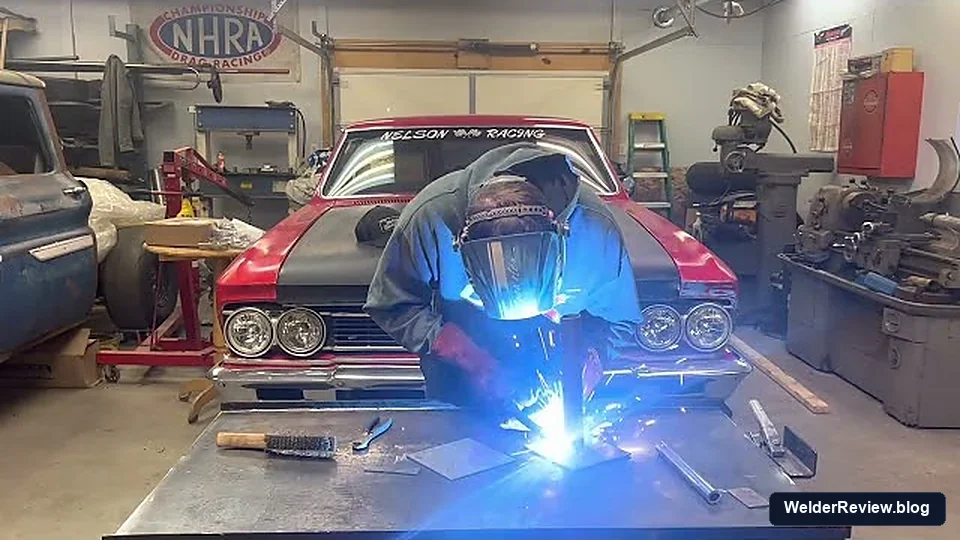
Both units feature multi-voltage plug systems allowing seamless transitions between household and industrial circuits. This flexibility makes them exceptionally popular for mobile contractors and ambitious garage fabricators alike.
Our Hobart Handler 210 review highlights its traditional transformer-based architecture with a multi-voltage plug system, delivering robust electrical stability when stepping down from heavy-duty industrial input lines to standard residential circuits.
Conversely, the Millermatic 211 employs an advanced inverter-based power source featuring Auto-Set Elite technology, which automatically optimizes your voltage parameters based on exact material thickness selections and wire diameter inputs.
- Transformer versus inverter core topologies
- Multi-voltage plug interchangeability standards
- Total machine weight and portability metrics
- Dual-voltage capability allows both welding machines to operate efficiently on standard 115-volt household circuits or high-output 230-volt workshop lines without requiring complex internal wiring modifications.
- Transformer durability gives the Hobart unit rugged resistance to power surges, whereas the Miller inverter focuses on precise microprocessor control for superior arc stability.
Input Voltage Versatility
Operating on both standard circuits requires robust internal switching. Voltage adaptability ensures your machine never stalls when moving between remote job sites and well-equipped permanent workshops.
Users must verify breaker sizes before pushing these machines to their maximum amperage limits on standard residential lines.
- 115V and 230V operational parameters
- Required breaker amperages for peak output
Input Power Versatility
Operating on dual voltages requires efficient circuitry capable of handling transient current spikes without tripping standard garage breakers or damaging sensitive internal capacitors during heavy MIG welding operations.
- Input voltage switching occurs seamlessly through interchangeable adapter cords on both machines, eliminating the need for hardwired electrical modifications when moving between different job sites.
Transformer vs Inverter Efficiency
Transformer systems prioritize raw physical durability and simple component replacement, whereas modern inverter designs drastically reduce overall chassis weight while improving electrical conversion efficiency significantly.
- Power factor correction built into the Miller unit ensures stable arc performance even when connected to long extension cords or engine-driven generators with fluctuating output frequencies.
Wire Feed Mechanisms and Drive Systems
A reliable wire drive is vital for preventing birdnesting and erratic arc delivery. Both welders incorporate cast aluminum drive assemblies equipped with quick-change roll mechanisms for smooth wire feeding.
Proper tension adjustment remains critical when switching between solid steel wire and flux-cored alternatives during intensive fabrication sessions.
Reliable wire delivery depends heavily on cast aluminum drive assemblies that maintain proper tension and prevent birdnesting, especially when feeding soft aluminum filler wires through standard liner configurations.
Both welders feature quick-release drive rolls with dual-groove designs, allowing operators to switch between solid steel wires and flux-cored consumables without requiring specialized tools or complicated tension adjustments.
- Cast aluminum dual-drive roll systems
- Toolless drive roll changeover procedures
- Spool gun compatibility for aluminum projects
- Cast aluminum gearboxes provide exceptional alignment longevity, ensuring smooth rotational torque when pushing heavy steel wire spools through extended MIG torch cable assemblies.
- Quick-change drive rolls simplify routine maintenance, letting operators swap wire diameters rapidly without fumbling with tiny retaining clips or losing crucial tension settings.
Tension Control and Alignment
Accurate tension settings prevent wire deformation while ensuring consistent feed rates. Operators should routinely inspect drive rolls for metal shavings and wear.
Proper alignment directly affects bead appearance and reduces premature contact tip burnout.
- Drive roll groove sizing for various wire diameters
- Preventing birdnesting through correct pressure settings
Drive Roll Alignment and Pressure
Proper tension arm calibration ensures consistent wire speed without deforming the electrode, which directly prevents erratic arc behavior and premature contact tip wear during extended fabrication sessions.
- Indexed tension knobs provide repeatable pressure settings, helping operators replicate ideal feeding force after performing routine maintenance or swapping out empty wire spools.
Spool Capacity and Compatibility
Internal cabinet spaces accommodate standard four-inch and eight-inch wire spools securely, protecting filler metals from ambient workshop dust, moisture, and accidental physical impacts during transport.
- Spool hub brakes prevent overrunning when the drive motor stops abruptly, eliminating loose wire loops that frequently cause frustrating tangles inside the enclosure.
Arc Characteristics and Bead Profile Control
As detailed in our Hobart 210 MVP review, achieving clean puddle control depends heavily on arc stability and voltage step precision, utilizing discrete steps while competing units offer smoother infinite voltage control.
Welders working on thin automotive sheet metal will immediately notice the fine-tuning advantages provided by the Miller's inverter-driven arc profile.
Achieving optimal puddle wet-out requires precise voltage tuning and inductance control, which dictates droplet transfer frequency and minimizes excessive spatter across various carbon steel joint configurations.
The Millermatic 211 incorporates smooth-start technology that eliminates popping or stubbing during arc initiation, resulting in clean puddle establishment and professional-grade weld aesthetics immediately upon trigger pull.
- Discrete tap settings versus infinite voltage control
- Arc starting smoothness on dirty or painted steel
- Spatter minimization during short-circuit transfer
- Inductance tuning helps control arc crispness and puddle fluidity, allowing experienced welders to tailor bead profiles for optimal penetration on thick steel plates.
- Arc stabilization software monitors short-circuit transfers in real-time, instantly adjusting current to reduce annoying spatter during complex out-of-position fabrication tasks.
Penetration on Thicker Metals
Pushing these machines to their upper thickness limits requires proper joint preparation and beveling. Both units deliver ample penetration for structural brackets and trailer repairs.
Ensuring correct travel speed guarantees sound fusion without risking lack of sidewall fusion.
- Maximum single-pass welding capacities
- Joint preparation guidelines for structural steel
Short-Circuit MIG Dynamics
Fine-tuning wire feed speed relative to output voltage allows fabricators to dial in the ideal crisp arc sound associated with proper short-circuit metal transfer parameters.
- Arc stability optimization reduces post-weld cleanup time significantly by minimizing aggressive spatter and grinding requirements across standard fillet welds and complex structural butt joints.
Penetration and Heat Input
Proper machine calibration guarantees adequate root penetration on thick plates while preventing burn-through when joining thin sheet metal components in automotive restoration projects.
- Voltage tap selection on the Hobart unit requires manual testing on scrap material, whereas the Miller offers infinite voltage control for pinpoint heat input adjustments.
Setup Usability and Operator Interface
Exploring our Hobart Handler 190 review reveals how interface design dictates thickness transitions, where Hobart utilizes a traditional chart-based manual setup process preferred by experienced fabricators.
Conversely, Miller introduces digital parameter assistance that eliminates guesswork for less experienced workshop operators.
Intuitive control panels drastically reduce operator setup errors, allowing both novice fabricators and experienced welders to achieve optimal parameters quickly without referencing complex lookup charts.
The Hobart interface utilizes a straightforward multi-step voltage tap selector paired with a smooth potentiometer knob for wire feed speed adjustments, prioritizing mechanical simplicity and reliability.
- Traditional mechanical setup charts
- Digital parameter assistance integration
- Ergonomic control knob placement
- Analog dials provide tactile feedback during heavy glove-wearing operations, ensuring reliable parameter adjustments in cold or demanding industrial workshop environments.
- Digital interface screens offer precise numerical readouts, eliminating guesswork when operators need to replicate exact welding voltages across diverse commercial production runs.
The Auto-Set Advantage
Automated parameter selection matches wire diameter and material thickness instantly. This technology dramatically reduces setup time for vocational students and hobbyists.
Experienced welders can still override automated settings when specialized joint configurations require custom heat inputs.
- Thickness dial calibration steps
- Manual override capabilities for custom joints
Digital vs Analog Controls
Digital readouts on the Miller unit display precise voltage and amperage values concurrently, giving operators exact quantitative feedback during critical structural welding applications.
- Auto-Set functionality simplifies parameter selection by matching wire diameter and material thickness inputs directly to pre-programmed metallurgical curves stored in the internal firmware.
Quick Reference Guides
Inside the consumable compartment, comprehensive setup charts guide users through recommended gas flow rates, wire sizes, and voltage settings for various mild steel applications.
- Clear instructional labeling inside the wire cabinet ensures operators can troubleshoot minor configuration issues rapidly without halting production schedules to consult physical owner manuals.
Thermal Management and Duty Cycle Limits
Extended fabrication sessions demand robust internal cooling fans and effective thermal overload protection. Both welders feature built-in safety switches that halt operations before internal components overheat.
Monitoring your duty cycle prevents premature transformer degradation and ensures long-term operational reliability across demanding industrial environments.
Sustained fabrication work demands robust cooling systems and internal thermal overload protection to prevent premature transformer or inverter burnout during high-amperage structural welding sequences.
Fan-on-demand technology runs internal cooling fans only when necessary, reducing dust ingestion into the electrical cabinet and lowering ambient noise levels around the active workspace.
- Built-in thermal overload protection circuits
- Forced-air cooling fan operational cycles
- Duty cycle ratings at maximum amperage output
- Thermal protection circuits automatically shut down output power when internal temperatures rise too high, preventing permanent damage to delicate solid-state electrical components.
- Forced-air ventilation systems expel accumulated heat rapidly from the chassis, maintaining safe operating temperatures during continuous multi-pass structural steel welding operations.
Preventing Overheat Failures
Allowing cooling fans to run after heavy welding sessions prolongs internal component life. Operators should never block cabinet louvers during active shop fabrication.
Maintaining proper clearance around ventilation ports keeps operating temperatures well within safe engineering thresholds.
- Ventilation clearance requirements in tight shops
- Post-weld fan cooling duration practices
Duty Cycle Ratings
Operating these compact multi-process machines beyond their rated duty cycle triggers internal safety cutoffs, requiring a mandatory cool-down period before standard welding operations can safely resume.
- Thermal overload indicators illuminate immediately when internal temperatures exceed safe operating thresholds, protecting delicate semiconductor components from catastrophic heat damage during prolonged fabrication.
Ventilation and Airflow
Strategic louver placement directs cooling airflow across internal rectifiers and transformers, maximizing heat dissipation efficiency even when operating in dusty or confined workshop environments.
- Forced-air cooling systems actively prevent hot spots from forming near sensitive circuit boards, ensuring long-term equipment reliability under demanding professional fabrication workloads.
Maintenance Protocols and Serviceability
Routine maintenance keeps wire-feed welders running smoothly for years of heavy service. Cleaning drive compartments and replacing worn contact tips should form part of your weekly shop routine.
As highlighted in our Hobart Handler 140 review, the simpler analog board layout often appeals to field technicians who prefer straightforward mechanical troubleshooting over complex digital diagnostic systems.
Routine preventative upkeep ensures consistent wire feeding and clean electrical contact, minimizing unexpected downtime and expensive component replacements during time-sensitive commercial fabrication projects.
Accessing internal drive rolls, gun liners, and gas diffusers requires zero specialized hand tools, facilitating rapid consumable swaps between different wire diameters and shielding gases.
- Weekly wire liner blowing and cleaning
- Contact tip and nozzle inspection routines
- Internal dust removal procedures
- Torch liner cleanouts remove accumulated metallic debris and copper dust, preventing erratic wire feeding and frustrating burnback issues during extended structural welding sessions.
- Drive assembly maintenance requires periodic inspection of tension gears and drive roll grooves to guarantee uniform pressure distribution across all solid filler wires.
Consumable Inspection and Replacement
Worn contact tips cause erratic wire feeding and poor electrical transfer. Keep a healthy supply of matching tips and nozzles on hand to minimize workflow interruptions.
Inspecting gas diffusers prevents shielding gas turbulence and subsequent weld porosity issues.
- Contact tip bore wear identification
- Shielding gas diffuser maintenance checks
Drive System Servicing
Removing accumulated metal shavings from drive roll grooves prevents wire slippage and maintains steady electrical arc stability across all standard structural welding positions.
- Drive roll replacement takes mere seconds using simple spring-loaded retaining mechanisms designed for quick field servicing by busy welding professionals on location.
Torch and Liner Maintenance
Blowing out MIG gun liners with compressed air removes accumulated copper dust and debris, directly improving wire feed smoothness and reducing troublesome burnback occurrences.
- Contact tip inspections should occur frequently to spot ovalized orifices that cause erratic arc wandering and poor shielding gas coverage during critical passes.
Frequently Asked Questions
Can both welders run spool guns for aluminum fabrication?
Yes, both machines support direct-plug spool guns for aluminum work. Using a dedicated spool gun prevents birdnesting soft aluminum wire.
Do these MIG welders require specialized electrical wiring?
They operate on standard 115V or 230V circuits using adapter plugs. Always verify your breaker capacity before welding at maximum output.
Which machine is better suited for beginner welders?
The Millermatic excels for beginners thanks to its automated setup technology. This feature eliminates guesswork by matching wire speed and voltage automatically.
Are these welders capable of running gasless flux-cored wire?
Both models support flux-cored welding for outdoor or windy conditions. Reversing the polarity is required when switching from solid wire to flux core.
What is the maximum steel thickness these units can weld?
Both units handle up to three-eighths inch steel in single or multi-pass setups. Proper joint beveling ensures structural integrity on heavy plates.