Fronius vs Kemppi: European Welding Giants Compared
Selecting between Fronius and Kemppi requires evaluating heavy industrial automation ecosystems against ultra-portable fabrication engineering.

Choose Fronius for heavy-duty automated synergic welding and deep software control, or select Kemppi for unmatched field portability and rugged ergonomic design.
Compare all top models in our Best Welder: Top Home Shop & Jobsite Picks Tested.
Side-by-Side Breakdown
| Criteria | Fronius | Kemppi | Edge |
|---|---|---|---|
| Core Design / Build | Robust industrial modular frames | Compact lightweight composite housings | Split |
| Real-World Performance | Advanced pulsed MIG dynamics | Precise root passarc stability | Fronius |
| Ease of Setup & Use | Intelligent synergic weld curves | Intuitive graphical user interfaces | Kemppi |
| Durability & Reliability | Heavy-duty thermal protection | Impact-resistant structural chassis | Kemppi |
| Efficiency / Operating Footprint | High power factor correction | Energy-saving inverter technology | Fronius |
| Maintenance Requirements | Modular board replacement protocols | Quick-swap wire drive assemblies | Split |
| Best Ideal Use Case | Automated production facilities | Mobile structural steel erection | Split |
Core Engineering and Manufacturing Philosophy
European welding engineering represents the pinnacle of industrial manufacturing standards. Both brands prioritize strict compliance with international safety protocols and exceptional build quality.
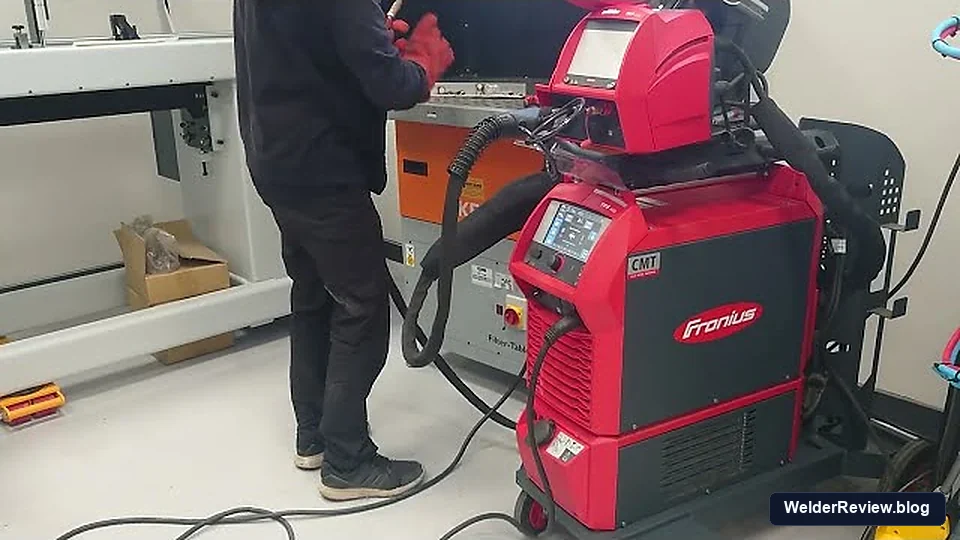
Fronius approaches machine design through total automation integration, as highlighted in our Fronius Magicwave 230I review. Their hardware utilizes sophisticated digital architecture built for high-duty cycle manufacturing environments.
Kemppi focuses heavily on operator comfort and mobile agility. Their structural philosophy emphasizes lightweight chassis design without sacrificing structural integrity on harsh job sites.
Fronius relies on a deeply integrated Austrian manufacturing approach, engineering transformers and inverter topologies in-house. This guarantees strict compliance with strict IEC standards for industrial welding power sources globally.
Kemppi constructs its Finnish power sources focusing on modularity, lightweight chassis design, and extreme cold weather endurance. Their strict internal testing protocols ensure reliable arc ignition down to minus 20 degrees Celsius.
Both brands reject outsourcing core PCB assembly, maintaining robust quality control loops. Fronius emphasizes high-duty cycle thermal thresholds, while Kemppi prioritizes compact footprint metrics for confined shipyard and structural steel fabrication environments.
- Fronius emphasizes modular, factory-floor automation integration.
- Kemppi champions lightweight, job-site mobility and ergonomics.
- Both brands enforce strict European electrical safety standards.
European Hardware Standards
Industrial power sources demand rigorous thermal management and dust ingress protection. Fronius deploys isolated cooling air tunnels to safeguard sensitive internal inverter electronics.
Kemppi utilizes sturdy impact-resistant composite casings that absorb severe mechanical shocks. Their physical layouts prevent dust accumulation around vital magnetic core components.
- Isolated cooling tunnels protect sensitive electronic boards.
- Impact-resistant composite housings absorb severe job-site drops.
Advanced Arc Performance and Control Systems
Arc stability dictates overall weld pool control across varied material thicknesses. Fronius units utilize proprietary waveform algorithms to minimize spatter during pulsed operations.
Kemppi machines deliver exceptional arc striking consistency and rapid parameter adjustment. Welders benefit from instantaneous adaptive voltage corrections during erratic manual manipulation.
Fine-tuning arc dynamics directly influences heat affected zone boundaries. Both manufacturers excel at minimizing distortion on thin gauge stainless steel and aluminum assemblies.
Fronius utilizes proprietary TransPulse Synergic wave control algorithms, adjusting wire feed speed dynamically to match joint tolerances. This drastically minimizes spatter during aluminum pulse welding applications on structural aerospace components.
Kemppi answers with WiseRoot+ and WiseThin+ software packages, optimizing complex short-circuit transfer modes. Professional welders achieve exceptional root pass penetration on heavy carbon steel pipes without requiring backing strips.
Digital sampling rates exceed 100 kilohertz across both advanced platforms, ensuring extremely rapid arc corrections. Fabricators notice immediate improvements in puddle stability when transitioning between manual GTAW torches and mechanized GMAW tracks.
- Proprietary waveform algorithms reduce spatter during high-amperage pulsing.
- Rapid adaptive voltage corrections maintain arc length under tension.
- Minimal heat affected zone distortion on sensitive alloy materials.
Waveform Modification and Penetration
Controlling droplet detachment requires microsecond-level current regulation. Fronius systems adjust current pulses rapidly to ensure consistent metal transfer dynamics, a trait also valued in top units featured in our best welder guide.
Kemppi processors focus on maintaining constant arc energy regardless of stick-out variations. This dynamic response prevents lack of fusion defects during out-of-position structural welding.
- Microsecond-level current regulation governs droplet detachment.
- Constant arc energy prevents common lack of fusion defects.
Interface Usability and Digital Integration
Modern fabrication shops demand intuitive digital interfaces that reduce operator training time. Fronius features comprehensive touchscreens with customizable curves, much like models analyzed in our best starter welder roundup.
Kemppi utilizes simplified graphical displays paired with sturdy control knobs. This design philosophy ensures operators can adjust parameters quickly while wearing heavy leather gloves.
Data logging and quality assurance capabilities have become standard industrial requirements. Both manufacturers provide robust software suites for tracking heat input and consumable usage.
Fronius implements high-definition color graphical displays featuring intuitive touch navigation. Operators configure complex synergic lines rapidly using built-in weld calculators that factor in shielding gas composition and joint geometry.
Kemppi relies on functional rotary dials combined with high-contrast LCD screens designed for heavy-duty welding gloves. Their system prioritizes quick parameter adjustments directly on the shop floor without deep menu navigation.
Both ecosystems support robust fleet management software via Ethernet or Wi-Fi modules. Quality managers track arc-on time, wire consumption, and heat input logs remotely to satisfy stringent ISO quality assurance reporting requirements.
- Comprehensive touchscreens offer deep synergic curve customization.
- Sturdy control knobs allow easy adjustments with heavy gloves.
- Advanced software suites track crucial heat input metrics.
Software Ecosystems and Updates
Firmware evolution ensures welding equipment remains compatible with emerging alloy specifications. Fronius allows seamless USB or network updates for expanding built-in program libraries.
Kemppi simplifies fleet management through cloud-connected software solutions. Supervisors can monitor machine settings across multiple locations to enforce strict welding procedure specifications.
- Seamless firmware updates expand built-in program libraries.
- Cloud-connected software simplifies multi-location fleet management.
Power Efficiency and Energy Management
Electrical efficiency directly impacts operational overhead in high-production fabrication facilities. Fronius incorporates advanced power factor correction circuits to minimize reactive grid draw.
Kemppi inverters prioritize high electrical conversion efficiency to reduce generator fuel consumption. This optimization proves vital for remote site operations relying on portable power.
Thermal efficiency prevents premature component degradation under sustained heavy loads. Both brands integrate smart fan controls that activate only when internal temperatures demand cooling.
Modern inverter topologies from Fronius incorporate active power factor correction circuits. These systems reduce total harmonic distortion, maintaining high electrical efficiency even under maximum continuous output load conditions.
Kemppi integrates intelligent standby modes that drop idle power consumption significantly during non-welding intervals. This efficiency mirrors our findings in the Fronius Transsteel 2200 review, reducing overhead in shops operating multi-process machines.
Grid voltage fluctuations are handled gracefully through wide input tolerance ranges. Both manufacturers protect sensitive internal components against sudden spikes, ensuring uninterrupted production cycles in volatile industrial power grids.
- Power factor correction circuits minimize reactive electrical draw.
- High conversion efficiency reduces portable generator fuel consumption.
- Smart fan controls prevent premature thermal degradation.
Grid Stability and Thermal Management
Fluctuating input voltages can disrupt sensitive digital inverter power supplies. Fronius handles wide voltage tolerances gracefully, maintaining stable output during local grid brownouts.
Kemppi engineers their power blocks to withstand harsh electrical spikes common on industrial sites. Robust internal MOV protection safeguards vital rectification stages against surges.
- Wide voltage tolerances maintain stability during grid brownouts.
- Robust internal protection guards rectification stages against surges.
Durability, Enclosure Ratings, and Field Maintenance
Harsh workshop environments punish welding equipment with abrasive dust, moisture, and impacts. Fronius builds heavy industrial chassis designed for stationary or semi-fixed production cells.
Kemppi emphasizes rugged portability, offering compact frames that withstand rough transport between job sites. Their protective handles double as secure tie-down points for trucks.
Preventative maintenance procedures dictate long-term machine reliability and operational uptime. Both manufacturers simplify routine upkeep through well-organized internal component layouts.
Fronius chassis designs utilize robust composite materials and reinforced steel frames to withstand harsh workshop impacts. Integrated dust filters protect internal electronics, achieving standard IP23 protection ratings for outdoor construction sites.
Kemppi constructs robust molded plastic casings designed specifically to resist chemical corrosion and UV degradation. Modular internal architecture allows technicians to replace faulty wire drive motors or power modules in minutes.
Routine maintenance procedures require minimal proprietary tools for both equipment lines. Regular compressed air purging of heat sinks prevents thermal overload, extending the operational lifespan of critical semiconductor switches.
- Heavy industrial chassis suit stationary production cells.
- Rugged portable frames withstand rough transport between sites.
- Organized internal layouts simplify preventative maintenance routines.
Modular Serviceability and Wear Parts
Quick diagnosis minimizes costly production bottlenecks during unexpected mechanical failures. Fronius uses modular internal circuit boards that technicians can replace swiftly in the field.
Kemppi wire feed mechanisms utilize tool-less roll changes to reduce downtime. Operators can swap drive rolls and inlet guides in seconds without specialized wrenches.
- Modular internal circuit boards allow swift field replacement.
- Tool-less wire drive roll changes reduce operational downtime.
Application Mapping and Industry Suitability
Matching machine capabilities to specific industry sectors ensures optimal return on investment. Fronius dominates automotive manufacturing and heavy structural steel fabrication facilities worldwide.
Kemppi excels in shipbuilding, pipe welding, and rapid mobile structural erection projects. Their specialized software packages cater directly to stringent pressure vessel code requirements.
Evaluating operator preference alongside technical specifications yields the most sustainable purchasing decision. Both brands deliver world-class weld quality when paired with correct parameters.
Fronius dominates heavy automotive production lines and aerospace manufacturing where absolute arc precision matters most. Their specialized pulse processes integrate seamlessly with complex robotic automation cells running continuous shifts.
Kemppi excels in shipyard construction, offshore rig maintenance, and pipeline fabrication where portability is paramount. Their rugged power sources handle long primary extension cables without suffering voltage drop failures.
Selecting between these premium brands depends heavily on your specific shop workflow and automation needs. Evaluating daily duty cycles ensures optimal return on investment for your heavy fabrication facility.
- Fronius dominates automotive and heavy structural steel production.
- Kemppi excels in shipbuilding, pipe, and mobile construction.
- Specialized software packages cater to pressure vessel codes.
Heavy Fabrication vs Precision Workshop
High-deposition industrial applications require sustained high-amperage output capabilities. Fronius systems maintain exceptional duty cycles during multi-pass structural steel welding tasks.
Precision sheet metal workshops benefit from the delicate arc control offered by Kemppi. Their lower amperage stability prevents burn-through on thin automotive body panels.
- High-amperage output maintains exceptional structural duty cycles.
- Delicate arc control prevents burn-through on thin panels.
Frequently Asked Questions
Which brand offers better arc stability for aluminum welding?
Both manufacturers deliver exceptional aluminum performance, though Fronius pulsed MIG algorithms offer superior droplet detachment control in automated cells.
Are Kemppi machines easier to transport than Fronius units?
Yes, Kemppi chassis design prioritizes lightweight portability and ergonomic handling for mobile fabrication crews working across changing job sites.
How do their user interfaces differ for daily operation?
Fronius utilizes advanced touchscreen displays with deep synergic customization, whereas Kemppi relies on physical knobs designed for easy glove operation.
Can both brands integrate with automated robotic welding cells?
Fronius systems feature native robotic communication protocols, while Kemppi focuses primarily on manual and mechanized semi-automated applications.
Which platform provides superior energy efficiency on standard power grids?
Fronius incorporates advanced power factor correction circuits that minimize reactive current draw, ensuring optimal electrical efficiency during heavy industrial utilization.