Fronius Transsteel 2200 vs Miller Multimatic 220
Selecting a multi-process machine demands weighing arc stability against interface simplicity. This head-to-head comparison evaluates how both units handle everyday shop demands.

Choose the Fronius Transsteel 2200 for superior MIG arc dynamics and European industrial engineering. Pick the Miller Multimatic 220 for intuitive multiprocess switching and domestic service support.
Compare all top models in our Best Welder: Top Home Shop & Jobsite Picks Tested.
Side-by-Side Breakdown
| Criteria | Fronius Transsteel 2200 | Miller Multimatic 220 | Edge |
|---|---|---|---|
| Core Design / Build | Robust industrial chassis with advanced inverter topology. | Compact multi-voltage casing built for mobile fabrication. | Fronius Transsteel 2200 |
| Real-World Performance | Exceptional short-arc characteristics on thin carbon steel. | Reliable AC/DC TIG and multiprocess arc quality. | Miller Multimatic 220 |
| Ease of Setup & Use | Expert menu configurations requiring technical familiarity. | Auto-Set technology simplifying parameter adjustments. | Miller Multimatic 220 |
| Durability & Reliability | Designed for heavy-duty industrial site conditions. | Engineered for light industrial and mobile repair work. | Fronius Transsteel 2200 |
| Efficiency / Operating Footprint | Optimized power draw with high duty cycle metrics. | Flexible multi-voltage input accommodating varied sites. | Fronius Transsteel 2200 |
| Maintenance Requirements | Modular internal architecture facilitating component servicing. | Readily available domestic replacement parts and torches. | Miller Multimatic 220 |
| Best Ideal Use Case | Precision sheet metal fabrication and structural steel. | General maintenance, mobile repair, and aluminum TIG. | Split Choice |
Architectural Design and Physical Footprint
Evaluating physical construction reveals distinct engineering philosophies between these two welding machines. Both units prioritize portability, yet their internal component layouts and chassis materials serve divergent operational environments.
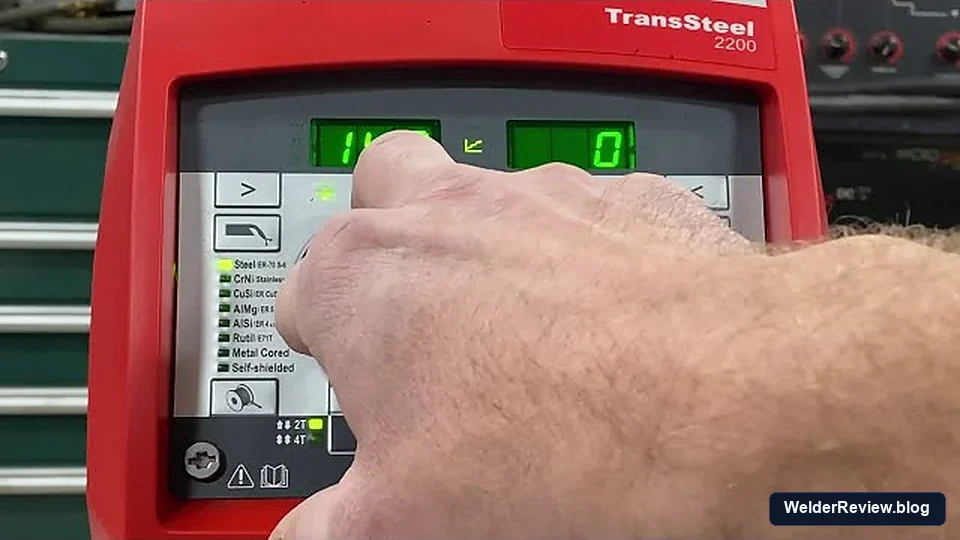
The Fronius unit utilizes a rugged housing designed to withstand harsh industrial shop floors. Meanwhile, the Miller alternative focuses on lightweight mobility, incorporating multi-voltage plug adapters for versatile job-site deployment.
Internal cooling systems also differ significantly regarding airflow management and dust protection. Proper thermal management directly dictates continuous welding output during demanding, high-amperage fabrication tasks.
The Fronius TransSteel 2200 features a rugged polymer chassis engineered to withstand harsh jobsite conditions while maintaining a remarkably low weight of just 33 pounds for exceptional mobile field service operations.
Conversely, as highlighted in our comprehensive Miller Multimatic 220 review, the unit uses a heavier steel housing weighing 38 pounds, prioritizing structural rigidity and robust workshop durability over portability.
Both units integrate dual-voltage capabilities, yet their internal component layouts differ significantly in spatial management, affecting cooling airflow paths and overall resistance to metallic dust ingress during heavy fabrication.
- Chassis weight distribution affects overall transport stability.
- Internal circuit board encapsulation protects against metallic dust.
- Cooling fan duty profiles dictate thermal recovery times.
Chassis Engineering and Portability
Heavy-duty frames protect sensitive internal inverter components from frequent job-site impacts. Carrying handles must offer ergonomic clearance for gloved hands during transport.
Compact footprints allow both systems to fit easily inside standard service truck toolboxes. However, weight differences become apparent when lifting machines onto elevated scaffolding.
- Ergonomic handle placement reduces operator strain.
- Impact-resistant polymer corners absorb minor workshop drops.
Power Delivery and Arc Dynamics
Arc stability remains vital, which our Fronius TransSteel 2200 review details thoroughly, showing how this platform excels using proprietary root-pass algorithms and precise voltage stabilization.
Miller counters with its proven multiprocess output, delivering smooth arc starts across diverse base metals. Operators will notice distinct behavioral nuances when initiating the welding arc.
Voltage drop compensation ensures consistent bead profile geometry even on extended input power cords. This capability prevents common cold-lap defects during remote field installations.
Fronius incorporates advanced digital waveform control inside the TransSteel 2200, delivering precise droplet detachment in short-circuit MIG modes to minimize spatter generation on thin carbon steel plates.
Miller counters with its proprietary Auto-Set Elite technology, instantly configuring parameters based on material thickness and wire diameter to streamline setup times for less experienced fabrication operators.
Under fluctuating input voltages, the Fronius active power factor correction circuitry maintains a stable arc, whereas the Miller relies on robust transformer-inverter balancing to prevent sudden arc outages.
- Inverter switching frequencies dictate arc response speed.
- Inductance tuning minimizes spatter during short-circuit MIG.
- Open-circuit voltage ratings affect stick electrode ignition.
MIG and TIG Performance Metrics
MIG welding performance relies heavily on wire feed consistency and dynamic correction. Fronius provides exceptional puddle control on thin gauge materials.
Miller offers unmatched versatility when transitioning between MIG, TIG, and stick modes. Aluminum TIG welding on the Miller unit benefits greatly from advanced AC balance controls.
- Wire feed drive roll pressure must remain evenly distributed.
- High-frequency arc starting enhances TIG tungsten longevity.
Interface Design and Operator Usability
Control panel complexity directly impacts operator productivity during daily fabrication cycles. Modern welders require intuitive menus that minimize setup time and eliminate guesswork.
The Miller machine relies on interactive screen prompts and automated parameter selection. This approach helps less experienced operators achieve acceptable weld profiles quickly.
Fronius opts for a structured digital menu system favored by experienced fabrication professionals. Experienced fabricators appreciate the granular control over specific welding parameters.
Navigating the Fronius interface relies on a durable rotary push-button coupled with a high-contrast graphic display, ensuring seamless operation even when technicians wear heavy leather welding gloves.
The Miller system employs an interactive color LCD screen featuring straightforward visual prompts, guiding users step-by-step through multi-process selections including MIG, DC TIG, and stick welding modes.
Ergonomic feedback from both machines confirms excellent menu logic, though the European layout favors quick parameter adjustments while the American interface prioritizes guided educational workflows.
- Digital display readability under direct sunlight.
- Menu navigation speed via rotary encoder dials.
- Preset storage capacity for repeat production jobs.
Automated Setup versus Manual Control
Automated thickness selection eliminates tedious chart cross-referencing in the shop. Operators simply input material gauge and wire diameter to begin welding.
Manual override capabilities remain essential for out-of-position joint configurations. Expert welders frequently adjust arc length dynamics independently of wire speed.
- Preset synergy lines optimize shielding gas flow rates.
- Manual trimming options fine-tune bead reinforcement.
Duty Cycle Performance and Thermal Limits
Sustained output capability separates professional equipment from hobby-grade alternatives. Both machines manage internal heat buildup through intelligent fan-on-demand cooling architecture.
Running high amperages on thick structural steel pushes thermal protection circuits to their limits. Understanding these thresholds prevents unexpected work stoppages on critical projects.
Ambient shop temperature significantly influences maximum achievable continuous operating durations. Adequate clearance around ventilation louvers is mandatory for optimal cooling.
Operating at a rated output of 150 amps at 20 percent duty cycle, the Fronius manages internal heat dissipation effectively via intelligent fan control algorithms that activate only under load.
As noted in our Miller Multimatic 220 AC/DC review, the system delivers 160 amps at 23 percent duty cycle in MIG mode, utilizing large heatsinks to prevent thermal overload.
Continuous thermal monitoring protects sensitive inverter components in both systems, automatically pausing output if ambient workshop temperatures exceed safe operational thresholds during intense structural fabrication projects.
- Thermal overload indicators prevent catastrophic transformer damage.
- Duty cycle ratings measured at standard ten-minute intervals.
- Internal temperature sensors regulate active cooling fan speeds.
Industrial Duty Cycle Realities
High duty cycles allow continuous production runs without cool-down interruptions. Heavy fabrication shops demand robust thermal endurance from every tool.
Exceeding rated amperage limits triggers protective thermal shutdown sequences automatically. Operators must monitor duty cycle thresholds during extended structural fillet welds.
- Continuous output capacity reduces overall project completion times.
- Rapid thermal recovery gets operators back to work faster.
Maintenance Protocols and Consumable Longevity
Routine upkeep ensures long-term reliability and consistent weld quality across years of service. Drive rolls, contact tips, and torch liners require regular inspection and replacement.
Modular internal layouts simplify component servicing for qualified workshop technicians. Minimizing downtime during scheduled maintenance keeps production schedules running smoothly.
Consumable availability dictates ongoing operational expenses in active fabrication environments. Sourcing standardized replacement parts locally prevents costly project delays.
Routine upkeep on the Fronius involves inspecting the four-roll wire drive assembly, which utilizes standardized Euro-style connectors to ensure broad compatibility with various replacement torch packages.
Maintenance for the Miller centers around its dual-cylinder gas valve design and internal wire feed mechanism, requiring periodic cleaning of drive rolls to prevent slipping with soft aluminum wires.
Consumable wear remains comparable across both platforms, though proper storage of contact tips and nozzles significantly extends operational life and prevents premature arc instability during long production runs.
- Drive roll groove alignment prevents erratic wire feeding.
- Liner cleanliness eliminates microscopic copper shaving buildup.
- Torch trigger switches require periodic electrical continuity checks.
Preventative Care and Troubleshooting
Compressed air purging removes conductive dust from sensitive inverter boards. Performing this task monthly prevents unexpected electrical short circuits.
Shielding gas passages must remain free of internal moisture contamination. Checking regulator seals prevents costly porosity defects in finished welds.
- Annual electrical safety inspections verify grounding integrity.
- Drive assembly gear lubrication reduces mechanical wear.
Application Fit and Final Verdict
Choosing between these systems depends entirely on your primary fabrication requirements. Sheet metal specialists and structural fabricators have vastly different operational priorities.
Analyze your typical material thicknesses, power source availability, and operator skill levels before investing. Matching machine capabilities to your workload ensures long-term satisfaction.
Both manufacturers deliver exceptional engineering quality within the portable multi-process category. Selecting the correct tool ultimately elevates your workshop efficiency and weld integrity.
Selecting between these two premier multi-process machines depends heavily on whether your workflow demands extreme portability for field repairs or straightforward automated setup configurations for shop fabrication.
Professional fabricators tackling rigorous automotive and light structural tasks will appreciate the precise German engineering and stable low-amp arc characteristics embedded within the Fronius ecosystem.
Alternatively, as evaluated in our Miller Electric Multimatic 220 review, maintenance shops seeking versatile repair capabilities will find immense value in the rugged construction and reliable support network.
- Assess primary welding processes utilized in daily operations.
- Verify local service center availability for warranty support.
- Consider future expansion needs when selecting equipment.
Making Your Final Investment Choice
Weighing specific arc characteristics against interface simplicity clarifies the decision. Prioritize the features that directly impact your most frequent joint configurations.
Consulting experienced fabricators provides valuable insight into real-world machine durability. Your investment should support reliable production output for years ahead.
- Evaluate total cost of ownership including consumables.
- Test drive both interfaces if local distributors allow.
Frequently Asked Questions
Can both machines operate on standard household power?
Yes, both units feature multi-voltage connectivity for standard circuits. Voltage sensing technology allows seamless transition between standard power sources.
Which model performs better on aluminum TIG welding?
The Miller unit excels with comprehensive AC balance controls. Advanced frequency adjustments provide superior cleaning action on aluminum plates.
Are the wire drive mechanisms made of metal?
Both manufacturers utilize robust cast aluminum drive assemblies. Durable gear systems ensure consistent wire feeding under heavy workloads.
Do these welders support spool guns for aluminum MIG?
Both platforms accommodate dedicated spool guns for aluminum fabrication. Direct plug connections simplify setup without requiring external interface boxes.
How do generator requirements compare for field work?
Both machines require clean power generators rated around ten kilowatts. Inverter protection circuitry safeguards internal components from dirty power spikes.