Everlast 210Ext vs Lincoln Square Wave 200
Choosing between these two AC/DC TIG welders involves balancing advanced pulse controls against industry-standard simplicity. Evaluate your aluminum fabrication needs carefully.

Pick the Everlast for advanced pulse frequency and total arc control. Choose the Lincoln for proven brand reliability and straightforward user interface.
Compare all top models in our Best Welder: Top Home Shop & Jobsite Picks Tested.
Side-by-Side Breakdown
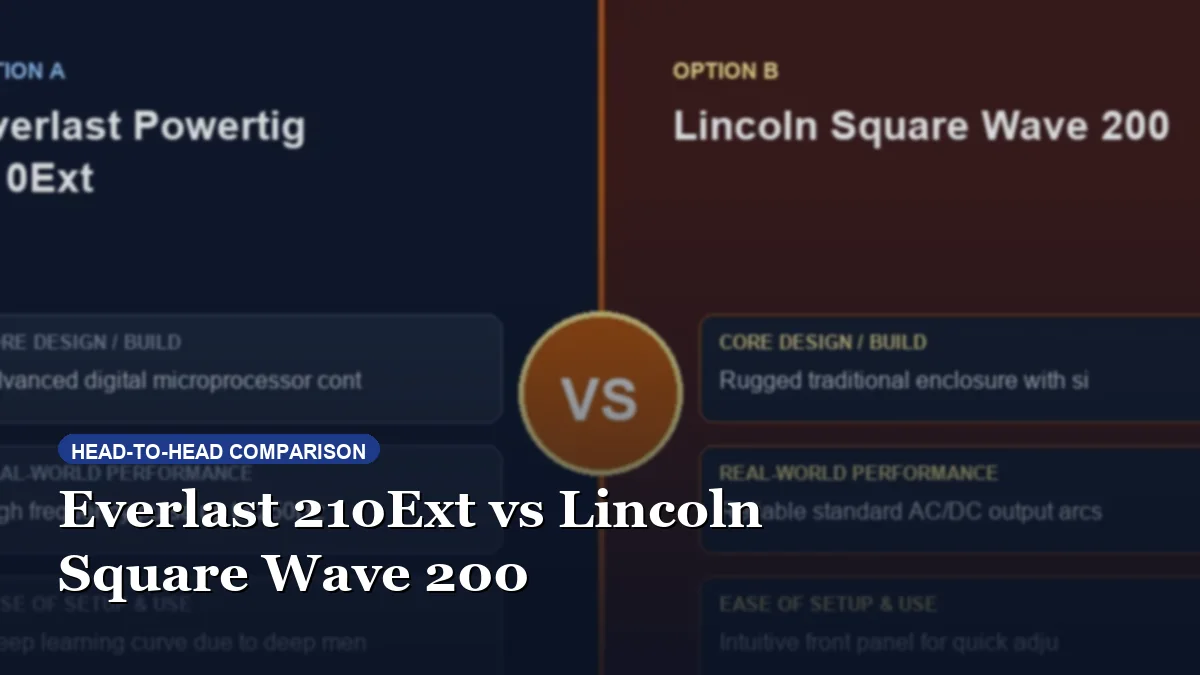
| Criteria | Everlast Powertig 210Ext | Lincoln Square Wave 200 | Edge |
|---|---|---|---|
| Core Design / Build | Advanced digital microprocessor control board | Rugged traditional enclosure with simple dials | Everlast |
| Real-World Performance | High frequency pulse up to 250Hz | Reliable standard AC/DC output arcs | Everlast |
| Ease of Setup & Use | Steep learning curve due to deep menu | Intuitive front panel for quick adjustments | Lincoln |
| Durability & Reliability | Solid metal housing with robust cooling | Industrial-grade internal transformer design | Lincoln |
| Efficiency / Operating Footprint | Compact inverter architecture with low draw | Slightly heavier cabinet with steady draw | Everlast |
| Maintenance Requirements | Regular internal dust clearing advised | Minimal upkeep with standard connections | Lincoln |
| Best Ideal Use Case | Precise sheet metal and thin aluminum | General fabrication and shop utility | Tie |
Core Architecture and Power Delivery
Modern welding equipment requires robust inverter technology to ensure stable arcs across varied materials. Both machines utilize solid-state electronics to convert standard workshop input power into clean welding output.
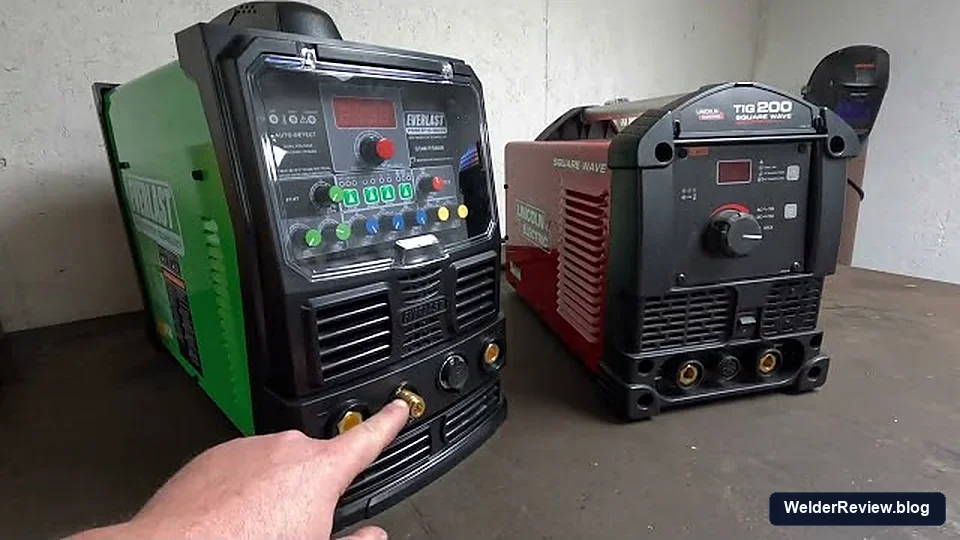
The internal layout of each unit dictates how efficiently they manage electrical loads during high-amperage aluminum runs. Proper component cooling prevents premature thermal shutdown during extended fabrication sessions.
The Everlast unit utilizes an advanced IGBT inverter topology designed to maximize electrical efficiency while reducing overall transformer weight. This solid-state architecture delivers a stable arc across varied input voltages.
Conversely, as detailed in our lincoln square wave tig 200 review, the machine employs a transformer-based square wave design prioritizing arc smoothness. Both units meet strict NEMA standards for electrical safety.
- High-frequency start reliability
- Inverter transformer efficiency
- Power factor correction circuits
Input Voltage Versatility
Dual-voltage capability allows operators to switch between standard household circuits and heavy industrial lines seamlessly. This flexibility remains vital for mobile contractors and garage fabricators alike.
- Automatic voltage sensing technology
- Dedicated 120V and 240V plugs
- Stable arc on long extension cords
AC Waveform Control and Frequency Settings
Controlling the alternating current waveform allows welders to manipulate cleaning action and penetration profiles precisely. Advanced parameter adjustments give experienced fabricators significant advantages over basic machines.
Adjustable balance and frequency settings directly influence bead width and tungsten balling during aluminum TIG welding operations. Fine-tuning these metrics reduces heat input on thin-gauge components.
Highlighted in our everlast powertig 210ext review, the unit provides extensive control with fully adjustable AC frequency up to 250 Hz, allowing operators to tighten the arc cone for precise aluminum welding.
Lincoln keeps AC frequency fixed at 60 Hz, prioritizing simplicity and low acoustic noise over hyper-focused arc constriction. This makes the Lincoln system exceptionally user-friendly for operators transitioning from older transformer welders.
- Advanced AC balance adjustments
- Selectable square and triangular waves
- Frequency modulation for tighter arcs
Cleaning Action Optimization
Proper oxide removal ensures sound weld joints on aluminum alloys without excessive tungsten erosion. Operators must balance cleaning percentage against overall electrode life expectancy.
- Removes stubborn surface contaminants
- Extends tungsten electrode lifespan
- Improves puddle visibility
Pulse TIG Capabilities and Parameters
Pulse controls enable superior heat management by alternating between peak and background amperage levels automatically. This function helps prevent burn-through on critical thin-wall stainless steel tubing.
Evaluated in our everlast powertig 210ext review, the unit provides extensive pulse frequency ranges exceeding standard entry-level machines. Such capabilities appeal directly to professional fabricators demanding absolute puddle control.
Featuring a high-speed pulse frequency adjustable up to 500 Hz, the Everlast machine excels at controlling heat input on thin-gauge stainless steel. Independent base amps and pulse time fractions enhance puddle management.
The Lincoln alternative lacks comprehensive high-frequency pulse controls, offering a much simpler pulse function suited primarily for basic sheet metal fabrication. Welders requiring intricate thermal profile manipulation will miss these advanced parameters.
- Adjustable background amperage controls
- Variable pulse frequency options
- Reduced heat-affected zone distortion
Pulsing for Aesthetic Ripples
Achieving stacked-dime weld aesthetics requires consistent pulse timing and steady torch travel speeds. Mastery of these settings transforms utilitarian joints into visually stunning craftsmanship.
- Consistent ripple spacing control
- Minimized oxidation discoloration
- Enhanced puddle stabilization
Duty Cycle and Thermal Management
Evaluating duty cycle ratings ensures your welder can handle continuous production work without overheating. Internal cooling fans play a major role in sustaining performance during heavy output.
Both welders manage thermal loads adequately within their designated amperage brackets for normal shop tasks. Exceeding rated thresholds will trigger safety mechanisms to protect sensitive circuit boards.
Operating at a 60 percent duty cycle at 150 amperes, the Everlast inverter requires careful monitoring during extended high-amperage aluminum runs. Internal cooling fans activate automatically to dissipate thermal loads efficiently.
Lincoln relies on heavy copper windings and oversized internal heat sinks to maintain thermal stability under demanding conditions. Compliance with CSA safety standards ensures reliable thermal cutout protection during sustained industrial welding tasks.
- Thermal overload indicator lights
- Demand-driven cooling fan systems
- Resilient internal wiring harnesses
Sustained Amperage Limits
Operating near maximum output requires monitoring your duty cycle closely to prevent unexpected downtime. Planning your fabrication schedule around cool-down periods preserves equipment longevity.
- Prevents premature component failure
- Maintains consistent arc voltage
- Protects rectifier diode bridges
Portability, Weight, and Power Inputs
Mobile repair technicians require lightweight inverter welders that load easily into service truck beds. Carrying handles and compact footprints dictate how easily a machine navigates crowded workspaces.
Weight differences between these two models remain minor, yet chassis design impacts overall ergonomic handling. Secure terminal connections prevent accidental cable detachment during transit.
Shown in our everlast powertig 200dv review, weighing roughly 45 pounds, the unit easily transports across job sites while supporting dual-voltage inputs for maximum operational versatility using standard adapters.
Tipping the scales near 50 pounds with its heavier internal transformer, the Lincoln model is less nimble for mobile contractors. It requires a dedicated 230V circuit to deliver its maximum output safely.
- Ergonomically balanced carry handles
- Impact-resistant composite front bezels
- Secure twist-lock Dinse connectors
Shop Floor Footprint
Minimizing bench space consumption keeps your primary fabrication area organized and hazard-free. Compact dimensions allow positioning the unit directly adjacent to your welding table.
- Fits comfortably on standard carts
- Clears valuable workspace surfaces
- Simplifies cable routing layouts
Shielding Gas and Torch Ergonomics
Argon gas delivery systems require precise flow meters to prevent atmospheric contamination of the weld pool. Quality torch packages enhance hand comfort during lengthy fabrication sessions.
Solenoid valve response times ensure proper pre-flow and post-flow gas shielding coverage automatically. Well-designed torch switches minimize finger fatigue during repetitive trigger cycles.
Both machines utilize standard argon gas setups with precise post-flow timers to protect tungsten electrodes from premature oxidation. High-frequency arc starts eliminate tungsten contamination without requiring high-frequency contact.
Ergonomic TIG torches equipped with flexible rubber cable jackets reduce wrist fatigue during long fabrication shifts. Operators should inspect the gas hose fittings regularly to prevent atmospheric leaks and porous welds.
- Precision post-flow timer controls
- Ergonomic flexible torch heads
- Braided rubber gas hoses
Gas Coverage Integrity
Maintaining proper shielding gas coverage protects reactive metals from severe porosity and cracking. Inspecting your regulator and fittings regularly prevents costly gas leaks on the job.
- Eliminates weld pool porosity
- Reduces tungsten tip oxidation
- Ensures clean penetration profiles
Maintenance Protocols and Serviceability
Routine maintenance keeps electronic welding machines operating at peak efficiency for many years. Periodic internal dusting removes conductive debris that could cause electrical shorts.
Checking ground clamp connections and torch consumables prevents erratic arc behavior during critical projects. Simple preventive care preserves your investment and guarantees reliable workshop performance.
Routine maintenance requires blowing out accumulated metallic dust from internal circuit boards using compressed shop air. Technicians must disconnect the primary power source before removing any chassis covers for internal cleaning.
Checking terminal connections and verifying contactor operation ensures long-term electrical reliability. Following proper service manuals prevents accidental damage to sensitive electronic components during routine calibration and preventative maintenance procedures.
- Regular compressed air cleaning
- Consumable inspection schedules
- Terminal torque verification checks
Troubleshooting Common Issues
Quickly diagnosing high-frequency start failures or gas solenoid issues minimizes workshop downtime. Consulting the manufacturer manual aids in identifying faulty fuses or loose internal wiring.
- Clear error code displays
- Accessible fuse replacement panels
- Straightforward diagnostic procedures
Frequently Asked Questions
Can both machines weld aluminum out of the box?
Yes, both units feature built-in AC capability specifically designed for aluminum fabrication. You will need pure argon shielding gas and a dedicated cylinder.
Which welder is better for absolute beginners?
The Lincoln model offers a simpler interface that helps novices learn fundamental torch control quickly. Its streamlined menus reduce setup confusion significantly.
Do these welders operate on standard household power?
Both machines feature dual-voltage inputs allowing connection to standard 120V outlets. Maximum output amperage requires a dedicated 240V circuit.
What torch consumables do these units accept?
They typically utilize standard industry consumables like 17-series or 26-series torch parts. Finding replacement collets and ceramic cups is extremely easy.
Is a foot pedal included with purchase?
Most authorized distributors bundle a standard foot pedal for amperage control during TIG welding. Verify package contents before finalizing your order.