ESAB vs Miller Multiprocess: Technical Head-to-Head
Comparing industrial ESAB systems against Miller multiprocess units reveals distinct engineering philosophies. Operating technicians must weigh arc stability, duty cycles, and digital interface responsiveness before finalizing their workshop acquisition.

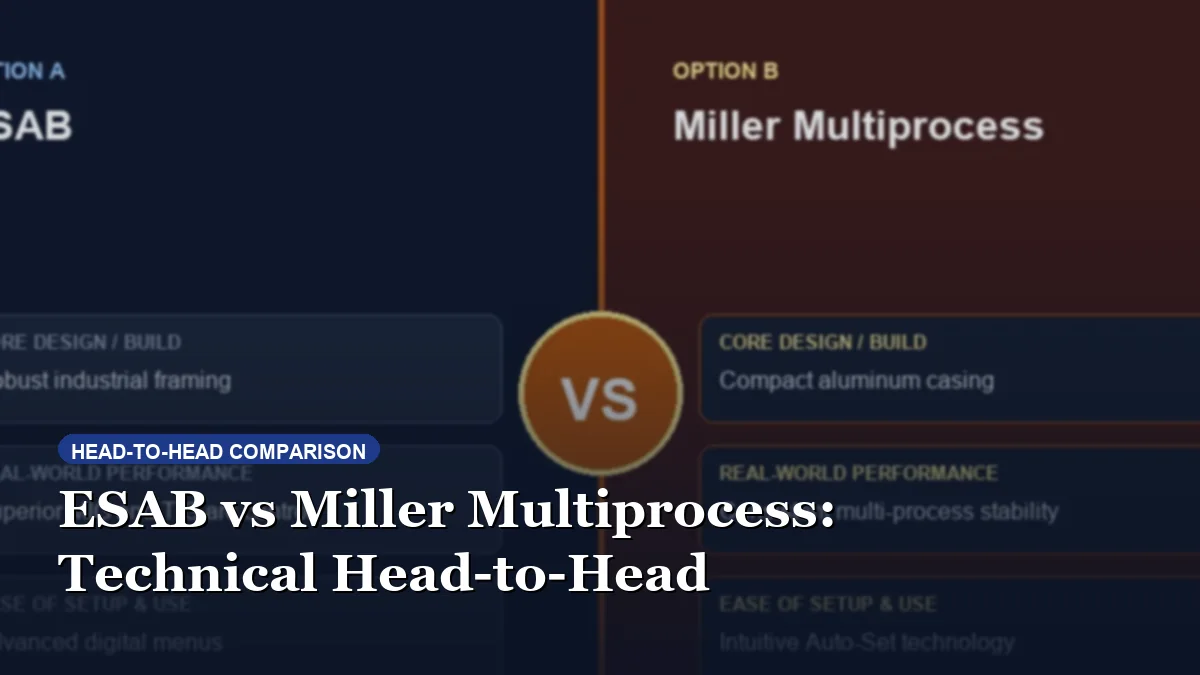
Choose ESAB for advanced wave control and high-amperage output. Select Miller for unmatched interface simplicity and dependable local service networks.
Compare all top models in our Best Welder: Top Home Shop & Jobsite Picks Tested.
Side-by-Side Breakdown
| Criteria | ESAB | Miller Multiprocess | Edge |
|---|---|---|---|
| Core Design / Build | Robust industrial framing | Compact aluminum casing | ESAB |
| Real-World Performance | Superior MIG and TIG arc control | Consistent multi-process stability | ESAB |
| Ease of Setup & Use | Advanced digital menus | Intuitive Auto-Set technology | Miller |
| Durability & Reliability | Heavy-duty internal shielding | Proven jobsite longevity | Miller |
| Efficiency / Operating Footprint | Optimized power factor correction | Inverter energy conservation | ESAB |
| Maintenance Requirements | Modular board replacement | Accessible wire drives | Miller |
| Best Ideal Use Case | Heavy fabrication shops | Mobile service trucks | Split |
Core Design and Engineering Principles
Engineering heavy-duty welding equipment requires balancing structural integrity with internal component protection. ESAB units often prioritize industrial-grade internal shielding to withstand harsh fabrication environments and continuous daily operations.
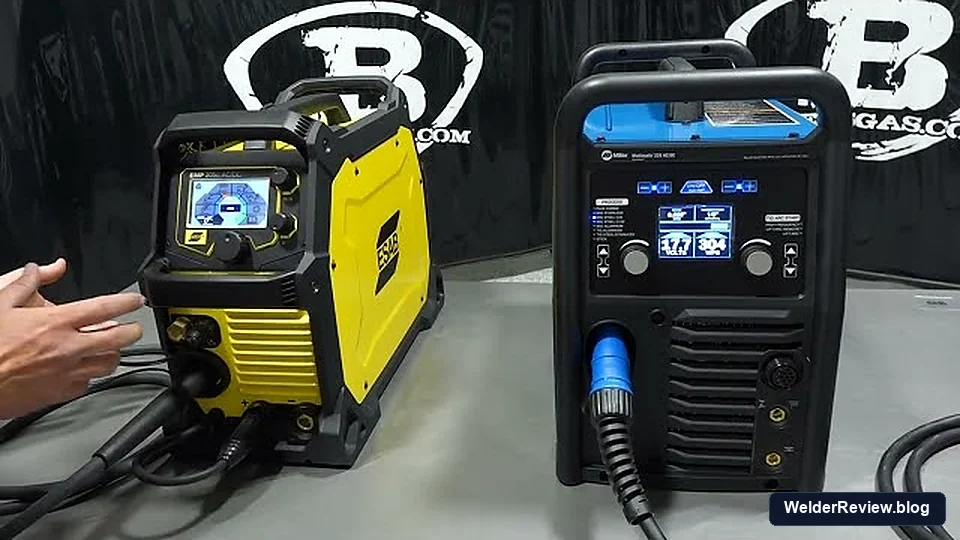
Conversely, Miller emphasizes modular chassis layouts that reduce overall weight without sacrificing frame rigidity. Evaluating these structural frameworks helps fabrication managers determine long-term durability across demanding jobsite applications.
Internal transformer designs also diverge significantly between these two industry giants. Understanding how cooling airflow paths protect sensitive electronics dictates how well each machine handles prolonged high-amperage output.
ESAB and Miller approach heavy-duty inverter architecture with distinct structural priorities. ESAB units often integrate modular chassis designs that isolate sensitive circuit boards from structural vibration and aggressive workshop environments.
Conversely, Miller emphasizes centralized thermal management pathways. Their internal wind tunnel technology routes cooling air directly over high-heat insulated gate bipolar transistors without exposing delicate control microprocessors to abrasive metallic dust.
Engineering choices directly impact duty cycle reliability under heavy industrial loads. Operators welding structural steel plates must evaluate how effectively each internal transformer handles prolonged amperage draws without triggering thermal overload protection.
- ESAB deploys heavy gauge steel enclosures.
- Miller uses optimized composite-reinforced structural frames.
- Cooling fan placement impacts thermal duty cycles.
Internal Component Layouts
Circuit board encapsulation protects sensitive microprocessors from conductive metal dust. ESAB applies specialized conformal coatings to resist aggressive shop contaminants effectively.
Meanwhile, Miller utilizes isolated airflow tunnels to direct cooling air past heat sinks while shielding primary control boards from airborne debris.
- Conformal coating prevents short circuits.
- Isolated airflow reduces thermal stress.
Arc Dynamics and Real-World Performance
Achieving a stable puddle requires precise voltage regulation and rapid arc recovery times. ESAB incorporates proprietary waveform control software to minimize spatter during short-circuit MIG welding operations.
On the other side, Miller focuses on smooth arc starts and consistent puddle wetting. As highlighted in our Miller Multimatic 220 AC/DC review, operators experience seamless transitions between TIG and MIG processes.
Pulsed welding capabilities further highlight the technological divergence between these competing brands. Advanced waveform customization allows operators to fine-tune heat input for thin-gauge stainless steel projects.
Arc stability during short-circuit MIG welding depends heavily on inductive tuning. ESAB machines feature adjustable inductance controls that let fabricators precisely tailor puddle fluidity, minimizing spatter generation on carbon steel fabrication projects.
Miller relies on proprietary waveform control software to optimize droplet transfer across varying input voltages. Their technology automatically compensates for minor cable voltage drops, maintaining a consistent arc length during demanding field installations.
TIG arc initiation also highlights fundamental performance differences. High-frequency starts on ESAB units deliver crisp tungsten contact, whereas Miller variants use sophisticated lift-arc sequences to eliminate tungsten inclusion risks in aerospace alloys.
- ESAB offers deep penetration profile adjustments.
- Miller delivers ultra-smooth arc ignition characteristics.
- Pulsed MIG performance varies under load.
Pulsed MIG Capabilities
Advanced synergy charts on ESAB machines automatically calculate optimal wire feed speeds based on material thickness. This automation reduces setup trial and error.
Alternatively, Miller relies on simplified parameter selection that helps apprentice welders achieve clean, uniform bead profiles without deep metallurgical training.
- Synergic curves streamline parameter changes.
- Apprentice operators benefit from guided menus.
Setup Ergonomics and Interface Technology
Operator fatigue often stems from convoluted menu navigation on modern digital faceplates. ESAB integrates high-resolution TFT screens that display comprehensive operational metrics clearly.
Meanwhile, Miller champions streamlined control knobs paired with intuitive graphic displays. This philosophy prioritizes rapid parameter adjustments while wearing heavy leather welding gloves.
Interface responsiveness directly influences daily productivity within high-throughput fabrication facilities. Minimizing the time spent adjusting voltage and wire feed speeds maximizes actual arc-on time.
Interface layouts dictate how quickly operators switch between MIG, TIG, and stick processes. ESAB prioritizes high-resolution TFT screens with graphic-heavy menus that guide novice welders through parameter selection steps without confusion.
Miller favors industrial membrane switches combined with precision rotary encoders. This tactile approach ensures reliable operation when technicians wear heavy welding gloves inside fabrication shops or cold outdoor environments where touchscreen sensitivity fails.
Ergonomics extend beyond control panels to handle placement and weight distribution. Balanced chassis handles and logical cable management brackets prevent fatigue during frequent relocations across expansive shipyard or automotive repair floor spaces.
- ESAB utilizes large multi-function color screens.
- Miller implements tactile knobs and clear displays.
- Gloved-hand usability remains a critical factor.
Digital Display Usability
Reading error codes quickly prevents extended diagnostic downtime during critical production runs. ESAB units provide descriptive text prompts alongside standard numeric fault codes.
In contrast, Miller streamlines troubleshooting by organizing diagnostic indicators logically across easily accessible front-panel LED status lights.
- Descriptive text aids rapid troubleshooting.
- Logical LED indicators speed up repairs.
Electrical Efficiency and Power Management
Modern power sources must comply with stringent energy efficiency standards while operating reliably on erratic jobsite generators. ESAB incorporates advanced power factor correction circuits to minimize wasted electrical draw.
Similarly, Miller utilizes multi-voltage plug technology allowing seamless transitions between single-phase and three-phase input power. These features protect internal components from unexpected voltage spikes.
Energy consumption directly impacts operational overhead for small fabrication shops and large manufacturing plants alike. Evaluating idle draw and under-load efficiency reveals true operating costs.
Modern multi-process welders rely on auto-line power technology to accept diverse primary voltages. As noted in our ESAB 215ic review, these efficient inverter systems significantly reduce overall power consumption during heavy fabrication shifts.
Power factor correction circuits further reduce idle current draw and generator fuel consumption. When running off portable diesel engine drives, these sophisticated inverter topologies prevent erratic voltage spikes that could damage internal rectifier components.
Monitoring amperage draw under load helps facility managers calculate operational utility overhead. Efficient power management ensures maximum output is delivered straight to the welding electrode without excessive parasitic power loss.
- Power factor correction reduces utility bills.
- Multi-voltage plugs enhance jobsite versatility.
- Generator compatibility prevents power faults.
Generator Power Compatibility
Running sensitive inverter welders off portable diesel generators demands robust internal surge suppression. ESAB designs tolerate fluctuating Hertz levels exceptionally well.
Meanwhile, Miller incorporates auto-line technology that automatically adjusts to incoming power fluctuations without requiring manual link-board changes.
- Surge suppression protects delicate inverters.
- Auto-line technology eliminates manual linking.
Maintenance Protocols and Longevity Factors
Preventative maintenance ensures consistent wire feeding and minimizes unexpected equipment failure on the shop floor. ESAB features accessible internal wire drive assemblies designed for rapid roll changes.
On the other hand, Miller emphasizes tool-less drive roll replacement and easy access to internal gas solenoids. Routine upkeep keeps downtime to an absolute minimum during shifts.
Long-term reliability depends heavily on the availability of replacement parts and authorized service repair centers. Both brands maintain extensive global distribution networks for critical components.
Preventative maintenance routines extend the working lifespan of expensive multi-process equipment. According to our ESAB Rebel EMP 215ic review, keeping internal circuitry clean prevents electrical bridging and premature board failures.
Drive roll maintenance is equally critical for consistent wire feed performance in MIG modes. Technicians must inspect gearboxes and tension arms periodically to avoid premature wear and eliminate wire birdnesting issues.
Calibration audits ensure output parameters match digital readouts over years of heavy usage. Authorized service centers verify voltage accuracy using calibrated dummy loads to maintain compliance with strict industry welding standards.
- ESAB features modular drive mechanisms.
- Miller uses tool-less roll changes.
- Service network availability ensures fast repairs.
Drive Roll Maintenance
Consistent wire delivery prevents bird-nesting and erratic arc behavior during long MIG runs. ESAB utilizes heavy-duty cast aluminum gearboxes for maximum torque.
Conversely, Miller employs precision-machined drive systems that maintain exact tension on soft aluminum welding wires effortlessly.
- Cast aluminum gearboxes provide high torque.
- Precision drives handle soft aluminum wire.
Consumable Ecosystems and Torch Compatibility
Standardizing consumable parts across multiple welding machines reduces inventory costs and simplifies ordering procedures. ESAB utilizes widely available contact tips and nozzles compatible with standard guns.
Similarly, Miller incorporates standard Euro-connections or proprietary direct-connect setups depending on the specific multi-process model. Selecting compatible torches improves gas coverage and weld quality.
Consumable lifespan directly affects ongoing operating expenses in high-production welding environments. Evaluating thermal degradation rates helps technicians choose superior contact tip materials.
Consumable compatibility dictates long-term operating costs across diverse welding applications. Both ESAB and Miller design proprietary torch connections, yet many models accept standard Bernard or Euro-style MIG guns for maximum flexibility.
Contact tip longevity and gas diffuser efficiency directly impact weld bead quality and consumable expenses. Selecting heavy-duty contact tips prevents premature burnout during high-amperage spray transfer operations on thick steel assemblies.
TIG torch configurations also require careful evaluation regarding water-cooling versus air-cooled setups. High-output production welding mandates water-cooled torches to protect torch heads from extreme heat during extended duty cycles.
- Standardized consumables lower inventory expenses.
- Torch connectivity impacts shielding gas flow.
- Tip longevity reduces replacement frequency.
Shielding Gas Management
Precise post-flow and pre-flow timing protects the molten puddle from atmospheric contamination. ESAB allows granular digital adjustment of these vital gas parameters.
Meanwhile, Miller automates gas delivery cycles through smart presets tailored to specific wire diameters and shielding gas blends.
- Granular gas timing prevents oxidation.
- Automated presets simplify shielding setup.
Selecting the Optimal Multiprocess Machine
Choosing between these premier brands ultimately depends on your specific workshop requirements and operator skill levels. ESAB excels in heavy industrial settings requiring complex arc control parameters.
Conversely, Miller dominates mobile service applications where quick setup is paramount. As detailed in our Miller 220 multiprocess welder review, this machine delivers exceptional arc stability for field fabrication tasks.
Investing in a quality multiprocess machine streamlines fabrication workflows by combining MIG, TIG, and Stick capabilities into one footprint. Careful evaluation guarantees long-term operational satisfaction.
Choosing the ideal multiprocess machine requires balancing current workshop demands against future fabrication expansion goals. Maintenance supervisors should analyze primary material thicknesses and commonly used welding processes before making final purchases.
Portability requirements often dictate whether a compact inverter or a heavier industrial unit suits the job. Field service technicians benefit immensely from lightweight machines capable of running off auxiliary engine-driven generators.
Budget allocation must encompass initial capital costs alongside ongoing consumable and maintenance expenses. Investing in reputable brands ensures long-term reliability and guarantees access to replacement parts when unexpected repairs occur.
- Match machine specs to daily fabrication needs.
- Consider operator familiarity with digital interfaces.
- Evaluate local service and warranty support.
Final Purchasing Checklist
Review maximum amperage requirements against your facility electrical service capabilities before buying. ESAB units often demand robust three-phase power supplies.
Verify that your chosen model includes necessary accessories like primary torch leads and ground clamps to avoid unexpected startup expenses.
- Check facility electrical amperage limits.
- Verify included accessories before purchase.
Frequently Asked Questions
Which brand offers better arc stability for aluminum MIG welding?
ESAB provides superior waveform control for aluminum. This advanced technology minimizes spatter and ensures clean puddle wetting.
Are Miller multiprocess units easier for beginners to set up?
Miller features intuitive interface technology like Auto-Set. These built-in guides significantly reduce learning curves for new operators.
Can both brands operate reliably on portable diesel generators?
Yes, both manufacturers integrate robust voltage surge suppression. This internal protection prevents damage from fluctuating generator power.
Do these machines require specialized consumables for everyday fabrication?
Standard consumables work well for both brands. Universal compatibility keeps ongoing operational costs manageable for small shops.
How do warranty terms compare between ESAB and Miller?
Both companies offer competitive industrial warranties. Authorized service centers ensure fast turnaround times for any necessary repairs.