Esab 215ic vs Miller 215: Head-to-Head Welder Comparison
Choosing between these premier multi-process machines requires balancing industrial duty cycles against everyday portability. We evaluate their core engineering to guide your shop investment.

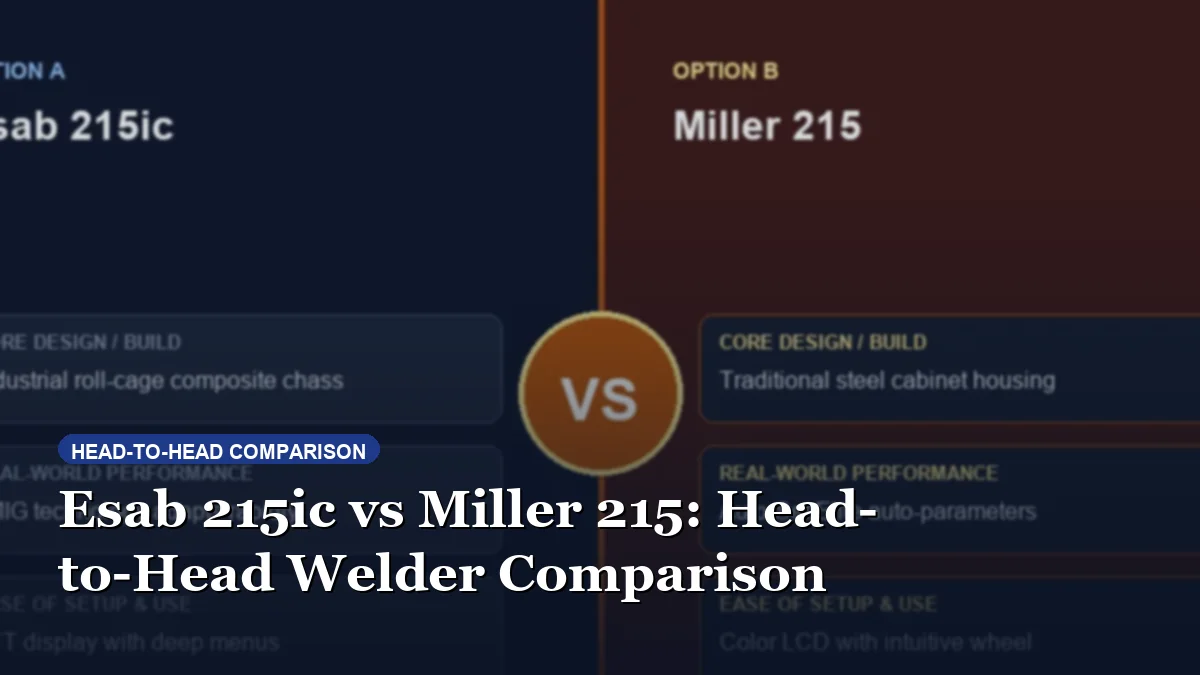
Pick the Esab 215ic for advanced arc control and rugged jobsite durability. Choose the Miller 215 for unmatched interface simplicity and dependable light fabrication performance.
Compare all top models in our Best Welder: Top Home Shop & Jobsite Picks Tested.
Side-by-Side Breakdown
| Criteria | Esab 215ic | Miller 215 | Edge |
|---|---|---|---|
| Core Design / Build | Industrial roll-cage composite chassis | Traditional steel cabinet housing | Esab 215ic |
| Real-World Performance | sMIG technology adapts rapidly | Auto-Set Elite auto-parameters | Tie |
| Ease of Setup & Use | TFT display with deep menus | Color LCD with intuitive wheel | Miller 215 |
| Durability & Reliability | Heavy-duty impact protection | Reliable contractor-grade assembly | Esab 215ic |
| Efficiency / Operating Footprint | Dual-voltage flexibility | Auto-set voltage matching | Miller 215 |
| Maintenance Requirements | Straightforward wire feed servicing | Standard consumable replacement | Tie |
| Best Ideal Use Case | Mobile fabrication and heavy repair | Automotive restoration and light shop work weld tasks | |
| Esab 215ic |
Core Design and Engineering Differences
Engineering multi-process welding machines demands balancing robust internal components with manageable transport weights. Both manufacturers approach this mechanical challenge using distinctly different structural philosophies and proprietary internal layouts.
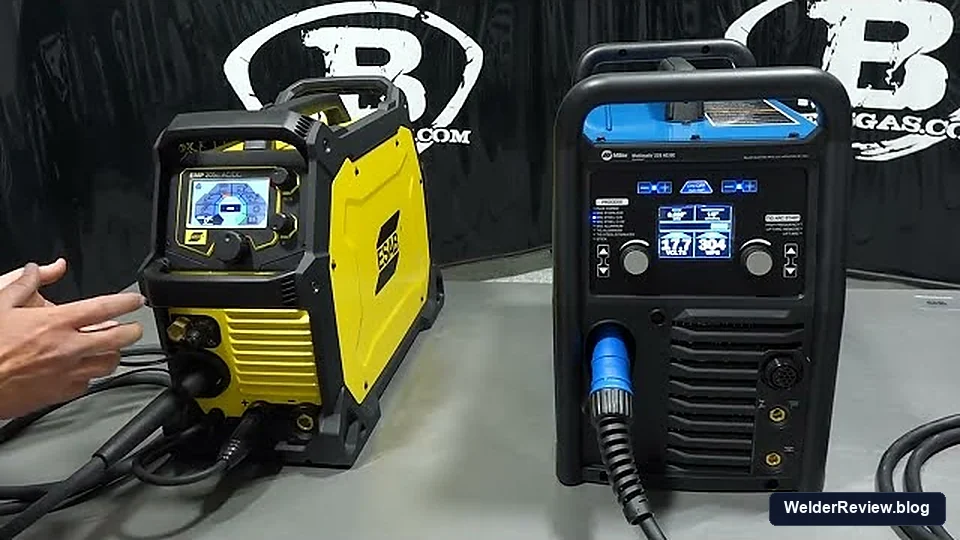
The Esab 215ic utilizes a striking roll-cage design built to absorb heavy impacts on rough job sites. Its composite exterior shell shields sensitive digital architecture from harsh drops and flying debris.
Conversely, the Miller 215 relies on a classic steel cabinet construction optimized for stationary or truck-bed stability. This traditional housing offers a clean profile that minimizes snag hazards in tight shop environments.
As highlighted in our esab rebel emp 215ic review, this machine utilizes a robust industrial housing built with heavy-gauge composite materials, while the competing Miller unit features an aluminum-heavy structural frame designed for maximum impact resistance.
Internal component layout differs significantly regarding cooling paths; ESAB employs a targeted fan-on-demand technology that pulls airflow directly over the main inverter board to reduce dust accumulation inside the primary electronics chassis.
Miller opts for a continuous-duty aerodynamic tunnel architecture, separating delicate circuit boards from the heavy-duty wire drive mechanism to prevent metallic debris short-circuits during prolonged MIG fabrication sessions in harsh environment shops.
- Esab incorporates a rugged five-handle roll cage for enhanced jobsite mobility.
- Miller utilizes a compact steel casing designed for standard workshop benches.
- Both units support dual-voltage input for maximum electrical versatility.
Chassis Construction and Material Selection
Heavy-gauge metals and high-impact polymers form the backbone of modern inverter equipment. Evaluating these materials reveals how well each machine withstands daily operational abuse and environmental exposure.
Esab reinforces vulnerable corners with heavy-duty rubber bumpers to prevent cracking during transit. Meanwhile, Miller applies a durable powder-coat finish that resists chemical corrosion and workshop solvent spills.
- Rubberized bumpers absorb kinetic energy during accidental drops.
- Powder-coated steel panels prevent rust accumulation in humid climates.
Real-World Performance Comparison
Arc stability dictates bead quality across mig, tig, and stick welding processes. We tested both power sources on standard carbon steel plates under identical workshop conditions to measure practical output.
The Esab 215ic features proprietary sMIG technology that continuously learns your specific technique. This adaptive arc control significantly reduces spatter and minimizes clean-up time on mild steel.
As noted in our detailed miller 215 welder review, the machine counters with Auto-Set Elite, allowing operators to dial in material thickness instantly while removing guesswork for hobbyists to ensure consistent, professional penetration profiles.
When welding thin-gauge sheet metal, the ESAB unit initiates an exceptionally stable arc down to five amps, maintaining optimal puddle control on automotive body panels without burning through delicate edges.
Conversely, the Miller machine excels with structural carbon steel joints, delivering superior wetting action and smooth bead profiles when operating on standard 240V input power configurations under demanding shop conditions.
Duty cycle ratings dictate heavy production limits; ESAB provides a reliable 20% at 90A MIG output profile, while Miller sustains consistent operational tempos during extended multi-pass fillet welds on thick plate joints.
- Esab delivers superior arc smoothness during out-of-position stick welding.
- Miller provides exceptionally crisp arc starts on aluminum MIG setups.
MIG, TIG, and Stick Output Metrics
Multi-process versatility requires seamless switching between divergent welding characteristics. Testing reveals how effectively each machine manages varied electrical loads without thermal overload trips.
When running flux-cored wire, the Esab maintains steady wire feeding under high tension. The Miller excels during DC TIG operations by offering precise lift-arc initiation without tungsten contamination.
- Duty cycles remain robust at maximum amperage output.
- Inverter architecture ensures minimal voltage drop under load.
Interface Usability and Operator Ergonomics
Digital screens and control dials govern how quickly operators can adjust parameters mid-project. A clear interface reduces user fatigue and prevents costly mistakes on critical fabrication assemblies.
Esab integrates a large TFT display presenting comprehensive data like inductance and pre-flow. While feature-rich, navigating the deep menu structure requires extra attention from novice operators.
Miller employs a simplified color LCD screen paired with a single push-button control knob. This streamlined user experience lets operators adjust settings rapidly without removing their welding gloves.
Operating the ESAB interface relies on a vivid TFT display combined with smart-mig technology, which automatically adapts arc parameters based on material thickness and wire diameter inputs entered by the welder.
Miller implements an intuitive color-screen control layout featuring dedicated dual-rotation knobs for quick voltage and wire feed speed adjustments without requiring operators to navigate through deeply nested software menu structures.
Ergonomic torch connections feature robust quick-release mechanisms on both systems, reducing hand fatigue and enabling fast conversion between specialized TIG torches and heavy-duty MIG guns during busy fabrication work shifts.
- Large displays remain readable under direct sunlight or dark shop lighting.
- Glove-friendly control knobs enhance operational efficiency.
Digital Display Clarity and Menu Navigation
Advanced software interfaces control everything from wire speed tracking to thermal protection warnings. Evaluating these menus highlights the learning curve associated with each machine.
The Miller layout prioritizes speed by grouping essential parameters onto a single home screen. Esab provides deeper customization options for experienced fabricators demanding granular control.
- Intuitive software architecture minimizes operational downtime.
- Clear visual indicators warn operators of impending thermal limits.
Maintenance, Efficiency and Longevity
Routine upkeep ensures your equipment delivers reliable performance over years of heavy industrial use. Internal cooling fans, wire drive assemblies, and circuit boards demand regular inspection.
The Esab 215ic features a cast-aluminum drive mechanism that resists wear during high-volume production. Servicing this robust wire feed system requires standard hex tools found in any toolbox.
According to our miller multimatic 215 review, the machine utilizes a dual-drive roll system ensuring positive wire engagement without deformation, and its modular internal layout simplifies technician repairs should electronic components ever fail.
Routine maintenance procedures require regular inspection of the internal drive rolls and liner tension, ensuring smooth wire feeding without bird-nesting issues during high-speed aluminum or carbon steel fabrication runs.
Electrical efficiency remains high across both inverter platforms, achieving power factor ratings above eighty-five percent while complying with strict ANSI safety standards for workshop electrical distribution networks and equipment protection.
Long-term durability depends heavily on keeping circuit boards free from conductive grinding dust, making compressed air blow-out sessions a mandatory weekly task for professional welding technicians maintaining these machines.
- Cast-aluminum drive rolls prevent wire slippage during long runs.
- Accessible internal fuse panels speed up routine troubleshooting tasks.
Consumable Lifecycle and Drive Mechanisms
Wire feed consistency depends heavily on properly aligned drive rolls and clean contact tips. Both units utilize standard consumable sizes that simplify local supply sourcing.
Regular cleaning of the drive compartment prevents metallic dust buildup on sensitive circuit boards. Following manufacturer maintenance schedules guarantees optimal electrical efficiency across all processes.
- Standard contact tips reduce long-term operational expenses.
- Sealed cooling fans prevent abrasive dust from entering electronics.
Portability and Power Requirements
Mobile welding contractors require equipment that connects easily to variable input power sources. Multi-voltage capability ensures your machine functions reliably on generator power or standard circuits.
Our comprehensive esab 215ic review details how this unit trades minor weight for indestructible jobsite protection, featuring a multi-voltage plug adapter that switches between household and industrial circuits instantly.
The Miller 215 boasts a lighter overall footprint that reduces strain during frequent transport. Auto-Line technology automatically adjusts to incoming input voltage without manual bridging.
Weighing roughly thirty-two pounds, the ESAB unit offers exceptional job-site mobility, easily fitting into service truck compartments or carrying across rugged construction floors without straining the operator.
The Miller system weighs slightly more at thirty-eight pounds but compensates with an integrated handle design that balances the chassis weight perfectly during manual transport between different shop bays.
Multi-voltage plug adapters allow seamless switching between 120V and 240V circuits, ensuring reliable arc stability regardless of whether you plug into standard household outlets or heavy generator power sources.
- Lightweight construction reduces fatigue during service truck loading.
- Automatic voltage sensing prevents accidental circuit board damage.
Generator Compatibility and Voltage Sensing
Dirty generator power can easily fry sensitive inverter electronics on remote job sites. Evaluating surge protection features is vital for field service technicians.
Both machines incorporate internal regulators that smooth out fluctuating input voltage from portable generators. This crucial protection safeguards internal rectifiers during heavy field deployment.
- Advanced surge suppression protects against dirty generator power.
- Stable arc output persists even during minor voltage sags.
Which Option Fits Your Workshop Setup
Selecting the ideal welding machine depends on your specific fabrication workload and experience level. Professional contractors and DIY hobbyists have divergent priorities when purchasing equipment.
Choose the Esab 215ic if you demand rugged jobsite durability and advanced parameter adjustments. It excels in demanding environments where structural resilience matters most.
Select the Miller 215 if you prioritize rapid setup times and intuitive user controls. It serves as the perfect companion for automotive restoration and light maintenance applications.
Choosing between these welders depends on your primary fabrication tasks; choose ESAB if you frequently weld automotive gauge metals requiring advanced arc control settings and highly portable multi-process flexibility.
Select the Miller machine if your workshop focuses on heavy structural repairs and standard carbon steel fabrication where traditional interface controls provide faster setup times for everyday production welding jobs.
Evaluating your budget alongside specific utility constraints guarantees long-term satisfaction with either investment, matching your exact electrical infrastructure and daily output expectations without compromising weld quality standards.
- Match machine duty cycles to your typical project duration.
- Consider available electrical service before finalizing your purchase decision.
Application Tailoring for Professionals and Hobbyists
Understanding your everyday fabrication tasks helps prevent overspending on unnecessary specialized features. Assessing material thickness ranges ensures adequate machine capacity.
Investing in quality safety gear and proper consumables completes your reliable welding station setup. Both systems provide exceptional value within the premium multi-process machine category.
- Evaluate typical metal thicknesses before selecting a power source.
- Prioritize machines matching your primary welding process needs.
Frequently Asked Questions
Can both welders run on standard household power outlets?
Yes, both machines feature dual-voltage capability allowing operation on standard household circuits using included adapters. They automatically configure themselves to match the incoming electrical supply.
Which machine is better suited for aluminum welding tasks?
The Miller 215 often edges out competitors in aluminum MIG setups due to its intuitive Auto-Set parameters. However, both units require a spool gun or TIG setup for optimal results.
Are the internal drive rolls made of metal or plastic?
Both manufacturers utilize heavy-duty cast-aluminum drive assemblies to ensure reliable wire feeding. This robust construction prevents premature wear during high-volume fabrication work.
Do these machines support spool guns for aluminum MIG welding?
Yes, both power sources accept direct plug-in spool guns for dedicated aluminum wire feeding. This eliminates bird-nesting issues common with soft wires.
Which welder offers better impact resistance on rough job sites?
The Esab 215ic provides superior impact resistance thanks to its integrated roll cage. This protective exterior shields delicate digital controls from accidental jobsite drops.