Eastwood Tig 200 vs Digital TIG: Technical Clash
Comparing the analog transformer and inverter heritage of the Eastwood TIG 200 against advanced microprocessor-controlled digital welding machines for everyday fabrication shop utility.

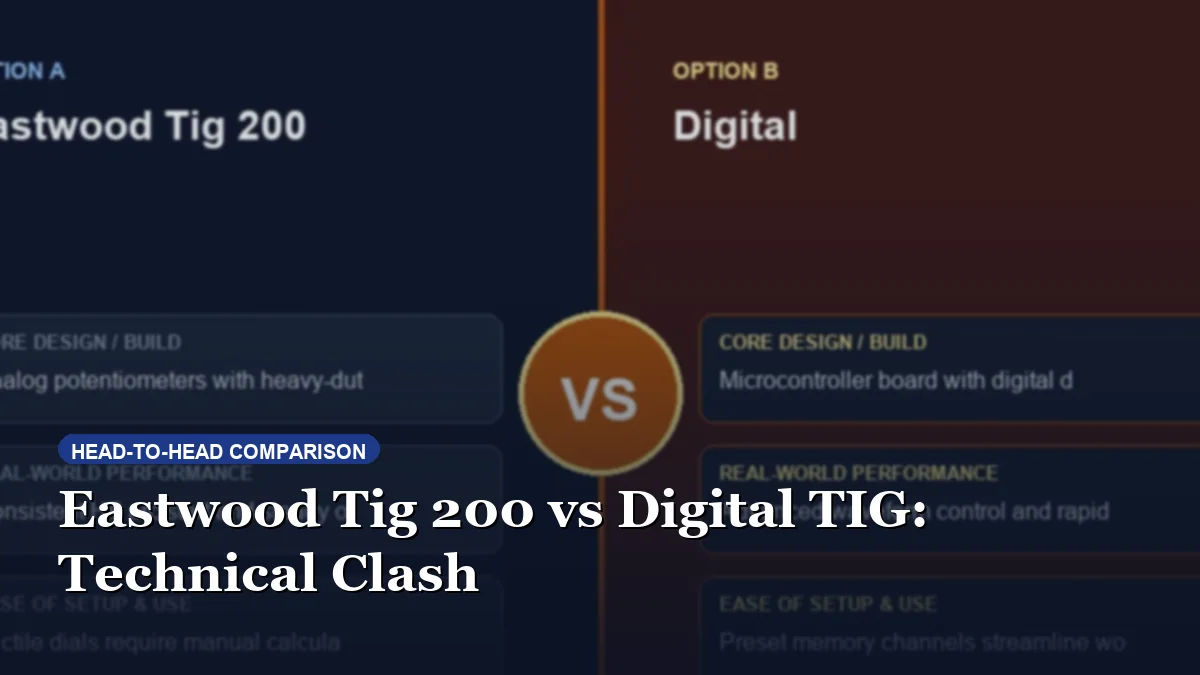
Choose the Eastwood Tig 200 for reliable physical knobs and straightforward repairs. Select Digital units for exact parameter storage and superior pulse frequency precision.
Compare all top models in our Best Welder: Top Home Shop & Jobsite Picks Tested.
Side-by-Side Breakdown
| Criteria | Eastwood Tig 200 | Digital | Edge |
|---|---|---|---|
| Core Design / Build | Analog potentiometers with heavy-duty chassis | Microcontroller board with digital display | Digital |
| Real-World Performance | Consistent HF arc start and steady output | Advanced waveform control and rapid response | Digital |
| Ease of Setup & Use | Tactile dials require manual calculation | Preset memory channels streamline workflows | Digital |
| Durability & Reliability | Fewer circuit boards prone to heat fatigue | Complex electronics demand clean workshop power | Eastwood Tig 200 |
| Efficiency / Operating Footprint | Standard inverter draw with dual voltage | Optimized power factor correction circuitry | Digital |
| Maintenance Requirements | Simple component swaps and easy cleaning | Professional diagnostics needed for board faults | Eastwood Tig 200 |
| Best Ideal Use Case | General fabrication and budget hobbyists | Aerospace, motorsport, and production welding | Digital |
Core Design and Engineering Differences
As detailed in our Eastwood AC/DC TIG welder review, engineering philosophies separate traditional analog systems from modern microprocessor platforms. The unit relies on sturdy physical potentiometers for precise amperage tuning.
Conversely, digital welding machines integrate advanced software to govern output frequencies, balancing high-frequency arc stability with strict thermal management protocols.
Our Eastwood TIG 200 review highlights its reliance on discrete potentiometers and traditional transformer-rectifier topologies. This build prioritizes rugged simplicity, making circuit board diagnostics straightforward for technicians using standard multimeters in the field.
Conversely, the digital iteration integrates an advanced microprocessor-controlled inverter architecture. This modern layout drastically reduces overall cabinet weight while optimizing internal component placement for improved thermal dissipation during extended aluminum AC welding sessions.
- Analog architecture utilizes discrete potentiometers for amperage control.
- Digital alternatives feature embedded microchips for rapid waveform adjustments.
- Chassis construction varies between heavy steel frames and compact composite shells.
Circuitry and Component Layout
Internal circuit layouts dictate how easily a machine handles thermal stress. Traditional layouts separate high-voltage components from sensitive logic boards effectively.
Digital systems cluster microcontrollers close to display panels, requiring robust heat sinks to prevent premature thermal overload during extended heavy fabrication cycles.
- Separated power pathways minimize electrical noise interference.
- Integrated logic boards manage intricate pulse sequence timings.
Real-World Arc Performance and Stability
Evaluating arc characteristics across units featured in our best 200 amp AC/DC TIG welder guide reveals distinct operational traits. High-frequency starts on this analog model remain dependable across various alloy types.
Digital power sources manipulate current milliseconds faster, providing superior arc focus when joining thin stainless steel or aerospace-grade aluminum assemblies.
Analog transformers deliver a naturally soft, forgiving arc that absorbs slight hand tremors during manual torch manipulation. However, lower-amperage starting can occasionally lack the crisp initiation required for ultra-thin stainless steel fabrication work.
Digital units utilize high-frequency arc starts paired with rapid current regulation loops. Welders benefit from exceptional arc stability down to 10 amps, preventing base metal burn-through on razor-thin sheet metal assemblies without sacrificing penetration depth.
- Smooth arc initiation prevents tungsten contamination during startups.
- Advanced square-wave controls dictate cleaning action on aluminum.
Low-Amperage Arc Behavior
Welding foil-thin metals demands exceptional arc stability at low current thresholds. Analog systems sometimes struggle to maintain ionization below twenty amperes reliably.
Digital architecture applies software-driven arc force compensation, ensuring stable low-end performance without unexpected arc extinguishment or erratic wandering.
- Stable low-end output prevents burn-through on sheet metal.
- Precise arc control reduces tungsten spitting during delicate passes.
Control Interfaces and Parameter Customization
User interfaces dictate how quickly operators can adjust settings mid-project. Physical dials offer immediate tactile feedback without navigating complex menu trees.
Digital displays present exact numerical readouts for pre-flow, post-flow, and pulse parameters, eliminating guesswork during repetitive fabrication tasks.
Analog faceplates feature physical dials for amperage, gas pre-flow, and post-flow timers. While tactile and glove-friendly, these rotary knobs lack precise numerical feedback, requiring operators to rely heavily on visual muscle memory and trial adjustments.
Digital interfaces introduce programmable memory channels and clear LED display screens. Fabricators can dial in exact pulse frequencies, AC balance percentages, and cleanup limits down to single-digit increments for repeatable, code-quality production welds every time.
- Physical knobs allow quick gloved adjustments in busy shops.
- Digital screens store custom job memories for instant recall.
Memory Storage and Job Recalls
Switching between different base materials often requires tedious parameter recalibration. Digital interfaces solve this by storing dozens of custom user profiles.
Traditional units lack memory banks, forcing fabricators to manually record and reset dial positions when transitioning between steel and aluminum projects.
- Saved profiles accelerate multi-material production workflows.
- Manual tracking demands meticulous record-keeping on paper.
Maintenance, Efficiency and Longevity
Long-term machine survival depends on preventative upkeep and environmental resilience. Simple electronic designs make troubleshooting circuit faults manageable for independent shop owners.
Digital units offer diagnostic error codes on screen, simplifying initial troubleshooting while occasionally requiring costly proprietary replacement circuit boards.
Traditional analog machines feature heavy copper windings and robust mechanical switches capable of withstanding severe workshop environments. Routine maintenance focuses primarily on blowing out accumulated metallic dust and inspecting internal cooling fan bearings.
Digital power sources demand cleaner operating environments due to sensitive circuit boards. Technicians must regularly check firmware connections and verify that cooling fan thermistors operate correctly to prevent thermal fault shutdowns during heavy industrial workloads.
- Regular dust removal protects sensitive internal cooling fans.
- Diagnostic error codes accelerate professional technician repairs.
Cooling Systems and Thermal Thresholds
Effective thermal management prevents unexpected shutdowns during long welding sessions. Tunnel-flow ventilation directs cooling air past critical transformer windings efficiently.
Digital platforms utilize demand-driven fan algorithms that activate only when internal temperature sensors detect rising heat loads across logic components.
- Continuous airflow protects heavy-duty transformer cores.
- Smart fans reduce dust accumulation inside the cabinet.
Power Delivery and Input Requirements
Electrical infrastructure dictates where and how you can deploy your welding equipment. Dual-voltage capability allows seamless transition between standard household and heavy industrial circuits.
Advanced inverter topologies maximize electrical efficiency, drawing fewer total amperes from the wall while delivering robust output at the torch tip.
Operating these welders safely requires strict adherence to NEMA 6-50 receptacles and dedicated 220-volt circuits. Voltage fluctuations can severely impact analog transformer stability, leading to erratic arc behavior during peak grid usage hours in commercial shops.
Digital inverter models incorporate built-in voltage compensation circuits. These smart electronics automatically adjust for minor input power sags, ensuring consistent arc output and bead profile uniformity even when running on long extension cords.
- Dual-voltage plugs provide flexible shop placement options.
- Inverter efficiency lowers monthly electrical operating costs.
Generator Compatibility and Voltage Fluctuations
Field repairs often require running welding equipment off portable engine-driven generators. Analog machines tolerate dirty power and minor voltage surges gracefully.
Sensitive digital microprocessors require clean, stable electricity to prevent erratic behavior or catastrophic logic board failures during remote field operations.
- Rugged analog internal components withstand dirty generator power.
- Inverter surge protection safeguards delicate digital microchips.
Material Compatibility and Thickness Limits
Successfully joining diverse metals requires adequate amperage headroom and precise control. Both options handle mild steel, stainless steel, and aluminum proficiently.
Pushing past nominal thickness limits exposes differences in duty cycle endurance, requiring careful joint preparation and multi-pass techniques on heavy plate sections.
Both machines effectively handle structural steel and stainless alloys up to one-quarter inch thickness in a single pass. Proper joint preparation, including standard 37-degree bevels and root gaps, remains mandatory for achieving full penetration welds.
When welding aluminum, digital units excel by offering independent cleaning control adjustments. This feature strips stubborn surface oxides efficiently while maintaining a stable tungsten ball, outperforming the fixed frequency limits of older analog transformers.
- AC balance controls remove aluminum oxide layers effectively.
- High duty cycles support continuous multi-pass structural welding.
Tungsten Preparation and Arc Ignition
Proper tungsten conditioning directly impacts arc stability across all material types. High-frequency ignition circuits reduce electrode wear and preserve ball geometries.
Advanced digital arc control minimizes thermal shock to the tungsten tip during high-frequency initiation sequences, extending consumable lifespan significantly.
- Clean high-frequency starts preserve pointed tungsten profiles.
- Consistent arc energy prevents split electrode tips.
Which Option Fits Your Setup
Selecting the ideal welding machine depends entirely on your daily fabrication demands and technical expertise. Budget-conscious hobbyists benefit immensely from straightforward controls.
Professional production environments justify investing in digital precision to achieve repeatable quality standards across complex aerospace and motorsport assemblies.
Unlike options covered in our Lincoln Square Wave TIG 200 review, this analog machine prioritizes bulletproof reliability and straightforward circuit repair. It suits budget-conscious fabricators who primarily tackle general repairs and standard automotive tasks.
Select the digital version when your workflow demands precise parameter repeatability and advanced AC wave control. It proves indispensable for aerospace contractors, motorsports fabricators, and production environments working with exotic alloys and thin gauges.
- Assess your typical material thickness before finalizing purchase decisions.
- Weigh the value of preset memory slots against upfront equipment expenses.
Making Your Final Purchasing Choice
Take time to evaluate your workshop electrical supply and primary project types. Prioritizing robust build quality ensures dependable service for years of heavy use.
Matching machine capabilities to your specific skill level guarantees maximum productivity and cleaner finished weldments on every single project.
- Match machine specs to your most demanding fabrication tasks.
- Prioritize reliable customer support and warranty coverage.
Frequently Asked Questions
Can the Eastwood TIG 200 weld aluminum effectively out of the box?
Yes, this machine features integrated AC balance controls designed specifically for removing heavy aluminum oxide layers. Selecting proper pure or ceriated tungsten ensures stable arc cleaning action during your fabrication runs.
Why do digital TIG welders cost significantly more than analog units?
Digital systems incorporate advanced microprocessors, programmable memory slots, and sophisticated software for precise waveform control. These components deliver superior arc stability and exact parameter repeatability that justify the higher purchase price.
Are digital welding machines more sensitive to dirty workshop power?
Microcontroller boards rely on clean electrical current to function properly without experiencing logic errors. Utilizing a dedicated power line protects sensitive internal components from harmful voltage spikes and drops.
What maintenance is required to keep an inverter TIG welder running smoothly?
Routine upkeep involves blowing out accumulated metal dust with compressed air every few months. Inspecting torch leads and cleaning cooling fan vents prevents overheating during extended heavy fabrication work.
Which machine type is better suited for beginner welders learning the trade?
Analog units with physical dials provide a straightforward learning curve without confusing menu navigation. Beginners master the fundamentals quickly when relying on tactile feedback rather than digital interface screens.