Contact Tip vs Nozzle Welding: Technical Performance
Understanding MIG welding consumable dynamics requires analyzing current transfer versus gas shielding. Choosing the right component optimizes weld pool integrity and reduces equipment downtime.

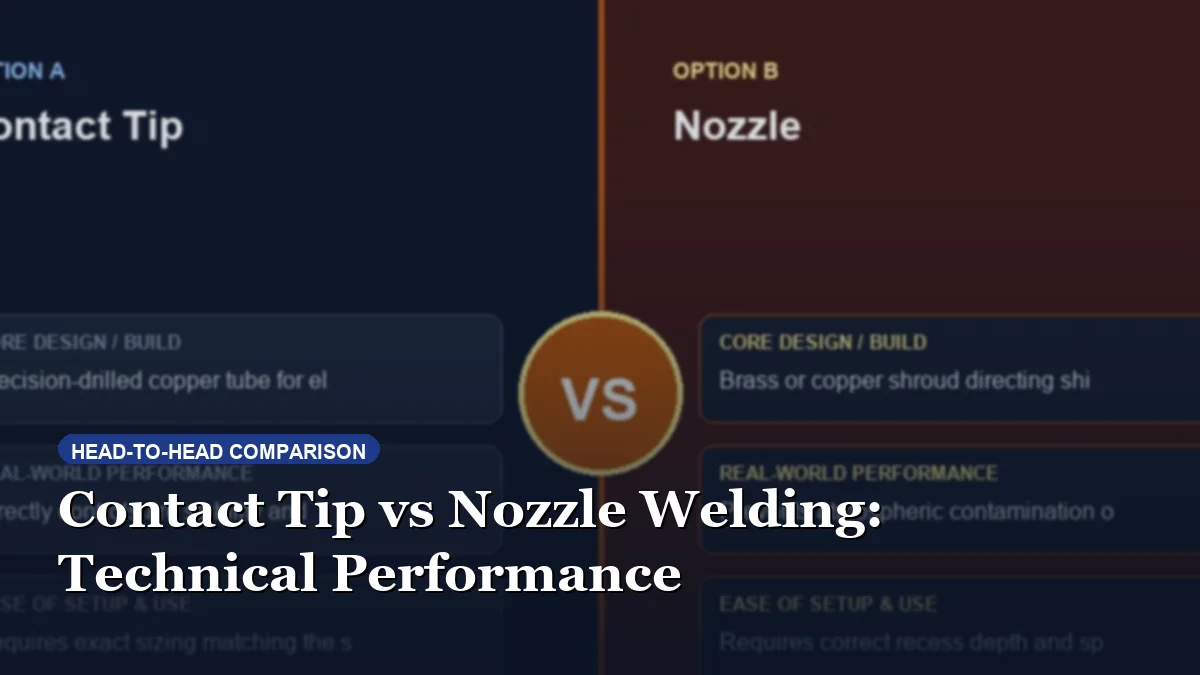
Operators focusing on high-amperage electrical continuity should prioritize the contact tip, while those managing weld pool shielding choose the nozzle. Balance both for optimal GMAW results.
Compare all top models in our Best Welder: Top Home Shop & Jobsite Picks Tested.
Side-by-Side Breakdown
| Criteria | Contact Tip | Nozzle | Edge |
|---|---|---|---|
| Core Design / Build | Precision-drilled copper tube for electrical current transfer. | Brass or copper shroud directing shielding gas over the weld. | Split |
| Real-World Performance | Directly controls arc stability and wire feed consistency. | Prevents atmospheric contamination of the molten weld pool. | Split |
| Ease of Setup & Use | Requires exact sizing matching the specific electrode diameter. | Requires correct recess depth and spatter-free inner walls. | Contact Tip |
| Durability & Reliability | Subject to rapid thermal wear and internal keyholing. | Prone to heavy spatter buildup and thermal degradation. | Nozzle |
| Efficiency / Operating Footprint | Minimal physical footprint with high electrical resistance loads. | Larger physical envelope dictating joint accessibility limits. | Contact Tip |
| Maintenance Requirements | Frequent reaming or replacement due to burnback events. | Regular cleaning with anti-spatter paste and reamers. | Nozzle |
| Best Ideal Use Case | High-deposition fabrication requiring consistent electrical contact. | Critical structural projects requiring flawless gas shielding. | Split |
Core Functional Production Roles
Modern fabrication facilities rely heavily on efficient consumable management to maximize output. Understanding how these components interact under heavy industrial workloads remains vital for operators.
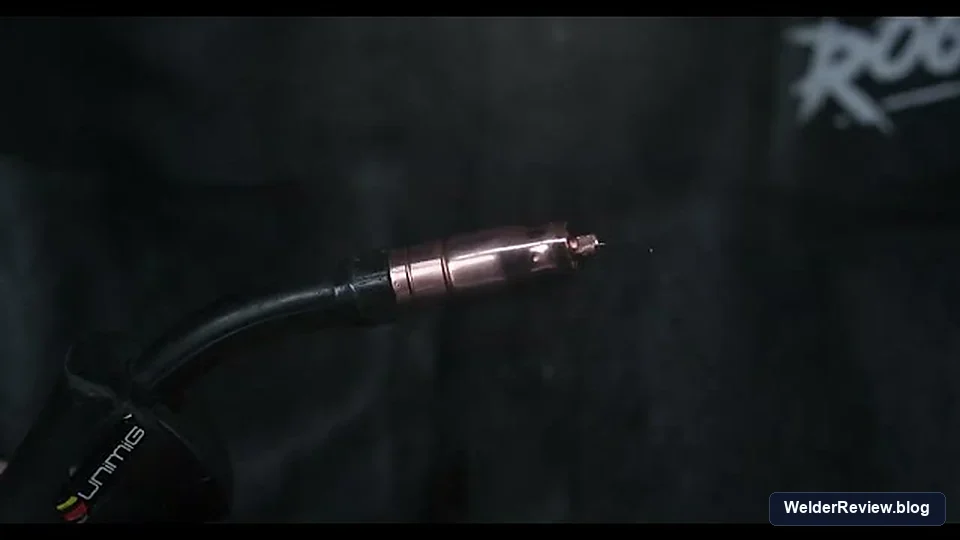
In this article, we examine the mechanical differences governing GMAW setups. Every single parameter impacts overall weld integrity and operational longevity across diverse structural fabrication environments.
Welding fabrication floors rely on distinct operational roles where contact tips manage current transfer. Beginners starting out can explore our top picks for the best starter welding machine to master fundamental GMAW parameters.
Production managers assign specialized technicians to monitor consumable wear rates, ensuring that copper alloy compositions withstand high thermal stress during continuous MIG welding shifts without premature thermal degradation.
- Electrical current transfer efficiency parameters
- Shielding gas coverage dynamics and flow rates
- Thermal management during high-amperage cycles
Production Output Metrics
Production lines demand uninterrupted wire feeding to maintain profitable output speeds. A worn delivery component introduces erratic arc behavior that instantly diminishes overall productivity.
Operators must monitor thermal expansion rates to prevent premature failure during extended high-duty-cycle manufacturing runs.
- Duty cycle limitations in automated cells
- Wire feed resistance benchmarks
Technical Design and Critical Reception
Industry feedback highlights distinct engineering challenges regarding consumable lifespan. Maintaining proper thermal conductivity prevents premature melting during intensive structural fabrication projects.
Critical reception from master welders emphasizes strict adherence to manufacturer sizing specifications. Using incorrect dimensions leads to immediate arc instability and excessive spatter accumulation.
Equipment engineers design contact tips with precise internal bore tolerances to match wire diameters accurately. Industry feedback highlights that tapered seat designs significantly reduce electrical resistance and prevent arc interruptions.
Metallurgical evaluations and welder reviews consistently emphasize that optimized nozzle geometries prevent turbulent gas shielding. New operators exploring equipment can check our top picks for the best welding machine for beginners for reliable options.
- Alloy composition trade-offs for enhanced wear
- Machining tolerances for precise electrode guidance
- Thermal dissipation characteristics under load
Evaluating Field Performance
Field tests consistently demonstrate that superior copper alloys significantly extend operational lifespan. Selecting premium components minimizes costly unscheduled maintenance pauses on busy shop floors.
Engineers evaluate thermal conductivity alongside mechanical hardness to determine optimal material choices for demanding industrial applications.
- Rockwell hardness testing benchmarks
- Thermal conductivity ratings
Professional Training and Consultancy
Educational programs focus heavily on consumable inspection techniques for aspiring professionals. Trainees learning manual processes should consult our top picks for the best welding rods for beginners to achieve smooth arcs.
Consultancy services help manufacturing plants optimize their consumable selection processes. Expert guidance reduces operating costs while simultaneously improving overall weld quality standards across shifts.
Technical instructors train apprentices to recognize early warning signs of contact tip burnback. Proper instructional modules stress maintaining tip-to-work distance to protect threaded gas diffusers from catastrophic thermal spatter damage.
Welding consultants advise industrial plants on implementing preventative maintenance schedules, noting that recessed tip configurations extend consumable lifespan when operating at high amperage settings for structural applications.
- Standardized inspection protocols for apprentices
- Troubleshooting guides for arc instability
- Preventive maintenance scheduling models
Advice and Support Contacts
Technical support teams assist fabricators in resolving complex consumable compatibility issues. Quick access to expert advice minimizes downtime when specialized alloy welding arises.
Establishing reliable communication channels with equipment manufacturers ensures immediate resolution of persistent operational challenges in high-volume production facilities.
- Dedicated technical helpline availability
- On-site engineering assessment requests
Media Outreach and Public Relations
Industry publications regularly feature comparative analyses of welding consumables. Press releases highlight innovative alloy developments aimed at extending component service life in demanding environments.
Media campaigns educate the broader manufacturing sector about emerging technological advancements in GMAW equipment design and protective shielding delivery systems.
Trade publications regularly feature technical deep dives explaining how consumable selection impacts overall welding efficiency. Industrial communication teams highlight cost-per-arc-hour metrics to demonstrate long-term value to fabrication business owners.
Public relations campaigns for welding equipment manufacturers focus on educational whitepapers that demystify shielding gas dynamics, helping fabricators select correct nozzle orifice sizes for specialized aluminum and stainless steel projects.
- Trade magazine review criteria
- Press release distribution channels
- Public relations engagement strategies
Industry Publication Highlights
Leading technical journals spotlight breakthroughs in thermal barrier coatings designed for high-heat applications. These innovations directly reduce spatter adhesion during heavy structural fabrication.
Editors prioritize objective testing methodologies to provide readers with actionable data for equipment purchasing decisions.
- Coating durability test results
- Editor evaluation standards
Organizational Careers and Workplace Culture
Welding equipment manufacturers actively recruit skilled metallurgists to advance consumable technology. Engineering career paths focus on improving thermal management and electrical resistance properties.
Workplace culture within these specialized manufacturing firms prioritizes rigorous quality control testing. Employees understand that precision engineering directly impacts operator safety in the field.
Progressive fabrication facilities foster a safety-first culture where welders actively participate in routine equipment inspections. Encouraging workers to report worn contact tip threads prevents costly downtime on automated robotic welding cells.
Career progression pathways in modern manufacturing encourage line workers to master equipment troubleshooting. Understanding the interplay between shielding gas flow and contact tip condition empowers technicians to resolve welding defects independently.
- Metallurgical engineering career tracks
- Quality assurance certification programs
- Safety protocol training initiatives
Work for Us Opportunities
Prospective employees find diverse engineering and technical support roles within our expanding organization. We foster an innovative environment dedicated to advancing welding technology standards globally.
Joining our technical team offers opportunities to collaborate with industry leaders on groundbreaking welding consumable research and development projects.
- Current engineering job openings
- Internship and apprenticeship programs
Corporate Operations and Office Infrastructure
Efficient corporate operations ensure seamless distribution of welding supplies to industrial distributors worldwide. Strategic logistics planning guarantees timely delivery of essential replacement components.
Modern office infrastructure supports advanced inventory tracking systems that monitor global demand fluctuations for specific consumable sizes and alloy formulations.
Corporate supply chain teams maintain strict inventory thresholds for consumable welding components. Efficient warehouse management systems track minimum stock levels of contact tips and nozzles to prevent unexpected halts in production lines.
Facility management departments coordinate with shop floor supervisors to optimize ventilation systems, mitigating hazardous fumes generated when high-amperage welding processes interact with coated metals and heavy industrial lubricants.
- Global logistics and supply chain management
- Inventory tracking technology implementation
- Distribution hub network optimization
Our Central Office Locations
Our central office coordinates international research, engineering, and administrative functions. Executive leadership directs strategic growth initiatives from this primary operational headquarters.
National offices manage regional distribution networks and provide localized technical support to fabricators across diverse geographical territories.
- Headquarters operational oversight
- Regional support coordination
Quality Assurance, Fundraising, and Support
Rigorous quality assurance protocols guarantee every manufactured component meets strict industrial tolerances. Comprehensive testing ensures reliable electrical contact and consistent gas coverage performance.
Corporate social responsibility initiatives include targeted fundraising campaigns supporting local technical education scholarships. We invest in the future workforce of the welding industry.
Quality control inspectors utilize nondestructive testing methods to verify weld integrity, linking internal discontinuities directly to worn contact tips covered in our guide to selecting the correct MIG contact tip size.
Technical support teams assist clients by diagnosing root causes of excessive spatter buildup, frequently recommending adjustments to gas flow rates alongside routine replacement of fouled protective nozzles and contact tips.
- Dimensional accuracy inspection procedures
- Scholarship program funding allocations
- Customer satisfaction monitoring systems
Feedback and Complaints Management
Customer feedback drives continuous product improvement across our entire consumable catalog. A structured complaints resolution process ensures rapid investigation and corrective action implementation.
We value transparent communication with end-users to refine our manufacturing processes and deliver superior welding performance on every job site.
- Customer service response metrics
- Product redesign feedback loops
Frequently Asked Questions
How does electrical resistance affect consumable wear?
High electrical resistance generates excessive heat that accelerates thermal degradation. Choosing high-conductivity copper alloys significantly prolongs operational lifespan.
What causes premature burnback in MIG setups?
Incorrect wire feed speed combined with improper voltage settings causes burnback. Using the correct contact tip size prevents this issue.
Why is proper gas coverage essential for quality?
Atmospheric contamination ruins weld pool integrity and causes porosity. Maintaining a clean shielding gas nozzle prevents weld failure.
How often should operators clean their equipment?
Routine cleaning should occur after every major welding shift. Applying anti-spatter spray reduces buildup frequency considerably.
Can mismatched components ruin the weld bead?
Mismatched sizing creates erratic electrical transfer and turbulent gas flow. Always verify component compatibility before striking an arc.