6010 vs 7018: Structural Stick Electrode Battle
Choosing the right shielded metal arc welding electrode dictates structural integrity. This technical guide contrasts deep-penetrating cellulose rods with low-hydrogen iron powder alloys.

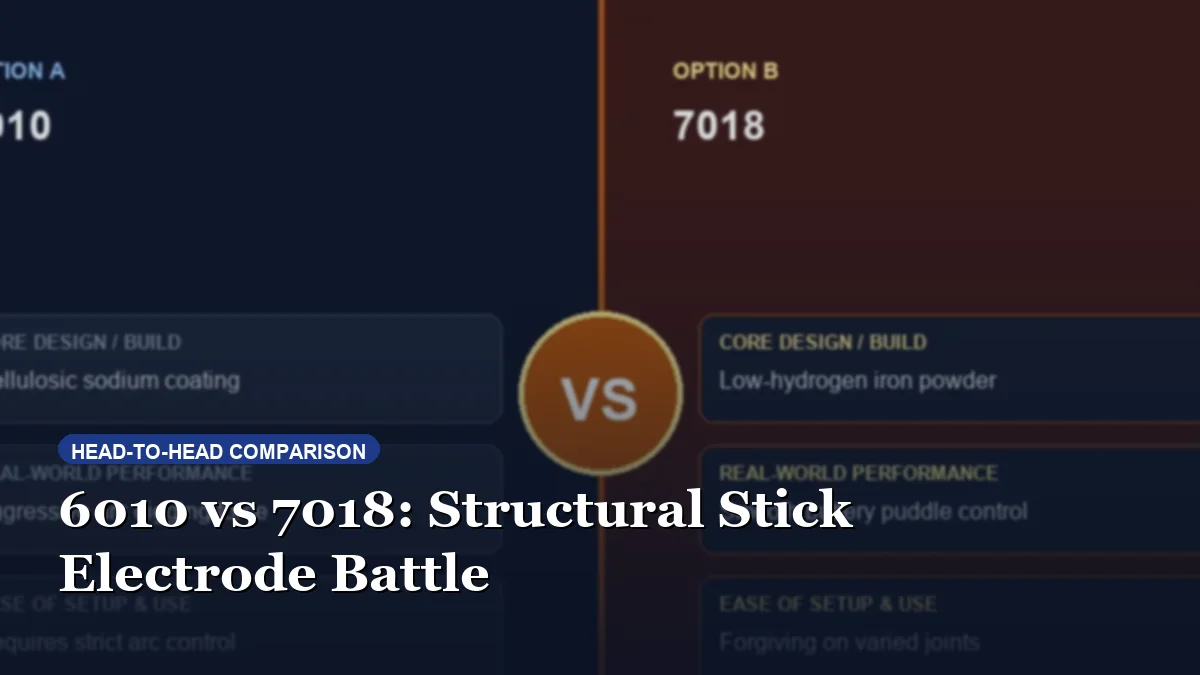
Choose 6010 for dirty joint penetration and out-of-position pipeline welding. Select 7018 when ultimate tensile strength and crack-resistant low-hydrogen deposits are mandatory.
Compare all top models in our Best Welder: Top Home Shop & Jobsite Picks Tested.
Side-by-Side Breakdown
| Criteria | 6010 | 7018 | Edge |
|---|---|---|---|
| Core Design / Build | Cellulosic sodium coating | Low-hydrogen iron powder | Depends on Joint |
| Real-World Performance | Aggressive arc digging force | Smooth buttery puddle control | 7018 for strength |
| Ease of Setup & Use | Requires strict arc control | Forgiving on varied joints | 7018 |
| Durability & Reliability | Moisture dependent flux | Strict oven baking rules | Tie |
| Efficiency / Operating Footprint | High spatter, fast freeze | High deposition, low slag | 7018 |
| Maintenance Requirements | Standard cool storage | Hermetic or rod oven required | 6010 |
| Best Ideal Use Case | Root passes and rusty steel | Structural frame welding | Depends on Task |
Core Design and Electrode Engineering
Understanding internal flux formulations reveals why these two classification types behave differently under an electrical arc. The AWS A5.1 specification dictates distinct chemical and mechanical baselines for each electrode group.
Cellulosic coatings on electrodes tested in our best starter welder feature create a gaseous shield driven by moisture inside the flux. Conversely, other rods rely on limestone to minimize absorption.
Metallurgists design these consumables for completely different operational environments and base metal preparation levels. Reviewing core chemistry helps fabricators match rods to specific structural load requirements safely.
The 6010 electrode features a cellulose-based sodium coating that produces a forceful, digging arc. This design creates high gas volume, blowing away light rust, mill scale, and paint during field welding operations.
In contrast, the 7018 electrode utilizes a low-hydrogen iron powder flux coating. This engineering formulation minimizes moisture absorption, significantly reducing the risk of hydrogen-induced cracking in high-strength carbon steel structural assemblies.
Understanding these core chemical differences dictates your preparation steps. While 6010 tolerates imperfect joint surfaces, 7018 demands meticulous cleaning to prevent porosity and ensure maximum mechanical integrity across demanding industrial fabrication applications today.
- Cellulose-sodium flux generates forceful arc drive for deep root penetration.
- Iron powder additions boost deposition efficiency in the low-hydrogen coating.
- Moisture management dictates storage protocols for both electrode types.
Chemical Composition Variations
The cellulosic electrode utilizes organic materials that burn off aggressively during the welding process. This creates a high-velocity gas volume that blasts through contaminants effortlessly.
Low-hydrogen formulations substitute organic elements with mineral-based compounds. This reduces residual hydrogen diffusion, preventing underbead cracking in high-strength carbon steels.
- Organic binders dominate the first classification group.
- Basic limestone flux shields the weld pool from atmospheric gases.
Real-World Performance and Joint Penetration
Performance in the field highlights the stark operational contrasts between these two popular welding rods. Welders must balance arc force against puddle control when selecting consumables for demanding field erection tasks.
The first option provides an aggressive, digging arc that easily handles painted or rusted surfaces. Operators appreciate its ability to bridge wide gaps during demanding open-root pipe welding applications.
The second option yields a smooth, stable arc that produces finely rippled bead geometry. Its fluid slag system requires a tight arc length to prevent porosity and slag inclusions.
When evaluating joint penetration, 6010 excels by driving deeply into root passes on open-root pipe joints. The aggressive arc action allows welders to establish solid keyholes quickly, even in out-of-position vertical up configurations.
Meanwhile, 7018 provides a smoother, softer arc profile designed for filling and capping passes. It deposits a finely rippled bead with minimal spatter, reducing post-weld cleanup time and eliminating severe undercutting risks along plate toes.
Combining both rods often yields the best results on heavy industrial projects. Welders typically strike a 6010 root for maximum root fusion before switching to 7018 for high-deposition hot, fill, and cap passes safely.
- Digging arc characteristics excel at burning through mill scale.
- Smooth transfer mechanisms reduce overall spatter generation significantly.
- Puddle fluidity demands precise manipulation during vertical and overhead progression.
Arc Dynamics and Digging Force
Arc force directly influences how deeply the molten weld pool penetrates into the base metal. High arc voltage in the cellulosic rod forces maximum heat into tight joint roots.
Lower voltage characteristics in the iron powder rod distribute heat more uniformly across the weld face. This increases deposition rates while sacrificing some extreme root penetration depth.
- High voltage supports aggressive whip-and-pause techniques.
- Uniform heat transfer prevents excessive burn-through on thin plates.
Operational Setup and Machine Compatibility
Power source selection plays a critical role in achieving optimal operational performance from stick electrodes. Modern inverter machines and traditional motor generators handle these consumables with varying degrees of efficiency.
The cellulosic rod requires a power source with high open-circuit voltage and strong digging arc control. Without adequate voltage stability, the aggressive arc tends to extinguish prematurely during manipulation.
Low-hydrogen electrodes demand consistent amperage delivery and low moisture pickup to prevent internal porosity. Proper machine calibration ensures stable droplet transfer across the welding arc gap.
Operating a 6010 rod requires a DC-positive power source with high open-circuit voltage. Selecting an appropriate unit from our best inverter welder for 6010 guide ensures necessary arc stability without frequent extinguishing.
Conversely, 7018 operates smoothly on both AC and DC-positive polarity. When using alternating current, ensure your welding machine features sufficient OCV to maintain an arc with low-hydrogen potassium-coated variants without frustrating restarts.
Cable length and work clamp placement drastically impact performance for both electrodes. Voltage drop over long extension runs can destabilize the digging arc, while poor grounding causes erratic behavior during critical passes.
- High open-circuit voltage prevents sudden arc outages during manipulation.
- Constant current output stabilizes puddle freezing rates across joints.
- Polarity settings must match manufacturer recommendations for optimal results.
Polarity and Power Source Demands
Direct current electrode positive polarity maximizes heat input directly into the base metal plate. This setting is standard for achieving maximum penetration on heavy structural weldments.
Some cellulosic rods operate effectively on direct current electrode negative when specific root pass profiles are required. Always verify machine output characteristics before striking an arc.
- Direct current positive delivers deep thermal energy transfer.
- Inverter power sources provide precise arc force tuning capabilities.
Mechanical Properties and Weld Integrity
Tensile strength and ductility form the foundation of structural steel fabrication safety standards. Engineers specify particular electrode classifications based on calculated load distributions and environmental service temperatures.
The first option delivers high tensile strength paired with excellent low-temperature impact toughness values. However, its higher diffusely retained hydrogen level requires careful consideration on thick steels.
The second option provides superior crack resistance due to its strictly controlled low-hydrogen weld deposit. This characteristic makes it the industry standard for critical infrastructure and pressure vessels.
The tensile strength of a welded joint dictates its load-bearing capacity under stress. A standard 6010 weld delivers approximately 60,000 psi of minimum tensile strength, making it ideal for ductile piping and general structural repairs.
Stepping up to a 7018 consumable guarantees 70,000 psi of tensile strength alongside superior impact toughness at sub-zero temperatures. This makes low-hydrogen electrodes mandatory for heavy equipment frames, bridges, and certified pressure vessels.
Ductility and elongation metrics also favor 7018 deposits in cyclic loading environments. The controlled microstructure resists cracking under fatigue, whereas 6010 welds exhibit slightly higher yield strength variations across complex joint geometries.
- Tensile strength ratings meet rigorous American Welding Society standards.
- Low hydrogen levels minimize susceptibility to delayed hydrogen cracking.
- Impact toughness properties ensure reliability under dynamic cyclic loads.
Tensile Strength and Ductility
Minimum tensile strength ratings are encoded directly into the standardized numerical electrode designations. The resulting weld metal must match or exceed the mechanical strength of the parent steel.
Ductility measurements confirm the ability of the solidified weld to elongate under stress without fracturing. Proper interpass temperature control preserves these vital mechanical properties throughout fabrication.
- Tensile strength numbers indicate thousand pounds per square inch limits.
- Elongation percentages verify structural flexibility under load.
Maintenance, Storage, and Consumable Longevity
Consumable storage protocols directly impact final weld quality and prevent costly rework operations. Moisture absorption remains the primary enemy of coated manual arc welding electrodes in humid environments.
Cellulosic flux relies on ambient moisture to maintain its unique operating arc characteristics. Storing these rods in a dry, temperature-controlled environment prevents the coating from becoming excessively brittle.
Low-hydrogen electrodes require strict adherence to heated storage oven guidelines after opening hermetic containers. Exposing these hygroscopic rods to ambient air quickly introduces moisture into the weld pool.
Proper electrode storage prevents moisture degradation that ruins weld quality. While 6010 coatings rely on ambient moisture to function correctly and become brittle if over-dried, 7018 rods demand strict environmental controls to avoid defects.
Unsealed 7018 electrodes absorb atmospheric humidity within hours, leading directly to porosity and hydrogen cracking. Welders must store these consumables in heated portable ovens maintained between 250 and 300 degrees Fahrenheit continuously.
Discard any 7018 rods exposed to moisture outside acceptable time limits to maintain structural compliance. Always inspect flux coatings for cracking or chipping before striking an arc on critical pressure pipeline infrastructure components.
- Ambient storage suits moisture-dependent cellulosic electrode flux coatings.
- Heated portable ovens preserve low-hydrogen rod integrity on job sites.
- Discard contaminated consumables showing cracked or flaking flux layers.
Moisture Control and Oven Storage
Exposing basic low-hydrogen flux to atmospheric humidity leads directly to weld porosity. Fabricators must utilize dedicated rod ovens maintained at specified elevated temperatures during critical projects.
Rebaking procedures can sometimes salvage damp electrodes if executed according to strict industrial guidelines. Preventing initial moisture contamination remains far more efficient than attempting high-temperature drying.
- Storage ovens maintain constant elevated temperatures for basic rods.
- Hermetically sealed cans protect consumables prior to initial opening.
Code Compliance and Industry Standards
Navigating structural welding codes requires thorough familiarity with approved electrode classifications and testing protocols. Regulatory bodies enforce strict limitations regarding consumable selection on load-bearing components.
Structural engineering codes frequently mandate low-hydrogen filler metals to prevent catastrophic brittle fractures. Inspectors verify electrode compliance through certified mill test reports and proper traceability documentation.
Pipeline construction standards often permit cellulosic electrodes for initial root passes. Their unique digging capability ensures complete joint fusion before filling with high-strength capping passes.
Structural welding codes governed by AWS D1.1 impose strict limitations on consumable selection. Engineers specify low-hydrogen electrodes like 7018 for dynamically loaded structures to satisfy rigorous impact testing and crack resistance mandates.
Pipeline construction governed by API 1104 frequently permits cellulosic 6010 for root and hot passes. The rapid freeze characteristics align with field construction demands where speed and root penetration outweigh notch toughness requirements.
Quality control inspectors verify electrode certifications against project specifications before any arc is struck. Choosing appropriate equipment highlighted in our best welder guide prevents structural compromise and costly weld rejection.
- Structural codes mandate specific filler metal classifications for safety.
- Certified mill test reports confirm batch mechanical property compliance.
- Pipeline standards regulate allowable welding techniques and consumable types.
Structural and Pipeline Specifications
Building codes differentiate between bridge construction, pressure piping, and general commercial steel fabrication. Each distinct sector enforces unique testing requirements for deposited weld metal chemistry.
Quality control inspectors review Procedure Qualification Records to validate chosen consumable pairings. Adhering to these strict industry standards protects both fabricators and the general public.
- Building codes require rigorous welder performance qualification testing.
- Procedure specifications dictate exact electrode usage parameters.
Selecting the Right Electrode for Your Project
Choosing between these two legendary electrodes depends entirely on your specific project requirements. Analyze joint preparation, base metal cleanliness, and structural engineering codes before beginning work.
Opt for the first electrode when tackling dirty, rusty steel or demanding out-of-position pipe joints. Its aggressive arc forces contaminants out of the molten puddle for sound root penetration.
Select the second electrode for maximum structural integrity, high deposition rates, and crack-resistant welds. Proper storage and clean joint prep guarantee professional results on critical structural steel assemblies.
Choosing between these two industry staples requires analyzing your joint design and operational environment. Assess whether your application involves dirty, uncleaned steel outdoors or clean, fit-up plate inside a climate-controlled fabrication facility.
Opt for 6010 when tackling field repairs on rusty agricultural machinery or executing root passes on fixed-position pipes. Select 7018 when maximum tensile strength, heavy plate thickness, and code-certified impact toughness are mandatory.
Balancing welder skill level against project requirements ensures optimal productivity and safety. Applying advice from our setting amperage for 7018 stick electrodes guide helps fabricators achieve reliable arc starts and puddle control.
- Match consumable choice directly to base metal cleanliness levels.
- Evaluate positional welding demands before striking the initial arc.
- Prioritize low-hydrogen options for heavy, restrained structural weldments.
Practical Decision-Making Framework
Create a standardized checklist covering material thickness, joint configuration, and environmental conditions. This structured approach eliminates guesswork and ensures reliable mechanical performance across every fabricated assembly.
Consult experienced welding engineers when encountering unfamiliar high-alloy steel base materials. Proper planning prevents costly field failures and maintains strict adherence to project specifications.
- Checklists streamline consumable selection for complex fabrication tasks.
- Engineering consultation resolves material compatibility challenges safely.
Frequently Asked Questions
Can you use 7018 electrodes on rusty or dirty steel surfaces?
Using 7018 on contaminated steel frequently causes severe porosity and weld defects. You must grind the joint clean down to bright metal before welding.
Why do 6010 electrodes require specific high voltage machine outputs?
Cellulosic rods demand high open-circuit voltage to maintain a stable, digging arc. Without this extra voltage, the aggressive arc will constantly extinguish during manipulation.
How long can you leave 7018 electrodes exposed to open air?
Exposing 7018 rods to humid air for more than four hours ruins their low-hydrogen rating. Always store them in a heated portable rod oven.
What makes 6010 the preferred choice for pipeline root passes?
The deep-digging arc force burns through gaps and contaminants easily. This ensures complete root fusion on open-butt pipe joints.
Are 7018 welds significantly stronger than 6010 weld deposits?
Both electrodes achieve high tensile strength ratings exceeding seventy thousand pounds. However, 7018 offers superior crack resistance in heavy structural applications.