110 vs 220 Welder: Complete Performance Breakdown
Choosing the right input power dictates your penetration depths and duty cycles. Match your electrical infrastructure to your everyday fabrication demands.

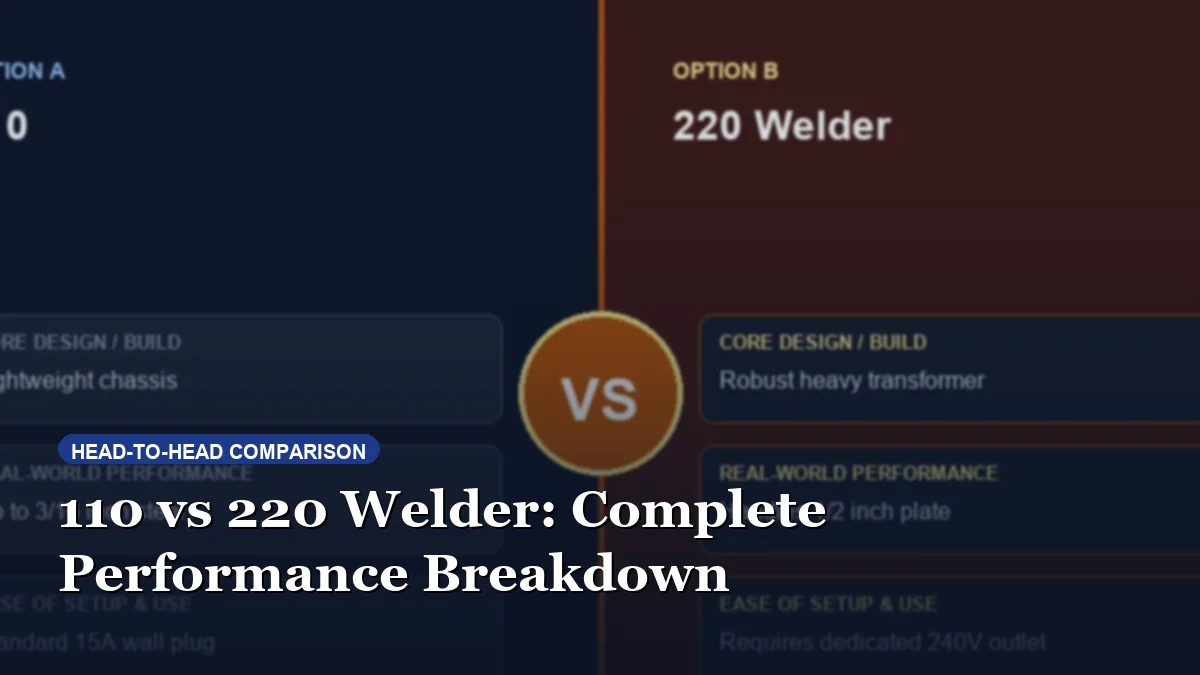
Pick the 110V welder for household repairs and thin sheet metal fabrication. Choose the 220V system for structural steel projects and heavy-duty industrial workflow demands.
Compare all top models in our Best Welder: Top Home Shop & Jobsite Picks Tested.
Side-by-Side Breakdown
| Criteria | 110 | 220 Welder | Edge |
|---|---|---|---|
| Core Design / Build | Lightweight chassis | Robust heavy transformer | 220 Welder |
| Real-World Performance | Up to 3/16 inch steel | Handles 1/2 inch plate | 220 Welder |
| Ease of Setup & Use | Standard 15A wall plug | Requires dedicated 240V outlet | 110 |
| Durability & Reliability | Moderate thermal strain | Superior industrial endurance | 220 Welder |
| Efficiency / Operating Footprint | High amp draw per volt | Lower amperage draw under load | 220 Welder |
| Maintenance Requirements | Standard terminal cleaning | Heavy breaker and plug checks | 110 |
| Best Ideal Use Case | Mobile maintenance and auto body | Structural fabrication and thick metals | Depends on scope |
Core Design & Engineering Differences
Modern welding machines rely on distinct internal architectures to convert standard electrical currents into usable arcs. The primary transformer design determines overall machine weight, portability, and long-term operating durability on active worksites.
Engineering standards require 110V units to prioritize compact inverter boards. These lightweight circuit configurations reduce total system weight while maintaining stable arc characteristics for standard household maintenance and automotive body repairs.
Conversely, evaluating options in our best 110 220 mig welder guide reveals that heavy-duty equipment utilizes robust inverter bridges to prevent premature component degradation under high thermal stress.
Standard transformer design in legacy units relies on heavy copper windings to step down voltage, whereas modern inverter architectures utilize high-frequency switching components to drastically reduce total machine weight.
Internal rectification circuits convert incoming alternating current into direct current, managing thermal loads through aluminum heat sinks and variable speed cooling fans designed for continuous duty cycles.
Duty cycle ratings fluctuate dramatically between voltage classes, requiring operators to monitor internal temperature sensors to prevent premature thermal overload during extended fabrication sessions on thick steel.
- Inverter vs transformer topologies dictate total machine weight.
- Copper winding thickness scales directly with continuous output capacity.
- Internal circuit board shielding protects against conductive metal dust.
Input Voltage Architecture
Single-phase 110V machines draw higher amperage to deliver lower overall wattage outputs. This dynamic creates unique electrical resistance challenges across standard extension cords and standard household wall receptacles.
Dual-voltage and dedicated 220V units leverage doubled electrical potential to reduce line amperage. Lower amperage draw reduces internal heat generation and preserves cable longevity during long fabrication runs.
- Higher voltage minimizes electrical resistance losses across long cables.
- Lower input amperage prevents frequent breaker trips in older shops.
Real-World Performance & Penetration
Evaluating real-world performance requires measuring actual arc stability and weld pool puddle control. A machine must maintain consistent voltage drops to ensure proper fusion across varying base metal thicknesses.
Standard 110V welders typically excel when joining mild steel sheets under three-sixteenths inch thickness. Exceeding this dimensional threshold often results in cold laps and insufficient root penetration without aggressive beveling.
Heavy-duty 220V systems easily penetrate structural plate exceeding one-half inch thickness in single passes. Their higher thermal output ensures deep root penetration for critical load-bearing joints and heavy equipment repairs.
Operating on standard household circuits limits maximum amperage output, typically restricting penetration depth to mild steel plates measuring under one-quarter inch without aggressive multi-pass groove preparation.
Dual-voltage equipment unlocked via higher line voltage delivers deeper root penetration and stable arc characteristics, essential when joining structural members subject to rigorous AWS standards.
Arc stability directly correlates with open-circuit voltage parameters. Selecting a reliable unit from our best 110 volt mig welder review maintains fluid puddle control and reduces annoying spatter.
- Maximum plate thickness increases significantly with higher input voltage.
- Arc stability remains smoother during high-amperage MIG and TIG processes.
- Beveling requirements decrease when using higher output machines.
Duty Cycle Realities
Duty cycle ratings define how many minutes out of ten a machine can weld continuously. Entry-level 110V models often feature a twenty percent duty cycle at maximum output amperage.
Industrial 220V alternatives routinely deliver sixty percent or higher duty cycles. This structural advantage allows professional fabricators to complete extensive weld beads without triggering thermal overload protections.
- Thermal switches protect internal transformers from catastrophic melting.
- Higher duty cycles directly increase daily shop productivity rates.
Electrical Infrastructure & Circuit Loads
Before purchasing any welding equipment, you must verify your shop or garage electrical supply. Overloading standard household circuits creates serious fire hazards and damages sensitive internal inverter components.
Standard 110V units operate safely on common fifteen-amp or twenty-amp residential circuits. However, pushing these machines past their recommended limits will instantly trip standard breakers during a long weld pass.
Operating a dedicated 220V machine like the one featured in our Vulcan 220 welder review requires a professional installation of a heavy-duty receptacle and thicker gauge wiring for safety.
Standard 115V wall outlets generally supply limited amperage through a dedicated 20-amp breaker, demanding careful management of total electrical draw to avoid tripping household safety devices.
Industrial environments rely on heavy-duty NEMA receptacles configured for 230V service, ensuring adequate conductor sizing and minimal voltage drop across long extension cord runs in busy shops.
Calculating total input current requires evaluating power factor coefficients alongside rated output, ensuring facility wiring complies with national electrical codes for industrial heating and welding equipment.
- Residential circuits limit maximum output amperage on standard plugs.
- Dedicated 240V outlets prevent voltage drops during high-amp execution.
- Extension cord gauge matters significantly for preventing voltage starvation.
Extension Cord Guidelines
Using undersized extension cords causes severe voltage drop that weakens the welding arc. Always match your cord gauge to the maximum amperage draw specified in the manufacturer manual.
Shorter cable runs preserve electrical efficiency and prevent premature motor or transformer burnout. Never daisy-chain multiple extension cords together when operating high-amperage welding equipment under load.
- Thicker wire gauges prevent dangerous overheating in long extension lines.
- Voltage drop ruins wire feeder consistency and shielding gas coverage.
Portability & Site Ergonomics
Job site mobility heavily influences which welding system fits your daily workflow. Field repair technicians often prioritize lightweight machines that load easily into service truck toolboxes.
Compact 110V units weigh significantly less, making them ideal for mobile repair work. You can transport these portable devices to remote locations without needing specialized trailer generators.
Industrial 220V systems demand dedicated cart setups or fixed workshop bench placement. Their heavy transformers and robust steel housings make frequent manual transport impractical for single operators.
Compact single-voltage machines prioritize extreme mobility, allowing traveling fabricators to toss lightweight units into service trucks for quick maintenance calls without straining their backs.
Heavy-duty dual-voltage systems often incorporate robust steel chassis housing, increasing overall weight while requiring careful planning as outlined in our breaker sizing guide for demanding construction and fabrication jobsites.
Ergonomic handle placement and balanced cable management systems significantly reduce operator fatigue during long shifts, directly improving overall weld bead consistency and workplace safety standards.
- Lightweight inverters reduce physical strain during transport.
- Fixed workshop placement maximizes safety for heavy electrical connections.
- Service truck setups require secure tie-downs for heavy machines.
Workspace Footprint Management
Managing physical shop space requires balancing machine size with power capabilities. Smaller 110V setups tuck easily beneath crowded workbench surfaces without cluttering your main fabrication area.
Larger 220V units require dedicated floor space alongside heavy gas cylinders. Proper clearance around the machine ensures adequate airflow for internal cooling fans during long projects.
- Adequate ventilation prevents heat buildup around the chassis.
- Ergonomic cart placement minimizes tripping hazards from heavy cables.
Maintenance, Efficiency & Longevity
Routine equipment maintenance ensures long-term reliability across demanding fabrication schedules. Both machine classes require periodic cleaning of internal dust and inspection of high-current electrical connections.
Electrical efficiency favors 220V systems when executing high-amperage production work. Transferring power at higher voltage reduces resistive heat losses across internal bus bars and output terminals.
Component longevity depends heavily on avoiding chronic thermal overloads. Keeping cooling fans clear of debris prevents premature failure of sensitive solid-state circuit boards in modern inverters.
Routine maintenance protocols demand regular inspection of internal circuitry, cleaning accumulated metal dust with compressed air to prevent short circuits on sensitive printed circuit boards.
Electrical efficiency varies between input voltages, where higher voltage configurations generally draw lower amperage for equivalent output power, reducing thermal stress on internal copper components.
Component longevity depends heavily on proper storage in climate-controlled environments, shielding sensitive electronics from corrosive moisture and airborne contaminants found in aggressive industrial workshops.
- Compressed air clearing removes conductive dust from circuit boards.
- Terminal inspection prevents resistive heating at cable connection points.
- Cooling fan maintenance ensures optimal internal operating temperatures.
Preventative Care Protocols
Establishing a monthly maintenance schedule catches minor electrical issues early. Inspect ground clamp connections and torch leads for signs of fraying or excessive heat discoloration.
Replace worn contact tips and drive rolls regularly to maintain smooth wire feeding. Proper maintenance prevents erratic arc behavior and ensures consistent weld bead quality over time.
- Worn contact tips cause severe arc instability and poor penetration.
- Ground clamp corrosion restricts current flow and weakens the weld.
Which Option Fits Your Setup
Selecting the correct welder requires an honest assessment of your typical project materials. Buying based on future theoretical needs often leaves you with an impractical machine for daily tasks.
Choose a versatile 110V unit if your work involves thin sheet metal, automotive restoration, and general household repairs. These machines offer unbeatable convenience for light hobbyist fabrication environments.
Invest in a robust 220V welder if you routinely fabricate structural frames, roll cages, or heavy farm equipment. The extra power output ensures professional-grade fusion on thick steel plates.
Selecting the ideal machine requires balancing your typical material thickness requirements against available electrical service in your garage, preventing costly upgrades or disappointing performance limitations.
Hobbyists working on automotive sheet metal or light artistic projects find exceptional value in versatile 110V welders due to their incredible convenience and simple plug-and-play operation.
Professional fabrication shops handling heavy plate steel benefit immensely from investing in capable dual-voltage equipment, ensuring future project expansion without hitting immediate electrical power bottlenecks.
- Match machine capabilities directly to your most frequent project thickness.
- Evaluate available shop electrical service before making a final purchase.
- Consider dual-voltage models for ultimate flexibility across different jobs.
Budget and Value Considerations
Initial machine costs represent only part of your total fabrication investment. Factor in potential electrical upgrade expenses if your workshop lacks a dedicated high-voltage receptacle.
Purchasing a dual-voltage machine bridges the gap between portability and power. These adaptable units accept both input sources using interchangeable twist-lock adapter plugs safely.
- Electrical installation costs can exceed the price of the welder.
- Dual-voltage flexibility protects your investment as your skills grow.
Frequently Asked Questions
Can a 110V welder weld structural steel safely?
A 110V welder lacks the continuous penetration depth required for heavy structural steel projects. For safety, use 220V equipment on load-bearing frames.
Do I need a special outlet for a 220V machine?
Yes, a 220V machine requires a dedicated heavy-duty circuit and matching receptacle. Consult a certified electrician to ensure proper breaker sizing.
What is the main advantage of dual-voltage welders?
Dual-voltage welders offer ultimate flexibility for mobile fabricators. They connect to standard household outlets or heavy industrial circuits easily.
Why does my 110V welder keep tripping shop breakers?
High amperage demands on standard residential circuits cause immediate breaker trips. Reduce your machine output or upgrade to a dedicated circuit.
Can I use an extension cord with a 220V welder?
You can use an extension cord if it matches the proper wire gauge. Always use heavy industrial cables to prevent dangerous voltage drops.